A balance sheet summarizes a company's assets, liabilities, and shareholders' equity at a specific point in time. It measures liquid resources against short-term debts and total leverage to help investors evaluate business solvency and financial health.
A balance sheet is a core financial report that summarizes a company's assets, liabilities, and shareholders' equity at a specific point in time. It provides a snapshot of a business's net worth on a single date.
While headline revenue numbers attract attention on earnings days, a company's balance sheet reveals whether its growth rests on a solid financial foundation or a heavy pile of debt. Learning how to evaluate liquid resources against upcoming bills helps investors spot financial resilience before committing capital. This guide explains how a balance sheet works, its three main components, and how to spot balance sheet red flags.
Quick Takeaways
01A balance sheet provides a snapshot of what a business owns and owes at a single moment in time.
02The core accounting equation requires total assets to equal total liabilities plus shareholders' equity.
03Current assets and current liabilities measure short-term liquidity, showing whether a company can cover near-term bills.
04Book value represents accounting net worth, which often differs significantly from live market capitalization.
What Is a Balance Sheet? The Accounting Equation
A balance sheet presents a financial snapshot of a company at a given moment, such as the final day of a fiscal quarter or year. Unlike an income statement or cash flow statement, which track financial activity over a period of months, a balance sheet measures accumulated wealth and debt obligations on one specific date.
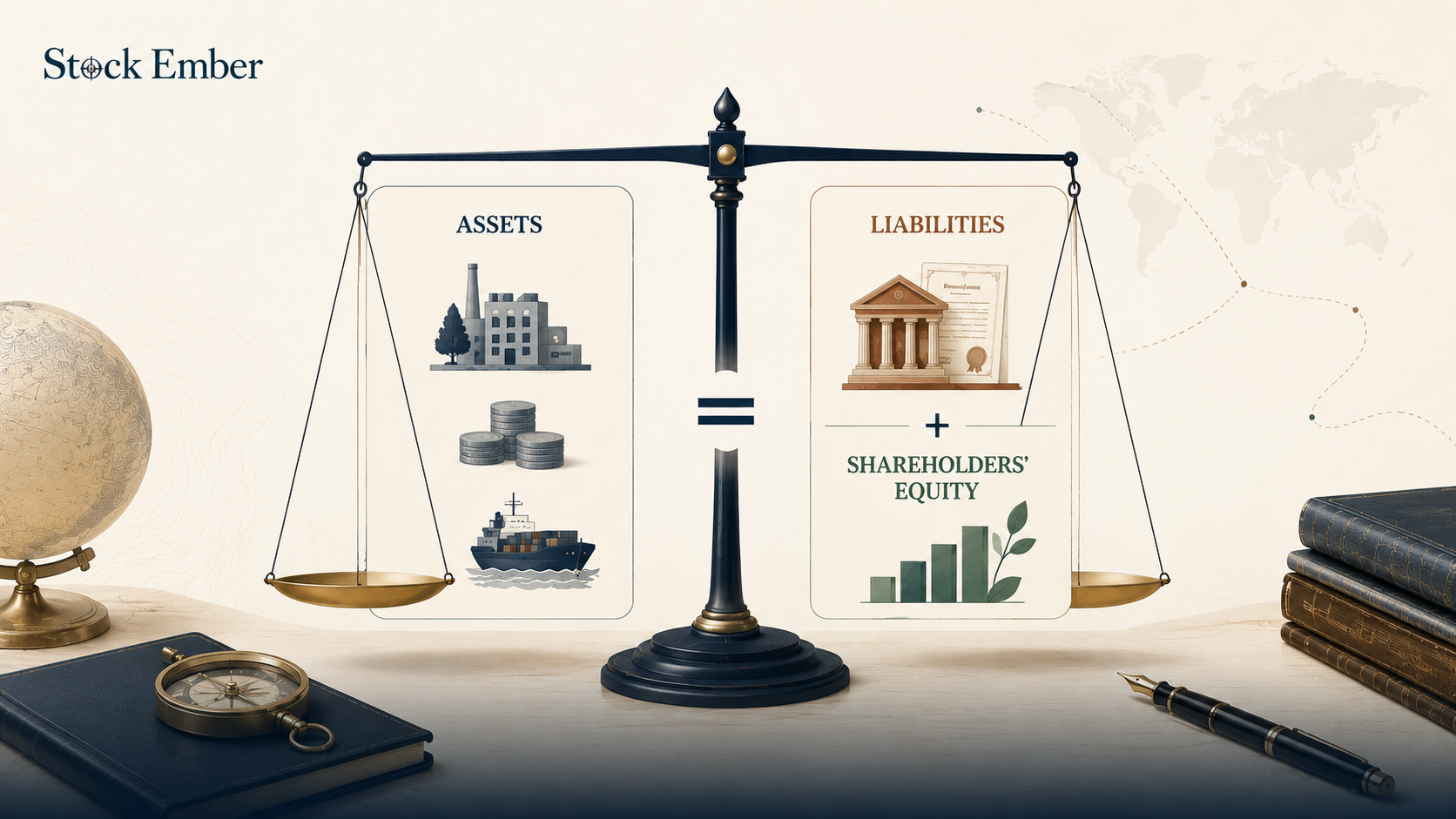
The balance sheet gets its name because it must always balance according to the fundamental accounting equation:
Assets = Liabilities + Shareholders' Equity
This equation balances because a business must pay for everything it owns (assets) by either borrowing money (liabilities) or using capital provided by owners and accumulated profits (shareholders' equity).
If a company buys a $50,000 delivery truck, it records a $50,000 physical asset. If it funded the purchase with a $30,000 bank loan and $20,000 of company cash, liabilities increase by $30,000 and net cash drops by $20,000, keeping both sides balanced.
For anyone building foundational knowledge when investing in stocks, checking balance sheet strength ensures that a company holds enough financial cushion to survive difficult economic periods.
Diagram illustrating the accounting equation: Assets equal Liabilities plus Shareholders' Equity.
The 3 Core Components of a Balance Sheet
Every balance sheet organizes financial items into three distinct sections:
1. Assets (What the Company Owns)
Assets are resources with economic value that a company controls. They are listed on the balance sheet in order of liquidity, how quickly they can be converted into cash:
Current Assets: Short-term resources expected to be converted into cash or used within one year, including cash equivalents, accounts receivable (uncollected customer payments), and inventory.
Non-Current Assets: Long-term investments expected to provide value beyond twelve months, such as property, plant, and equipment (PP&E), patents, and goodwill from acquisitions.
2. Liabilities (What the Company Owes)
Liabilities represent financial debts and legal obligations owed to outside parties. They are listed in order of maturity, how soon payments are due:
Current Liabilities: Short-term obligations due within one year, including accounts payable (unpaid bills owed to suppliers), short-term bank debt, and accrued operating expenses.
Non-Current Liabilities: Long-term financial commitments due after one year, such as corporate bond obligations, long-term bank loans, and lease commitments.
3. Shareholders' Equity (Net Worth)
Shareholders' equity represents the residual ownership claim on a business after subtracting total liabilities from total assets. It consists primarily of contributed capital (funds raised by selling shares) and retained earnings (cumulative profits kept in the business over time).
How to Read a Company Balance Sheet Step by Step
Learning how to read a company balance sheet does not require a degree in accounting. When evaluating financial reports, investors can follow three practical steps to answer how do you read a balance sheet effectively:
Step 1: Evaluate Near-Term Liquidity
Compare current assets against current liabilities to measure short-term solvency. Subtracting current liabilities from current assets gives working capital. If a company holds $500,000 in current assets and $300,000 in current liabilities, its working capital is $200,000. Positive working capital suggests the company has more short-term assets than short-term obligations, providing a liquidity cushion for near-term bills.
Step 2: Check Total Debt Obligations
Examine total interest-bearing debt across both current and long-term liabilities. Compare total liabilities against shareholders' equity to gauge financial leverage. A company with heavy debt obligations relative to its equity faces higher debt servicing costs, leaving less capital available for research or dividend payments.
According to financial analysis resources provided by the SEC, evaluating leverage alongside cash reserves helps investors measure debt sustainability across different market conditions.
Step 3: Compare Book Value to Market Capitalization
Shareholders' equity represents the accounting book value of a firm. However, book value rarely matches stock market valuation. Market capitalization reflects what investors pay for the whole company today, taking into account future growth potential.
When evaluating equity structure, long-term investors also monitor the public free floatof shares available for public trading to understand market liquidity.
Why Balance Sheets Matter for Buy-and-Hold Investors
For long-term buy-and-hold investors, balance sheet quality acts as an insurance policy against severe market downturns.
Over a ten-year holding period, economic cycles will inevitably test every business. Companies with minimal debt and large cash reserves can navigate unexpected recessions without issuing new shares at low prices or accepting high-interest loans. Conversely, over-leveraged companies often face severe financial distress when revenue temporarily dips.
In practice, many long-term investors find that reviewing three to five years of balance sheet debt trends reveals whether management is building lasting enterprise strength or relying on borrowing to boost short-term returns.
Common Balance Sheet Red Flags to Watch
Analyzing multi-year balance sheet trends helps highlight financial risks before they lead to unexpected earnings drops:
Inflated Goodwill Value: Goodwill created during corporate acquisitions can be written down if acquired businesses underperform, reducing total book equity.
Debt Maturity Cliffs: Large debt repayments coming due within twelve months when liquid cash reserves are low can create severe refinancing stress.
Ballooning Accounts Receivable: Customer debts growing much faster than total revenue suggests the company struggles to collect cash owed for past sales.
What a Balance Sheet Means for Investors
A balance sheet provides a clear view of a company's assets, debts, and ownership equity on a specific date. By reviewing liquidity, monitoring long-term debt levels, and watching for red flags like excessive goodwill, you can evaluate financial durability before investing.
When you are ready to choose an investment platform to build your equity portfolio, our broker reviews offer an objective analysis of trading platforms and account features. Always remember that balance sheet analysis represents one component of fundamental research, and all stock investments involve the risk of market loss.
FAQ
5 questions
How do you read a balance sheet?
To read a balance sheet, start by checking current assets versus current liabilities to measure short-term liquidity. Next, compare total liabilities against shareholders' equity to gauge overall financial leverage and debt sustainability.
What is the main equation of a balance sheet?
The fundamental balance sheet equation is Assets = Liabilities + Shareholders' Equity. This formula means a company must fund everything it owns through borrowing money or using capital provided by owners and accumulated profits.
What are the three main components of a balance sheet?
The three core components are assets (resources the company owns, listed by order of liquidity), liabilities (debts and financial obligations owed to outside parties, listed by maturity), and shareholders' equity (net worth remaining for owners).
What is the difference between current and non-current assets?
Current assets are short-term resources expected to convert into cash within twelve months, such as cash and accounts receivable. Non-current assets are long-term investments expected to provide value beyond one year, like machinery and patents.
Why does book value differ from market capitalization?
Book value represents the historical accounting net worth shown under shareholders' equity on the balance sheet. Market capitalization reflects the live stock market valuation based on investor expectations of future earnings growth and public share trading.
Disclaimer
This guide was written with AI assistance and reviewed by the StockEmber editorial team for accuracy. StockEmber provides independent education, not personal financial advice. Some links may support our work at no additional cost to you.
The StockEmber Team is our in-house desk of independent research writers. We test brokerage platforms, read the fine print on fees and custody, and cover ETFs and long-horizon investing for people who plan to hold for decades — not days.