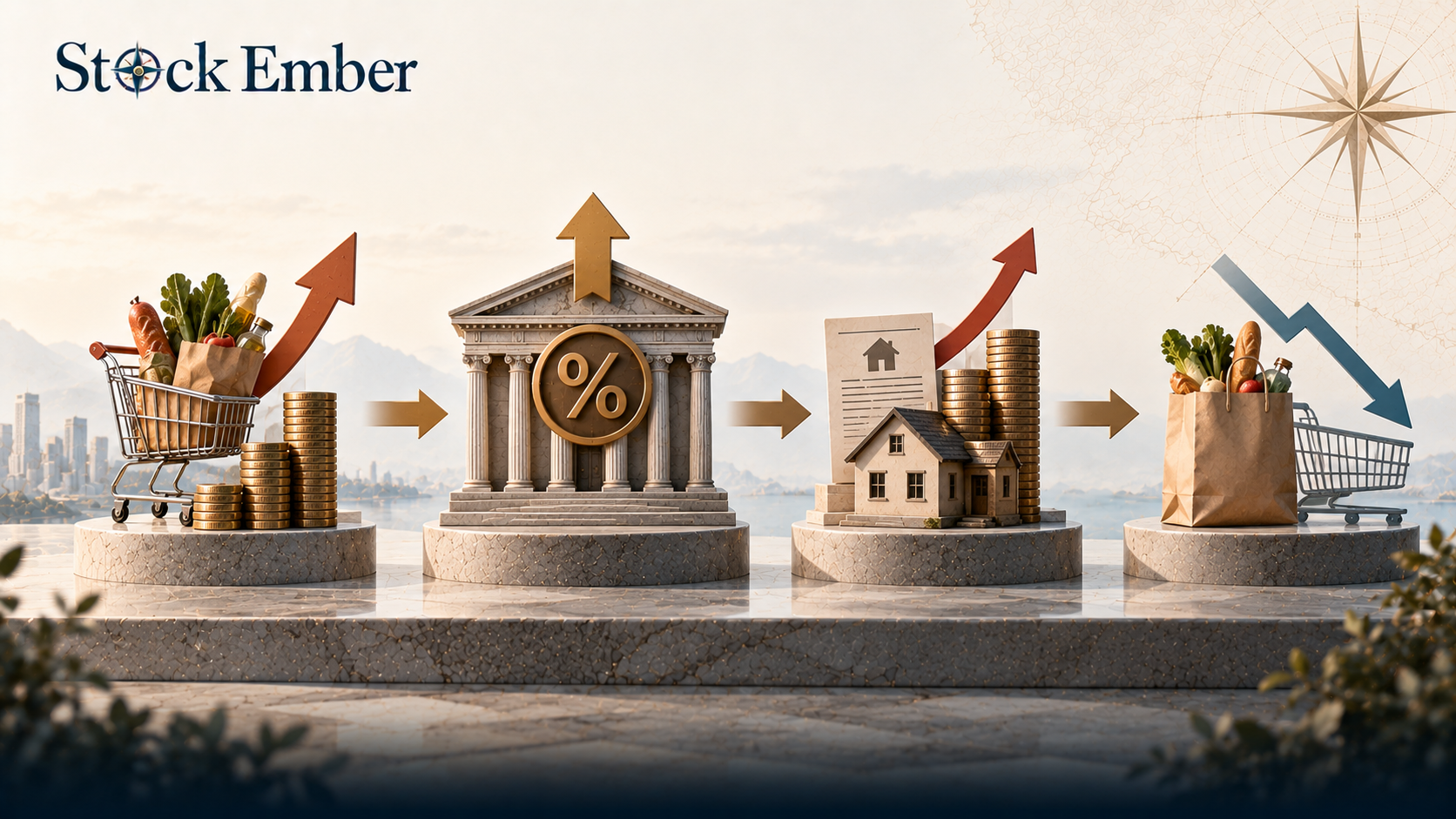
Inflation affects the economy by reducing currency purchasing power, raising living costs, and prompting central bank interest rate hikes. Elevated inflation compresses corporate profit margins and stock valuation multiples. Long-term investors protect purchasing power by maintaining asset allocation in broad-market index funds.
Inflation affects the economy by reducing the purchasing power of money, driving up living costs, and forcing central banks to raise interest rates to slow demand.
When prices rise quickly across food, energy, and housing, everyday budgets tighten and cash balances lose real value. For investors, rising prices alter borrowing costs, company profits, and portfolio returns over multi-year horizons. This guide explains how price growth works, how severe price pressure alters corporate earnings, and how rules-based investing protects long-term buying power.
Quick Takeaways
01Inflation reduces the real purchasing power of uninvested cash over time.
02High inflation forces central banks to raise interest rates, cooling consumer spending and compressing stock valuations.
03Rising production costs squeeze business profit margins unless companies possess strong pricing power.
04Staying invested in broad-market index funds helps long-term portfolios outperform inflation rates over multi-decade horizons.
What Is Inflation and How Does It Affect the Economy?
Inflation is the sustained increase in the general price level of goods and services across an economy over time. When inflation occurs, each unit of currency buys a smaller amount of goods, reflecting a direct loss of consumer purchasing power.
Beyond changing grocery bills, inflation alters the economic environment for households and businesses alike. As consumer prices rise, wage growth often lags behind, forcing families to spend more of their income on basic necessities. This shift reduces discretionary spending on non-essential goods and services. For businesses, rising prices increase the cost of raw materials, shipping, and employee compensation.
When companies face higher expenses, they must either raise prices for customers or accept lower profit margins, impacting overall economic growth.
How Inflation Works: Demand-Pull, Cost-Push, and Central Bank Policy
Inflation develops through two primary economic mechanisms: demand-pull dynamics and cost-push shocks. Understanding these drivers helps clarify how central banks respond to maintain price stability.
Demand-pull inflation occurs when aggregate demand for goods and services outpaces total economic supply. When employment is high and consumer spending rises rapidly, competition for limited goods pushes prices upward. Cost-push inflation happens when production costs increase due to supply chain disruptions, rising energy prices, or wage hikes. Businesses pass these higher costs onto buyers to preserve their operating margins.
To counter rising prices, central banks raise benchmark interest rates to reduce borrowing and cool consumer demand. This monetary tightening influences every phase of the market cycle. As shown in any standard economic cycle diagram, rising interest rates raise borrowing costs for mortgages, car loans, and business loans, intentionally slowing economic activity until inflation returns to healthy baseline targets.
Diagram illustrating inflation mechanisms and central bank policy transmission
How High Inflation Affects the Economy
When price growth accelerates significantly, how does high inflation affect the economy across different sectors? High inflation creates severe economic friction by creating uncertainty for consumers, businesses, and capital markets.
At elevated levels, inflation distorts consumer behavior and business planning. Companies struggle to set long-term capital budgets because future input costs become unpredictable. Fixed-income earners and wage workers experience a rapid drop in real living standards, as wage increases rarely match sharp jumps in consumer price indexes.
For stock investors, persistent high inflation triggers valuation adjustments. Central bank rate hikes increase discount rates used in valuation models, reducing the present value of future corporate earnings. This dynamic compresses price-to-earnings (P/E) ratios, particularly for growth stocks whose earnings lie far in the future.
Meanwhile, fixed-income investors suffer double losses: existing bond prices fall as interest rates rise, while fixed coupon payments lose real purchasing power.
Why Inflation Matters for a Long-Term Investor
For a long-term investor, inflation represents a silent tax on uninvested wealth because nominal investment gains do not equal real purchasing power growth.
Nominal returns reflect the raw dollar growth of a portfolio, while real returns adjust that growth for inflation. If a portfolio earns a 5% nominal return during a year with 4% inflation, the investor's real return is only 1%. If cash sits in a low-interest bank account earning 1% while inflation runs at 5%, the account owner loses 4% of their real purchasing power each year.
Over multi-year investment horizons, compounding inflation erodes cash holdings just as surely as market drawdowns. To preserve purchasing power across decades, long-term investors focus on assets such as broad-market equity index funds, that historically generate real returns above prevailing inflation rates.
The 10-Year Cost of Inflation on Cash Holdings
The long-term impact of inflation becomes clearest when evaluating uninvested cash balances over a ten-year horizon.
Suppose an investor holds $10,000 in uninvested cash over a decade in an economic environment with an average annual inflation rate of 3.5%. After ten years, the nominal cash value remains $10,000, but its real purchasing power declines to approximately $7,094. The investor loses nearly 29% of their purchasing power without ever seeing a negative account balance.
Now consider $10,000 invested in a broad-market index fund achieving an average nominal return of 8% annually. After accounting for 3.5% inflation, the investment yields a real return of 4.5% per year. Over ten years, the portfolio grows to approximately $15,530 in real purchasing power terms.
Strategy
Starting Cash
10-Year Nominal Value
Estimated 10-Year Purchasing Power
Real 10-Year Gain / Loss
Uninvested Cash (3.5% Inflation)
$10,000
$10,000
$7,094
-$2,906 (-29%)
Broad-Market Equity Index (8% Nominal)
$10,000
$21,589
$15,530
+$5,530 (+55%)
Note: Hypothetical values for educational illustration. Past performance does not guarantee future results.
The comparison shows that holding cash avoids short-term equity market volatility, but guarantees a steady loss of purchasing power over extended periods.
Common Inflation Pitfalls (and Portfolio Safeguards)
Three common pitfalls trap investors during inflation spikes:
Fleeing to Cash: Moving portfolio holdings into uninvested cash during inflation-driven rate hikes, locking in real purchasing power losses.
Chasing Speculative Hedges: Buying unproven commodities or speculative assets based on short-term market hype rather than productive earnings capacity.
Ignoring Real Returns: Measuring investment success solely by nominal gains without accounting for rising consumer price levels.
In practice, many long-term investors find that staying invested in broad-market index funds provides the most reliable long-term defense against inflation.
To protect your capital, maintain systematic dollar-cost averaging and reinvest dividend distributions. Equities represent ownership in real businesses that can adjust prices and grow earnings over time. According to educational guidelines from the SEC, understanding how inflation affects purchasing power is a fundamental step in building a resilient, long-term asset allocation strategy.
Conclusion
Inflation is an economic reality that continuously erodes the purchasing power of cash and fixed returns. While central bank rate hikes and price adjustments cause short-term market volatility, high inflation ultimately underscores the need for patient, rules-based investing. By holding productive assets through broad-market strategies, investors protect their wealth against multi-year currency depreciation.
When you are ready to explore low-cost funds designed for long-term compounding, checking our ETF reviews offers a practical next step. Investing carries risk of capital loss and past performance does not guarantee future results, so treat structured portfolio rules as your guide.
FAQ
5 questions
How does inflation affect the economy as a whole?
Inflation affects the economy by eroding consumer purchasing power, increasing input costs for businesses, and forcing central banks to raise benchmark interest rates. Higher interest rates increase borrowing costs across mortgages and business loans, intentionally cooling consumer spending and slowing overall economic expansion.
How does high inflation affect the economy differently than low inflation?
Moderate inflation (~2% annually) reflects healthy economic activity and steady growth. High inflation creates severe economic friction by making future input costs unpredictable for businesses, shrinking real household living standards, compressing price-to-earnings (P/E) stock valuation multiples, and eroding real yields on fixed-income investments.
Why do central banks target a 2% inflation rate instead of 0%?
Central banks target a moderate 2% inflation rate to encourage steady economic investment while avoiding the risks of deflation. Deflation leads consumers and businesses to delay purchases, causing economic stagnation. A small, predictable inflation rate provides a safety buffer for monetary policy transmission.
How does inflation affect long-term stock and portfolio returns?
Inflation creates a silent drag on portfolio returns by reducing real purchasing power. While nominal returns measure raw dollar growth, real returns subtract the rate of inflation. Holding uninvested cash during inflationary periods guarantees real wealth loss, whereas broad-market equities historically generate real gains above price growth.
How can long-term investors protect their portfolios from inflation?
Investors protect their portfolios by avoiding excessive uninvested cash and relying on rules-based investment strategies. Dollar-cost averaging into broad-market equity index funds ensures ongoing exposure to real businesses that can adjust prices, while periodic rebalancing automatically maintains target asset allocation over multi-year horizons
Disclaimer
This guide was written with AI assistance and reviewed by the StockEmber editorial team for accuracy. StockEmber provides independent education, not personal financial advice. Some links may support our work at no additional cost to you.
The StockEmber Team is our in-house desk of independent research writers. We test brokerage platforms, read the fine print on fees and custody, and cover ETFs and long-horizon investing for people who plan to hold for decades — not days.