Dividends work as corporate cash distributions paid directly to shareholders out of a public company's post-tax profits relative to the number of shares held. The distribution follows a strict timeline where stock exchanges automatically adjust the stock's reference price downward by the dividend amount on the morning of the ex-dividend date, though the actual opening price is set by the market. Eligible investors then receive the capital credited to their brokerage accounts on the official payment date.
A dividend is a direct cash distribution paid by a corporation to its shareholders out of its post-tax profits. When you buy shares of a dividend-paying company, you own a fractional piece of that business, making you eligible to receive a portion of its excess earnings relative to the number of shares you hold.
For long-horizon investors, understanding the underlying mechanics of these corporate distributions is essential. Dividends are not "free money" magically added to your account; rather, they represent a deliberate capital allocation choice by a company’s board of directors. Over a 10-year holding period, how these distributions are structured, taxed, and reinvested can fundamentally shape your total investment return.
Understanding exactly how dividends work, from declaration to payment, is the first step toward using them intelligently.
Quick Takeaways
01Corporate Profit Sharing: Dividends are distributions of a public company's post-tax profits paid out directly to eligible shareholders.
02The Cutoff Reality: You must buy a stock before the ex-dividend date to receive the upcoming payment; buying on or after it means the distribution goes to the seller.
03Not Free Wealth: Stock exchanges automatically adjust a company's reference price downward by the dividend amount on the ex-dividend date, so all else being equal, the payout is offset by a lower share price, reflecting the cash leaving the firm's balance sheet.
04Compounding Friction: Letting dividends sit as idle cash or exposing them to annual tax friction introduces a severe long-term drag on your overall portfolio growth.
What Is a Dividend?
So, how do dividends work at the most basic level? A dividend is a distribution of a public company's post-tax profits allocated directly to its shareholders. When a corporation generates net income, its leadership has two primary choices: retain those earnings to reinvest in the business — such as funding research, hiring, or building infrastructure — or return a portion of that cash directly to the investors who own the stock.
Established companies with mature operations and highly predictable cash flows often choose to pay regular dividends. Because their core business models no longer require aggressive capital expenditure to expand, distributing excess profits becomes an efficient way to reward shareholders and attract long-term capital. Conversely, younger or rapidly growing technology firms rarely pay dividends. They prefer to retain 100% of their earnings to fuel aggressive business expansion, banking on the idea that reinvesting that cash internally will drive greater long-term share price appreciation for investors.
The Dividend Timeline: Four Critical Dates
Dividend distributions follow a strict, highly regulated chronological path. To avoid missing out on a payment or miscalculating your portfolio income, you must understand the four distinct dates that govern every corporate payout:
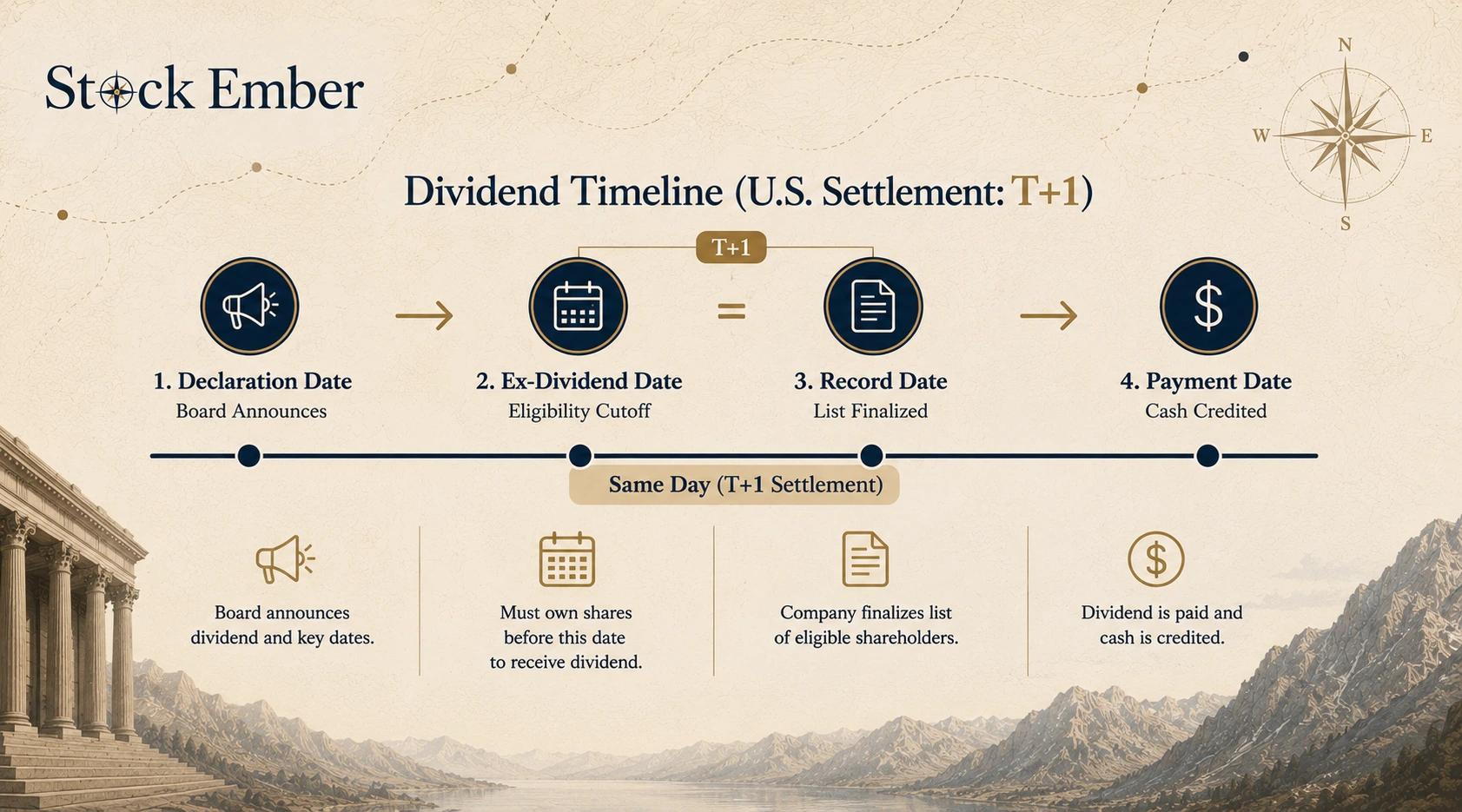
Dividend timeline showing the declaration date, ex-dividend date, record date, and payment date in order
Declaration Date: This is the day the company’s board of directors officially announces its intention to pay a dividend. During this announcement, the board specifies the exact dollar amount to be paid per share, the record date, and the final payment date.
Ex-Dividend Date: This is the critical cutoff line for investors. To receive the upcoming dividend, you must own or buy the stock before this specific day. If you buy the shares on or after the ex-dividend date, you will not receive the next payout; instead, that dividend goes to the individual who sold you the shares.
Record Date: Since the U.S. moved to T+1 settlement in May 2024 under the SEC's amended Rule 15c6-1, the record date now generally falls on the same day as the ex-dividend date; it is the administrative deadline when the corporation finalizes its official ledger of eligible shareholders. Because settlement timelines determine ownership, the ex-dividend date remains the primary day you must watch.
Payment Date: The final step in the sequence. This is the actual day the company distributes the capital, and the cash is credited directly to your brokerage account.
The Mechanics: Share Price Adjustments and Book Value
To fully grasp how do dividends work in practice, you must first understand what happens to the share price itself. A common behavioral trap is looking at a dividend distribution as a pure net bonus akin to finding cash on the sidewalk.
A common behavioral trap is looking at a dividend distribution as a pure net bonus akin to finding cash on the sidewalk. In institutional corporate accounting, dividends are entirely zero-sum events.
When a corporation pays a dividend, a massive amount of cash leaves its corporate balance sheet. Because cash is a tangible asset, removing it instantly reduces the company's overall book value and theoretical intrinsic worth.
To reflect this drop in asset value, stock exchanges automatically adjust the company's reference price downward by the amount of the dividend on the morning of the ex-dividend date, meaning the stock typically opens lower by roughly that amount, all else being equal. For example, if a stock closes at $100 per share on the night before its ex-dividend date and is scheduled to pay a $2 dividend, the exchange adjusts the reference price to $98, so all else being equal, the stock would typically be expected to open near $98 the following morning. You have not instantly gained $2 in value; you simply hold a $98 share of stock alongside a pending $2 cash distribution.
The 10-Year Friction: Reinvestment vs. Cash Drag
Because a dividend distribution removes cash from the underlying equity, the way you manage that cash determines your long-term wealth compounding. Long-horizon investors generally face two choices: pull the cash out, or automatically plow it back into the market using a Dividend Reinvestment Plan (DRIP).
Over a 10-year lens, the cost of failing to reinvest combined with immediate tax friction becomes highly apparent. Consider the structural difference between holding an asset that retains all its earnings versus one that distributes them.
In a standard taxable brokerage account, cash dividends face an immediate annual tax hit in the year they are received, as outlined in IRS Topic No. 404 on dividend income. This means a slice of your capital is redirected to the government annually, permanently removing it from the compounding engine. Over a decade, a portfolio exposed to this continuous tax drag and un-reinvested cash drag may fall behind a comparable strategy focused on long-term capital appreciation held untouched inside a broad index fund, depending on tax rates, reinvestment discipline, and market conditions.
Common Dividend Pitfalls to Avoid
Building a portfolio based around corporate payouts requires looking past the surface numbers. Long-term investors must actively protect themselves from three common structural risks:
The Yield Trap: A stock's dividend yield is calculated by dividing its annual dividend payout by its current share price. If a company's stock price plummets due to deteriorating business fundamentals, its dividend yield will temporarily look extraordinarily high. Chasing these outsized yields blindly often results in buying dying businesses right before they cut their payouts completely.
Ignoring the Payout Ratio: The payout ratio measures the percentage of net income a company uses to fund its dividend. If a firm is paying out 90% or 100% of its earnings as a dividend, it retains virtually no safety cushion. A single bad quarter could force the board to suddenly slash or eliminate the distribution to preserve operational cash.
Mental Accounting Bias: This behavioral bias occurs when investors treat dividend income as entirely separate, "safer" money than capital gains. For a long-term holder, total return (capital gains plus dividends) is the only metric that dictates real wealth generation. Focusing exclusively on cash yield while ignoring a decaying share price is a recipe for long-term underperformance.
Conclusion
So, how do dividends work for the long-term investor? Dividends are a foundational corporate mechanism for distributing post-tax profits back to equity owners. However, they operate under strict transactional timelines and carry structural trade-offs—including automated share price adjustments on the ex-dividend date and immediate tax drag. For the true buy-and-hold investor, dividends are not a shortcut to wealth, but rather one component of a holistic total return strategy that requires disciplined automated reinvestment to unlock true exponential compounding over a decade.
FAQ
5 questions
What Is a Dividend and How Does It Differ From Capital Gains?
To understand how dividends work versus capital gains: a dividend is a direct cash distribution paid from current post-tax earnings, while capital gains represent the increase in the market value of the stock itself, realized only when you sell.
How Often Are Dividends Usually Paid to Investors?
Most public companies distribute dividends on a quarterly schedule, though some opt for semi-annual or annual payouts. The exact distribution frequency and cash amount per share are explicitly determined and announced by the company’s board of directors.
Can a Company Stop or Cut Its Dividend Payments at Any Time?
Yes. Unlike bond coupon payments, dividends are completely discretionary corporate actions. If a business faces an economic downturn, declining cash flows, or shifts its strategy toward capital preservation, the board of directors can reduce, suspend, or entirely eliminate the payout without prior notice.
What Happens to the Stock Price on the Ex-Dividend Date?
On the morning of the ex-dividend date, the stock exchange automatically adjusts the stock's previous closing (reference) price downward by the dollar amount of the upcoming dividend, so the share price typically opens lower by roughly that amount although actual market movements can offset or amplify the adjustment
What Happens If I Sell My Stock on or After the Ex-Dividend Date?
If you sell your stock on or after the ex-dividend date, you will still receive the upcoming dividend payment. The eligibility cutoff is established when the market opens on the ex-dividend date; whoever owns the shares before that precise day receives the cash distribution.
Disclaimer
This guide was written with AI assistance and reviewed by the StockEmber editorial team for accuracy. StockEmber provides independent education, not personal financial advice. Some links may support our work at no additional cost to you.
The StockEmber Team is our in-house desk of independent research writers. We test brokerage platforms, read the fine print on fees and custody, and cover ETFs and long-horizon investing for people who plan to hold for decades — not days.