Dividends are taxed based on their classification as either ordinary or qualified. Ordinary dividends are taxed at standard progressive federal income tax rates up to 37%, while qualified dividends meet specific holding period criteria and are taxed at lower long-term capital gains rates of 0%, 15%, or 20%.
Dividends are taxed according to how they are classified by tax authorities—either as ordinary dividends, which are taxed at standard income tax rates, or qualified dividends, which enjoy the lower tax rates applied to long-term capital gains. For long-horizon portfolios, this distinction determines whether annual tax drag quietly erodes your returns or allows your compounding capital to build with maximum efficiency.
Understanding the specific holding period rules and account types allows you to minimize what you owe and maximize your net returns. This guide covers exactly how these asset classes are treated, how the rules apply to your portfolio, and how to protect your wealth over a 10-year horizon.
Quick Takeaways
01Dividend income is fully taxable unless it is held inside a designated tax-sheltered account like an Individual Retirement Account (IRA) or 401(k).
02Qualified dividends benefit from lower capital gains tax rates (0%, 15%, or 20%), making them highly tax-efficient structural assets.
03Ordinary dividends are taxed as regular income, scaling progressively with your standard federal income tax brackets.
04Reinvesting your dividends through an automated plan (DRIP) does not exempt the cash from being taxed in the year it is received.
Is Dividend Income Taxable?
Yes, dividend income is taxable, and tax authorities require you to report it on your tax filings regardless of whether you cash it out or immediately reinvest it. When a corporation distributes a portion of its earnings to shareholders, that distribution is treated as taxable income in the calendar year it occurs.
At the end of the tax year, brokerages compile these payouts onto tax documents—such as Form 1099-DIV in the United States—which outline your total distributions and how they are classified.
Even if you never withdraw the cash from your account, the liability remains. Failing to account for this annual liability means you are forced to pay the tax bill using outside cash or by liquidating a portion of your holdings, both of which interrupt your portfolio's natural growth. To understand the underlying asset class mechanics before looking at taxes, it helps to review the foundations of what is a dividend.
How Are Qualified Dividends Taxed?
Qualified dividends are taxed at preferential long-term capital gains rates of 0%, 15%, or 20%, depending on your overall taxable income level, as outlined by the IRS. Because these rates are substantially lower than standard income brackets, receiving qualified dividends is one of the most tax-efficient ways to collect income in a taxable brokerage account.
However, a dividend does not automatically receive this preferential treatment. To achieve "qualified" status, the distribution must meet strict statutory criteria:
Issuer Eligibility: The dividend must be paid by a domestic US corporation or a qualified foreign corporation — generally one that is incorporated in a US possession, is eligible for benefits under a US income tax treaty, or has shares that trade readily on an established US securities market.
The Holding Period Rule: You must hold the underlying stock for more than 60 days during a specific 121-day window. This window begins 60 days before the stock's ex-dividend date and ends 60 days after the ex-dividend date.
The holding period rule exists to prevent short-term traders from buying a stock just to harvest the dividend and immediately selling it. If you purchase shares just a few days before a distribution, those payouts fail the holding period test and are taxed at a higher rate. Tracking the timing of your asset purchases around the what is ex dividend date timeline is vital if you want to secure these lower rates.
Ordinary Dividends VS Qualified Dividends
The core difference between ordinary and qualified dividends rests entirely on the holding period and the resulting tax rate applied to the income. If a dividend payout fails to meet the strict structural and timing criteria required by tax codes, it defaults to an ordinary dividend.
Ordinary dividends enjoy no preferential tax breaks. Instead, Instead, they are bundled directly with your regular wages, salary, and interest income, meaning they are subject to standard progressive federal income tax rates that top out at 37% for the 2026 tax year, according to the IRS. under current IRS tax brackets. Higher-income investors may also face an additional 3.8% Net Investment Income Tax (NIIT) on both types of dividends, depending on their modified adjusted gross income thresholds set out in IRS guidance on the Net Investment Income Tax.
Feature
Ordinary Dividends
Qualified Dividends
Tax Rate
Standard income tax rates (up to 37%)
Long-term capital gains rates (0%, 15%, or 20%)
Holding Requirement
None (defaults to this category if unqualified)
Greater than 60 days within the 121-day ex-dividend window
Common Examples
REITs, business development companies (BDCs), short-term holdings
Standard domestic corporations, broad equity index funds
The 10-Year Cost: How Dividend Taxes Impact Compounding
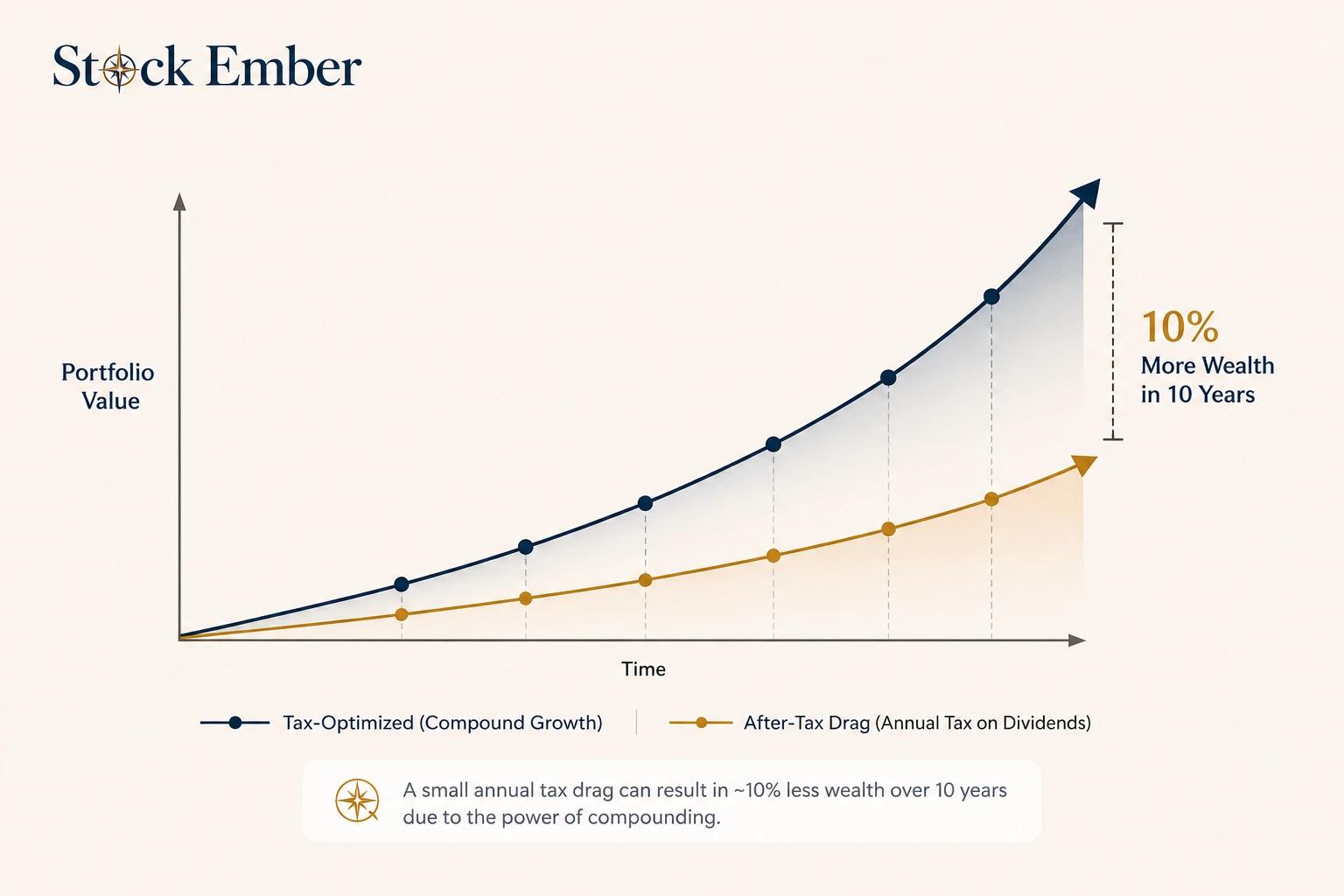
Over a single year, the variance between a 15% qualified capital gains rate and a 22% or 24% ordinary income tax rate might look like a negligible accounting detail. Over a decade, however, this recurring annual tax slice fundamentally reshapes the total value of your investment holdings.
When you hold dividend-paying assets inside a standard taxable brokerage account, tax drag removes money from your portfolio every single tax season. This means that a portion of your returns is eliminated before it can be reinvested into more shares.
Consider a hypothetical portfolio with an initial value of $100,000 yielding a consistent annual distribution. If those dividends face a high ordinary income tax rate every year, the amount available to purchase new shares is permanently diminished. Over 10 years, that missing capital causes your total return curve to flatten dramatically compared to an identical portfolio where dividends compound completely unhindered by annual taxes.
Fees and taxes compound against your wealth the exact same way returns compound for you. To see how optimizing your tax classifications changes your long-term wealth trajectory, it is useful to model these differences using the principles of simple vs. compound interest.
The 10-Year Cost: How Dividend Taxes Impact Compounding
Common Mistakes: The Reinvestment Trap & Account Placement
The most prevalent mistake dividend investors make is assuming that automated dividend reinvestment plans (DRIP) shelter cash from immediate taxation. A DRIP is a highly efficient tool for accumulating shares, but it is not a tax shelter. The IRS views a reinvested dividend as if the company handed you cash and you immediately used that cash to buy more stock. You owe tax on that dividend value in the year it was paid, regardless of whether it hit your bank account or went straight back into the market.
Another frequent error is poor account placement. Assets that pay high ordinary dividends—such as Real Estate Investment Trusts (REITs) or high-yield bond funds—are generally better suited to tax-sheltered accounts like Traditional or Roth IRAs, depending on your individual circumstances. Within those wrappers, the ordinary dividends compound tax-free or tax-deferred. Reserving your taxable brokerage accounts for long-term growth investments or qualified dividend payers keeps your annual tax liability as low as possible.
Conclusion
Understanding how your dividends are categorized prevents unexpected shortfalls and gives you control over the tax drag on your wealth. By aligning your stock holding periods with qualified timelines and utilizing tax-sheltered accounts for ordinary income assets, you keep more capital working for your future. When you are ready to evaluate diversified asset platforms that help optimize your portfolio layout, start by reading through our comprehensive ETF reviews.
FAQ
4 questions
How long do you have to hold a stock for a dividend to be qualified?
You must hold the underlying stock for more than 60 days within a specific 121-day window. This window begins 60 days before the stock's ex-dividend date and concludes 60 days after the ex-dividend date.
Are dividends taxed as income or capital gains?
Dividends can be taxed as either income or capital gains depending on their classification. Ordinary dividends are taxed as standard income, whereas qualified dividends benefit from lower long-term capital gains tax rates.
Do you pay tax on dividends if your income is low?
If your overall taxable income falls below the specified federal thresholds, your qualified dividend tax rate may be 0%. However, ordinary dividends will still be subject to the lowest progressive regular income tax brackets rather than capital gains brackets.
Why are REIT dividends taxed differently than regular stocks?
Real Estate Investment Trusts (REITs) are structured to pass regular real estate income directly through to shareholders. Because this income is generally not taxed at the corporate level, the distributions are classified as ordinary dividends and do not qualify for the lower capital gains rates.
Disclaimer
This guide was written with AI assistance and reviewed by the StockEmber editorial team for accuracy. StockEmber provides independent education, not personal financial advice. Some links may support our work at no additional cost to you.
The StockEmber Team is our in-house desk of independent research writers. We test brokerage platforms, read the fine print on fees and custody, and cover ETFs and long-horizon investing for people who plan to hold for decades — not days.