Direct indexing tax loss harvesting is an investment strategy where you directly own individual stocks within an index inside a brokerage account rather than holding fund shares. This enables automated trading software to sell individual losing stocks to offset capital gains and lower taxable income, even during broad market rallies.
Standard index funds hold every stock inside a single fund package, meaning you can only harvest a loss if the whole fund drops. Direct indexing unbundles the index into individual positions so you can sell falling stocks even when the broader market rises. This guide breaks down how component harvesting works, the 10-year fee trade-off, and key rules to consider.
Quick Takeaways
01Direct indexing lets you harvest tax losses from individual stocks, even during a bull market.
02Harvested capital losses can offset taxable capital gains and up to $3,000 of ordinary income.
03Platform management fees and benchmark tracking error can erode tax savings over a 10-year period.
04Tax benefits decay over time as your holdings build large unpaid gains, a process called portfolio ossification.
What Is Direct Indexing?
Direct indexing is an account structure where an investor owns the individual stocks that make up an index through a Separately Managed Account (SMA) rather than buying a single fund share. When you ask what is direct indexing, the main difference comes down to ownership structure. In a conventional index Exchange-Traded Fund (ETF), a fund manager holds hundreds of stocks, and you own shares of that single fund.
With direct indexing, automated software buys the underlying shares inside your personal brokerage account. Owning individual holdings gives you full control over every constituent stock. You can exclude specific companies you already hold elsewhere or filter out industries that do not match your values. However, direct indexing requires specialized technology to keep hundreds of stock positions balanced, which is why platforms often set higher account minimums ranging from $5,000 to $100,000, based on published minimums across major direct-indexing providers.
How Direct Indexing Tax Loss Harvesting Works
Direct indexing tax loss harvesting works by taking advantage of stock price dispersion within a broad market index. Even during years when an index like the S&P 500 rises overall, dozens of individual member companies drop in value. Because you own each stock directly, trading software automatically sells these specific underperforming holdings to realize a capital loss.
Once a loss is harvested, the proceeds are immediately reinvested into a correlated proxy stock or industry fund to keep your portfolio invested in the market. Under tax regulations established by the IRS, these harvested capital losses offset taxable capital gains dollar-for-dollar. If your total losses exceed your capital gains, you can offset up to $3,000 of ordinary income each tax year, carrying any unused balance forward into future tax years.
Direct Indexing vs. Index ETFs: The 10-Year Cost and Tax Trade-Off
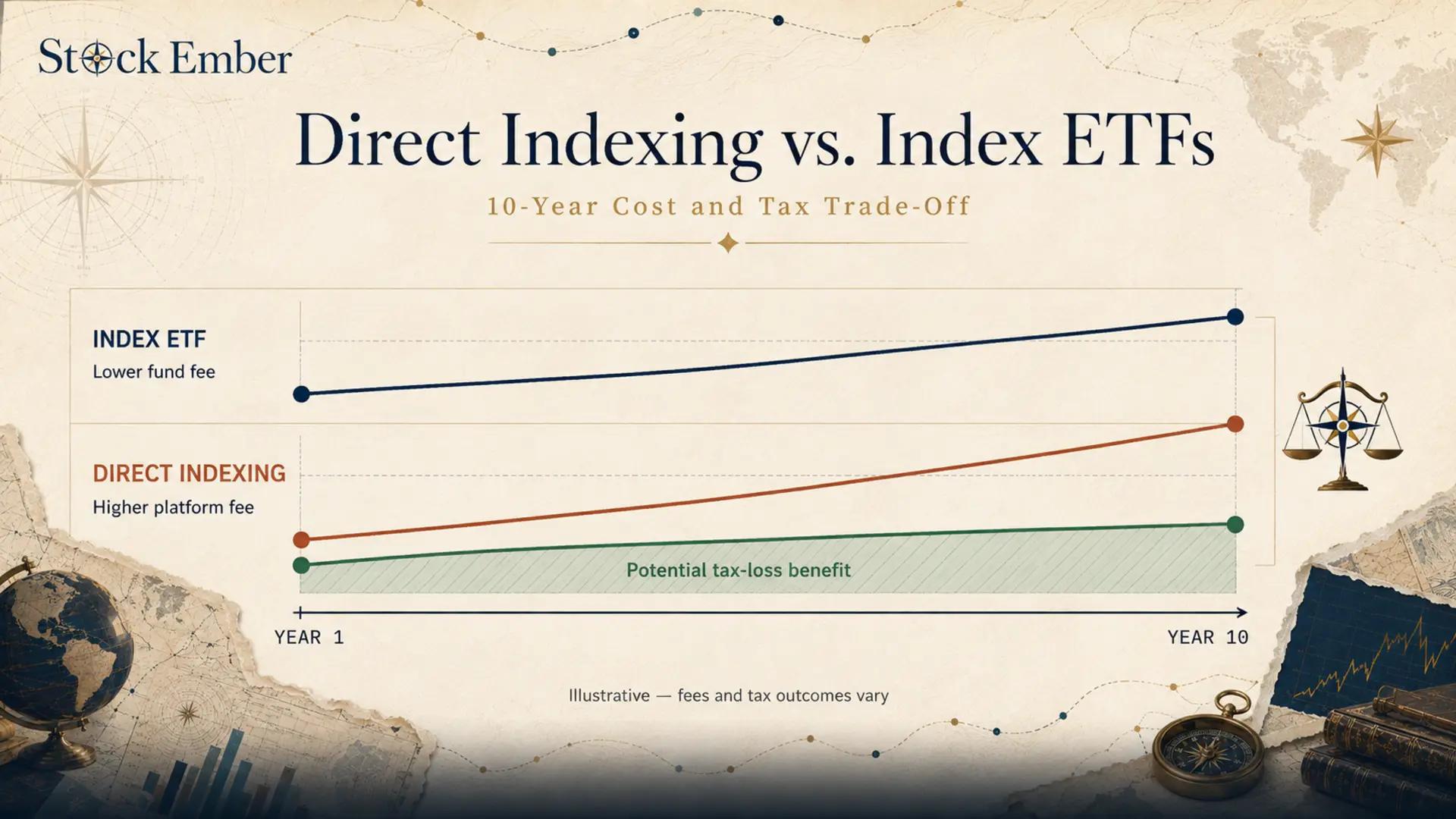
Comparing direct indexing vs ETF tax loss harvesting comes down to balancing expected tax savings against higher account management costs over time. Broad-market index ETFs charge very low expense ratios, often under 0.05% annually, but they offer zero stock-level loss harvesting. Direct indexing platforms charge higher advisory fees, typically between 0.15% and 0.40% per year, according to Morningstar's separately managed account research.
Chart showing 10-year fee comparison between direct indexing SMAs and broad index ETFs.
To see how this trade-off works, consider a hypothetical $500,000 portfolio held over 10 years. An extra 0.25% in annual platform fees adds $1,250 in yearly cost, totaling $12,500 over a decade before compounding. For an investor in a high tax bracket with frequent capital gains from real estate or private stock, harvesting individual losses can generate enough tax savings to offset that fee.
But for a buy-and-hold investor with few taxable gains, the extra platform fee creates a steady cost drag. Whether you trade in a margin account or cash account, high platform fees require active taxable gains to justify the added expense.
Pitfalls to Watch: Wash Sales, Tracking Error, and Ossification
Direct indexing introduces three specific operational risks that every investor must monitor closely:
The Wash Sale Rule: The wash sale rule that direct indexing software must comply with prevents claiming a tax loss if you purchase a 'substantially identical' security within 30 days before or after the sale.
Tracking Error: Because you sell losing stocks and hold replacement shares, your portfolio's returns will drift slightly above or below the benchmark index. This gap between your portfolio and the index is known as tracking error.
Portfolio Ossification: Over time, continuous tax loss harvesting lowers the cost basis of your holdings across the account. As markets rise over a multi-year period, most stocks accumulate large unpaid gains, leaving fewer losing stocks to sell. This decay in harvestable losses is known as portfolio ossification. By years 7 to 10, new tax-loss harvesting opportunities drop significantly unless you add fresh capital.
Conclusion
This strategy provides clear tax management advantages for investors in high tax brackets who hold active taxable gains. By harvesting individual stock losses within a benchmark index, you can lower your current tax bill without pulling your capital out of the broader market. However, the strategy comes with higher ongoing fees, potential tracking error, and diminishing tax benefits over a 10-year horizon.
When you are ready to evaluate platforms and trading features for your portfolio, our broker reviews & rankingsoffer a clear starting point. Keep in mind that tax rules vary by individual situation, and past tax savings do not guarantee future portfolio returns, so treat this guide as educational context rather than personal tax advice.
FAQ
4 questions
What is direct indexing and how does it enable tax-loss harvesting?
Direct indexing means buying individual shares of an index directly rather than holding an index fund. This allows you to sell individual losing stocks to harvest tax losses, even when the overall index is up.
How does direct indexing compare to a standard index ETF for tax efficiency?
With a standard ETF, you can only harvest losses if the entire fund falls in price. Direct indexing lets you unlock tax losses on individual declining components inside the index.
What portfolio size makes direct indexing practical?
Direct indexing is usually designed for larger portfolios—often $100,000 or more—because of the higher account management fees and software required to balance hundreds of individual stocks.
Can direct indexing trigger wash sales across my other accounts?
Yes. If a direct indexing program sells a specific stock for a loss and you buy the same stock in another account (like an IRA) within 30 days, it triggers a wash sale.
Disclaimer
This guide was written with AI assistance and reviewed by the StockEmber editorial team for accuracy. StockEmber provides independent education, not personal financial advice. Some links may support our work at no additional cost to you.
The StockEmber Team is our in-house desk of independent research writers. We test brokerage platforms, read the fine print on fees and custody, and cover ETFs and long-horizon investing for people who plan to hold for decades — not days.