

A cash flow statement is a financial document that tracks the actual cash entering and leaving a company during a specific period. It measures liquid money rather than accounting profits.
A clear cash flow statement definition is simple: it is a financial report that tracks cash moving into and out of a business over a set period.
A company can report strong earnings on its income statement and still run out of cash if customers delay paying their bills. Understanding cash movements helps you separate true business health from accounting estimates. This guide covers how a cash flow statement works, its three main sections, and how to spot financial red flags.
Quick Takeaways
- A cash flow statement records actual cash movements, ignoring non-cash gains and credit-based accounting entries.
- The statement breaks cash activity into three areas: operating, investing, and financing.
- Free cash flow shows how much cash remains after paying for operational costs and physical asset upgrades.
- Divergence between rising reported profits and falling operating cash flow often signals financial stress.
What Is a Cash Flow Statement?
A cash flow statement, also called a statement of cash flows, is one of the three core financial statements public companies publish each quarter. While the income statement records revenue when earned and expenses when incurred, this statement counts money only when cash changes hands. According to financial reporting standards summarized by the U.S. Securities and Exchange Commission (SEC), the cash flow statement details a company's cash receipts and cash payments over a set reporting period.
This distinction matters because accrual accounting rules allow companies to record sales before receiving cash. If a business sells $1 million of goods on credit, its income statement shows $1 million in revenue. However, if the buyer takes six months to pay, zero cash enters the bank account today. This statement bridges this gap by showing exact cash movements.
For anyone investing in stocks, checking cash activity ensures that reported profits reflect real money entering the business rather than unpaid invoices or paper adjustments.
What Does a Cash Flow Statement Show? The 3 Core Sections
The statement of cash flow splits money movements into three distinct categories: operating, investing, and financing activities.
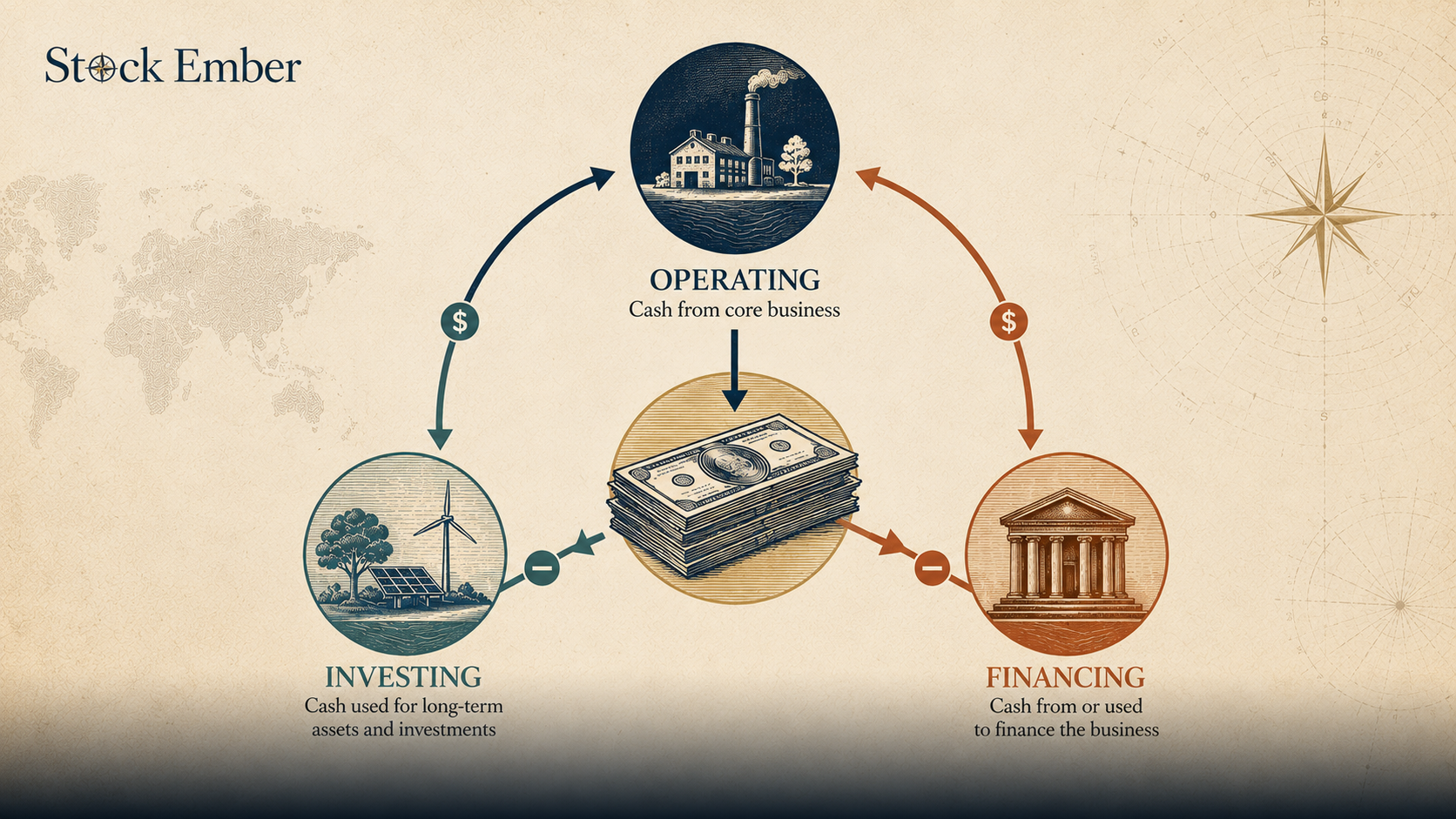
1. Cash Flow from Operating Activities (CFO)
Operating cash flow measures money generated or spent through core day-to-day business operations. It starts with net income from the income statement and adjusts for non-cash expenses, such as depreciation, as well as changes in working capital.
Working capital items include accounts receivable (uncollected bills), inventory (unsold goods), and accounts payable (unpaid bills to suppliers). If inventory expands rapidly because goods are sitting on shelves, cash is tied up, reducing operating cash flow. While balance sheet metrics like the current ratio measure short-term liquidity at a single point in time, operating cash flow reveals whether daily operations generate positive cash over an entire period.
2. Cash Flow from Investing Activities (CFI)
Investing cash flow tracks capital spent on or received from long-term assets. The primary item here is Capital Expenditures (CapEx), which represents funds spent buying or upgrading physical assets like manufacturing machinery, computer servers, or warehouses.
Cash outflows in this section are normal for growing companies building physical infrastructure. However, if a firm constantly sells off equipment or real estate to generate cash, it may be liquidating assets to cover operational shortfalls.
3. Cash Flow from Financing Activities (CFF)
Financing cash flow records cash transactions between a business and its capital providers, including banks and shareholders. Key activities include:
- Issuing or repaying bank loans and corporate bonds.
- Raising capital through stock sales.
- Paying cash dividends to shareholders.
- Repurchasing company shares from the open market.
A positive financing number means the business took on debt or raised equity capital. A negative number shows the company repaid loans, bought back stock, or paid dividends.
How to Make a Cash Flow Statement: Direct vs. Indirect Method
Companies prepare cash flow statements using one of two accounting approaches: the direct method or the indirect method.
The direct method lists every major cash receipt and payment, such as cash collected from customers and cash paid to suppliers or staff. While easy to read, few companies use it because tracking every cash transaction requires significant bookkeeping effort.
The indirect method is far more common. It starts with net income from the income statement and converts it into cash flow through a series of adjustments:
- Add back non-cash expenses: Depreciation and amortization reduce accounting profit but do not involve cash spent during the current period, so they are added back.
- Adjust for gains or losses on asset sales: Non-operating gains are subtracted, and losses are added back.
- Account for working capital changes: Increases in accounts receivable or inventory reduce cash, while increases in accounts payable increase cash.
For example, suppose a business reports $100,000 in net income. If depreciation is $15,000 and accounts receivable grow by $20,000 (uncollected sales), operating cash flow equals $95,000 ($100,000 + $15,000 − $20,000).
Why Cash Flow Matters for Buy-and-Hold Investors
Accounting profit can be influenced by management estimates, inventory valuation choices, and revenue timing. Cash flow can be harder to distort because it reflects actual cash receipts and payments.
Long-term investors pay close attention to Free Cash Flow (FCF), which measures the cash a business generates after funding its daily operations and necessary physical investments:
Free Cash Flow = Operating Cash Flow − Capital Expenditures
If a company generates $50 million in operating cash flow and spends $20 million on CapEx, its free cash flow is $30 million. This $30 million can be used to pay dividends, pay down debt, or buy back shares without relying on outside loans.
Over a ten-year holding period, cash generation determines business survival. A company charging $10,000 for a service might report strong paper earnings, but if fees, bad debts, or uncollected receivables eat away at cash over ten years, the business can face severe distress. A steady flow of free cash gives management capital allocation flexibility without diluting existing stock owners.
In practice, many long-term investors find that reviewing three to five years of cash flow trends reveals far more about a management team's capital discipline than a single quarter's net profit headline.
Common Cash Flow Red Flags to Watch
Evaluating cash flow statements helps highlight financial weaknesses before they show up in earnings headlines:
- Accumulated Deficit: A negative retained earnings balance means cumulative historical losses exceed total profits. While common for early-stage technology or biotech startups spending heavily on development, an accumulated deficit in a mature company indicates chronic unprofitability.
- Debt-Funded Dividend Payouts: If a company pays out cash dividends that exceed its current net income, it drains its accumulated retained earnings reserve. Continuing this pattern while taking on debt to sustain dividend levels often leads to sudden payout cuts.
- Stagnant Profit Growth despite Profit Retention: When a firm continuously accumulates earnings without generating higher future sales or earnings per share, management may be holding idle capital rather than deploying it effectively.
Conclusion
A cash flow statement removes non-cash accounting entries to show how cash enters and leaves a company. By tracking operating cash flow, capital expenditures, and financing activities, you can evaluate whether a business funds its own growth or relies on outside borrowing.
Before buying shares in any company, examine its free cash flow over multiple years to confirm that earnings reflect real money. When you are ready to select an investment platform to hold your shares, our broker reviews offer a clear breakdown of platform choices and account options. Always remember that investing involves risk, including the loss of capital, so treat financial statement research as one part of a broader evaluation process.