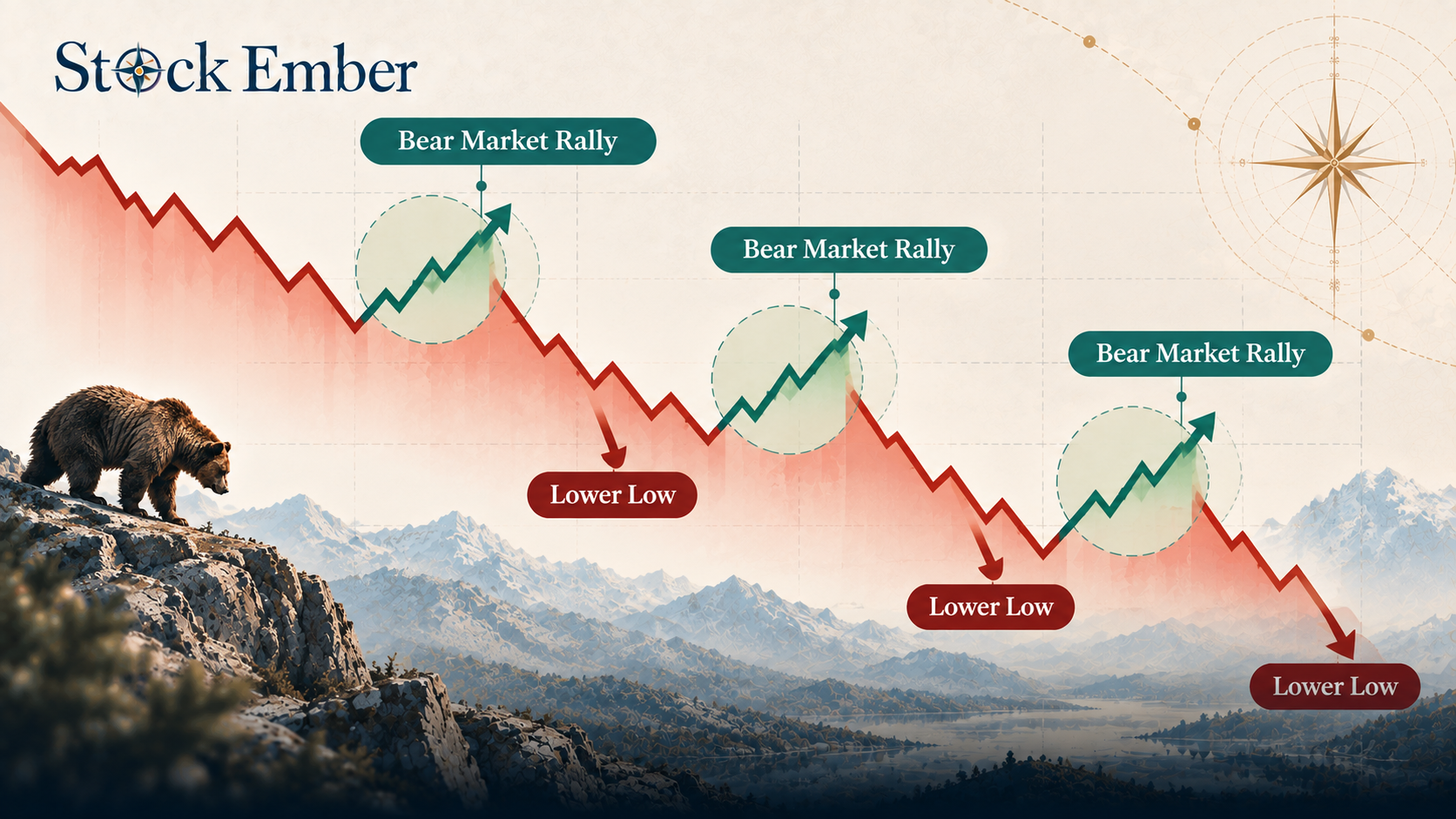
A bear market rally is a brief, sharp upward surge in stock prices that occurs within an ongoing, long-term market decline. These temporary price bounces are driven by short covering, oversold technical rebounds, and brief sentiment relief before the overall market downturn resumes to lower lows.
A bear market rally is a sharp, temporary rise in stock prices that occurs during a sustained, long-term market decline before prices turn down again to reach lower lows.
During a prolonged market downturn, a sudden multi-day market surge can easily feel like the start of a full recovery. Investors often rush back in, fearing they will miss the market bottom, only to watch prices drop further. Understanding how relief surges work helps long-horizon investors stay disciplined, avoid emotional timing traps, and protect their ten-year compounding plans.
Diagram showing temporary price rebounds occurring within an extended market downturn.
Quick Takeaways
01A bear market rally is a short-lived price surge within a broader, long-term market decline.
02Bounces are often fueled by short covering, oversold technical rebounds, and brief sentiment relief rather than improving fundamental earnings.
03Sharp upward surges occur frequently during bear markets, making market timing exceptionally risky for individual investors.
04Attempting to trade relief bounces introduces turnover costs, tax drag, and whipsaw risk that damage long-term investment returns.
What Is a Bear Market Rally?
These rallies show up as sudden bursts of buying pressure even while the broader downtrend remains firmly in place. In simple terms, the bear market rally definition comes down to this: it's a short-lived price rebound that occurs while the broader downtrend is still intact.
When markets fall into a bear market, defined as a sustained drop of 20% or more from recent peak prices, prices do not drop in a straight line. Periods of steep decline are punctuated by sudden, aggressive price bounces. These temporary rebounds can last anywhere from a few days to several weeks, rising by 5%, 10%, or even more before the overall downward trend resumes.
If you are looking for a practical bear market rally definition, it is best understood as a temporary relief surge rather than a true economic recovery. Investors often ask what is driving a bear market rally when the underlying news remains negative. The primary drivers include:
Short Covering: Active traders who sold borrowed shares (short positions) buy back stock to lock in short-term profits, creating buying pressure.
Oversold Rebounds: Technical traders step in when stock indexes appear oversold on short-term indicators.
Institutional Rebalancing: Large funds automatically adjust asset allocations at month-end or quarter-end, buying equities to re-establish target weights.
Understanding these bear market rally mechanics reveals why the bounces happen so quickly: buying demand concentrates in a short window, creating a rapid price spike that catches cautious investors off guard.
How Bear Market Rallies Work: Anatomy of a False Rebound
A bear market rally typically follows a distinct pattern that tricks market participants into believing the downturn has ended.
During the initial phase of a relief bounce, stock indexes jump sharply on high trading volume. Bad news appears to have less impact on stock prices, creating a sense that the worst of the decline is over. However, because underlying economic fundamentals and corporate earnings estimates have not improved, buying demand quickly fades as institutional sellers use the higher prices to exit positions.
Understanding where these false rebounds fit within broader market cycles helps keep short-term price action in perspective. In a typical multi-year contraction, multiple relief bounces occur before the market finds a genuine bottom.
Phase of Downturn
Market Trajectory
Price Behavior
Investor Risk
Initial Decline
Downward
Sharp price drops on heavy selling
Panic selling near initial lows
Relief Bounce
Upward (5% - 15%)
Rapid surge over days or weeks
Chasing false recoveries (bull traps)
Renewal of Trend
Downward
Orderly or sharp decline to new lows
Whipsaw losses and emotional fatigue
In practice, many long-term investors find that staying calm during relief surges is harder than staying calm during price drops, because sudden rallies create intense pressure to rush back into cash positions.
Macro Triggers and Bond Market Drivers
Macroeconomic shifts and interest rate expectations play a central role in sparking sudden stock market rebounds during broad downturns.
When central banks raise interest rates to cool inflation, borrowing costs rise and corporate valuations contract. However, any hint that rate hikes might pause or slow down can trigger an immediate surge in stock prices. These macro-driven bounces occur even if economic growth continues to weaken.
Similarly, changes in bond market volatility directly influence stock prices during market downturns. When government bond yields fall sharply, investors often rotate capital back into growth stocks, driving a short-term rally in broad equity indexes.
Regulatory guidance from the SEC emphasizes that market volatility and rapid price swings can create misleading trading signals during extended market downturns.
The 10-Year Cost Lens: Why Chasing Rallies Harms Compounding
Trying to trade or time bear market rallies introduces heavy execution friction, tax drag, and whipsaw risk that damage portfolio compounding over a ten-year horizon.
Consider how market timing affects long-term investment outcomes:
Missing the Best Days: Research on long-term market behavior suggests that a large share of the stock market's best single-day gains have historically occurred during bear markets. Moving to cash to avoid downturns often means missing these powerful recovery days, permanently reducing ten-year returns.
Tax Friction in Taxable Accounts: Selling stocks after a partial recovery to "lock in liquidity" triggers taxable capital gain realizations, reducing the amount of working capital left in the portfolio.
Whipsaw Risk: Buying stocks near the top of a relief bounce and selling after prices resume their downward trend creates repeated whipsaw losses, selling low and buying high.
Cash Drag: Holding extra cash while waiting for confirmation that a market bottom is real causes dividend income to be lost while compounding slows down.
For a buy-and-hold index investor, executing automated dollar-cost averaging remains far more effective over a ten-year period than trying to guess which rally represents the true market bottom.
Common Pitfalls: Bull Traps and Timing Traps
Investors managing portfolios through prolonged market downturns frequently fall into behavioral traps when relief surges occur.
Falling for Bull Traps: Buying aggressively into a multi-day rally without checking underlying economic signals often leads to purchasing shares right before the downward trend resumes.
Abandoning Dollar-Cost Averaging: Pausing regular monthly index contributions to "wait for clarity" disrupts automated investment habits and usually results in buying back at higher prices later.
Confusing Price with Value: Assuming a stock is cheap simply because it has rebounded 10% from its low ignores whether company fundamentals support the higher valuation.
Conclusion
Bear market rallies are sharp, temporary price bounces that occur naturally within broad market downturns. While these relief surges can look like the start of a permanent market recovery, they are frequently driven by short-term trading mechanics rather than improving economic conditions. Trying to time these bounces introduces turnover costs, tax drag, and whipsaw risk that compromise long-term portfolio growth.
When you are ready to build a durable core portfolio for long-term growth, reviewing our ETF reviews offers a practical next step. Investing always involves risk of loss and past market patterns do not guarantee future performance, so treat this guide as educational background rather than personalized financial advice.
FAQ
5 questions
What is the main difference between a bear market rally and a bull market?
A bear market rally is a temporary, short-term price surge that occurs within a sustained, long-term market decline, eventually giving way to lower price lows. In contrast, a true bull market represents a fundamental, prolonged upward market trend supported by expanding economic growth, rising corporate earnings, and sustained investor confidence over multiple months or years.
How long does a typical bear market rally last?
A bear market rally can last anywhere from a few days to several weeks, and occasionally even a few months. Because these bounces are fueled by short-term trading mechanics like short covering and institutional rebalancing rather than lasting economic recovery, they often end abruptly when selling pressure resumes.
Is a bear market rally the same as a bull trap or dead cat bounce?
Yes, these terms describe very similar market phenomena. A "bull trap" and a "dead cat bounce" both refer to short-lived price rebounds during a broader market decline that trick investors into believing a bottom has formed, only for prices to fall further shortly afterward.
What causes stock prices to jump during a bear market rally?
Bear market rallies are primarily caused by technical and behavioral factors rather than fundamental economic growth. Common triggers include short sellers buying back shares to lock in quick profits, automated institutional rebalancing, oversold technical indicators, and sudden shifts in central bank interest rate expectations.
How should long-term index investors handle a bear market rally?
Long-term index investors should avoid trying to time relief bounces by selling or buying aggressively during short-term price surges. Instead, maintaining a disciplined asset allocation and continuing automated dollar-cost averaging helps avoid whipsaw losses, tax drag, and missed long-term recovery gains.
Disclaimer
This guide was written with AI assistance and reviewed by the StockEmber editorial team for accuracy. StockEmber provides independent education, not personal financial advice. Some links may support our work at no additional cost to you.
The StockEmber Team is our in-house desk of independent research writers. We test brokerage platforms, read the fine print on fees and custody, and cover ETFs and long-horizon investing for people who plan to hold for decades — not days.