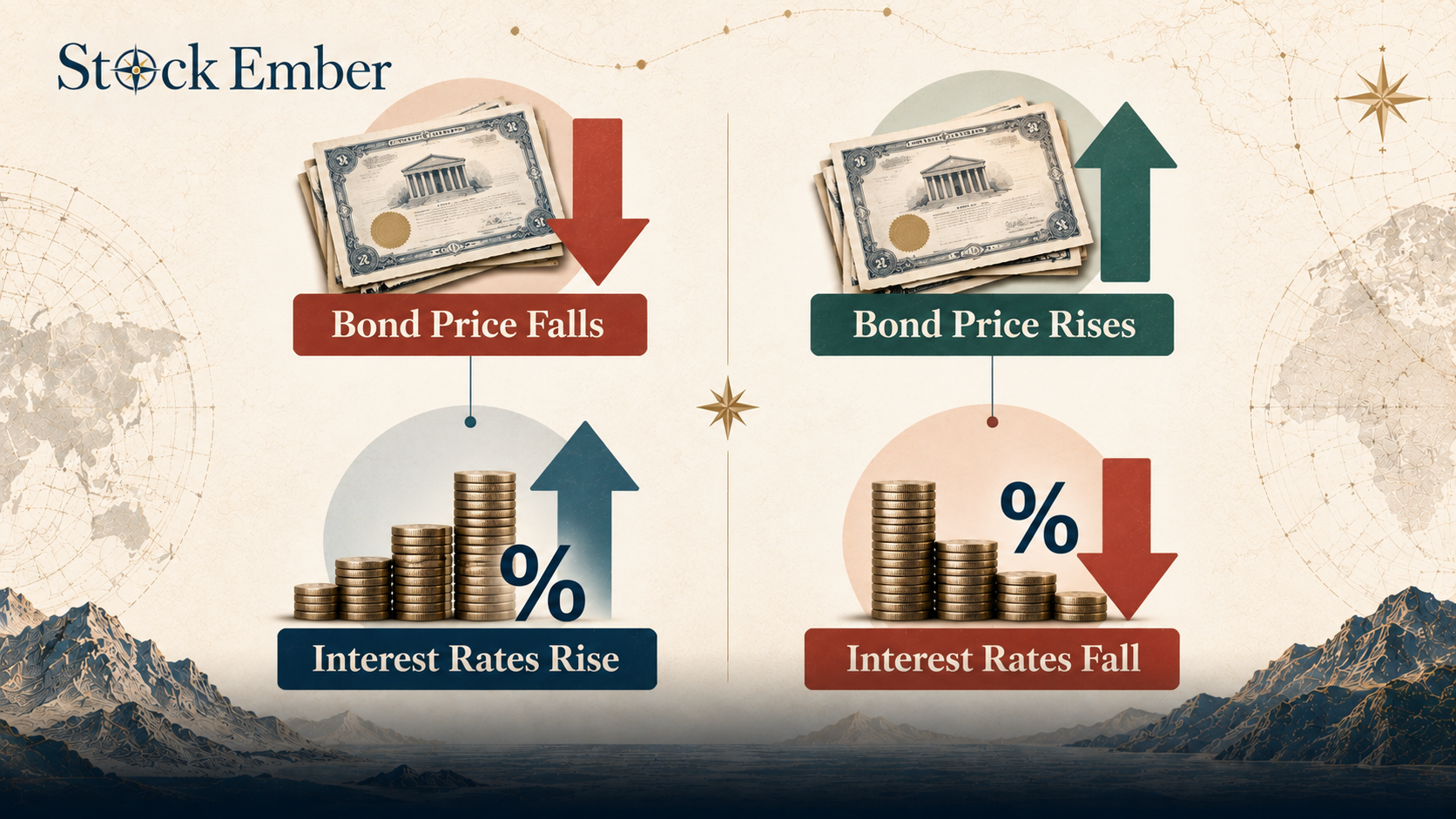
Bond market volatility refers to price fluctuations in fixed-income securities, primarily driven by shifting benchmark interest rates, inflation expectations, and central bank monetary policy. When prevailing interest rates rise, existing bond prices fall to align with higher market yields, while falling interest rates cause existing bond prices to increase.
Bond market volatility is the frequency and magnitude of price fluctuations in fixed-income securities, driven primarily by changing prevailing interest rates, inflation expectations, and central bank monetary policy.
When central banks adjust interest rates, bond prices move in the opposite direction, catching many income-focused investors by surprise. While price drops look alarming on account statements, fixed-income fluctuations behave differently than stock swings. Understanding what drives these price changes helps long-horizon investors manage risk without abandoning their asset allocation during rate cycles.
Quick Takeaways
01Bond market volatility is driven primarily by interest rate movements, inflation trends, and central bank policy decisions.
02Bond prices and yields move in opposite directions, meaning rising interest rates push existing bond prices down.
03Duration measures how sensitive a bond portfolio is to interest rate shifts, with longer maturities experiencing higher price swings.
04Reinvesting higher coupon payments offsets short-term capital declines over multi-year holding periods.
What Is Bond Market Volatility?
Bond market volatility refers to price swings in fixed-income instruments caused by shifting macroeconomic expectations rather than corporate earnings.
While stock market price swings usually depend on company profits, economic growth, and investor sentiment, bond market swings turn on interest rates and inflation forecasts. When investors expect borrowing costs to rise, existing fixed-income assets adjust in price to match new market rates.
Traders track fixed-income uncertainty using the ICE BAML MOVE Index. Similar to how the VIX measures stock market volatility, the MOVE Index measures implied volatility in US Treasury options. Higher MOVE readings reflect greater uncertainty about future central bank policy and interest rate paths.
The Core Engine: Interest Rates, Inflation, and Yields
The primary driver of bond price movements is the inverse relationship between interest rates and bond yields.
When central banks raise benchmark interest rates to slow inflation, newly issued bonds offer higher coupon payouts. As a result, older bonds with lower coupon rates become less attractive. To sell an older bond paying 3% when new bonds pay 5%, the price of the older bond must fall until its effective yield matches market rates. Conversely, when interest rates drop, existing bonds with higher coupons rise in price.
Inflation acts as the catalyst for this process. High inflation erodes the purchasing power of fixed future coupon payments. When inflation rises, investors demand higher yields to compensate for lost purchasing power, triggering rate hikes that ripple across the entire market cycle.
Chart showing the inverse relationship between interest rate changes and bond prices.
Duration: Measuring Portfolio Risk Sensitivity
Duration is a mathematical measurement of how sensitive a bond or bond fund's price is to changes in interest rates.
Expressed in years, duration tells investors roughly how much a bond's price will move for every 1% change in interest rates. For example, if a bond fund has a duration of 6 years, a 1% rise in interest rates causes its price to fall by approximately 6%. Conversely, a 1% drop in rates boosts the fund's price by about 6%.
Longer-term bonds carry higher duration because their cash flows are locked in far into the future. Short-term bonds, maturing in one to three years, carry low duration and experience smaller price swings when rates shift. Official educational guidance from institutions like the Federal Reserve Board emphasizes monitoring duration to manage interest rate exposure across monetary policy shifts.
Individual Bonds vs. Bond ETFs: Understanding Price Swings
Holding individual bonds to maturity guarantees the return of principal, whereas bond funds show daily price mark-to-market fluctuations.
When you buy an individual government or corporate bond and hold it until maturity, intermediate price swings do not change your final payout, assuming the issuer does not default. You receive regular coupon payments and get your full face value back at the end.
Bond ETFs, however, maintain a target duration by continually buying and selling bonds. They mark holdings to market daily, displaying price volatility on your account balance. However, as older bonds mature within the fund, the ETF manager buys newly issued bonds with higher yields. Over time, these higher interest payments increase overall fund income, helping recover capital losses caused by earlier rate hikes.
Common Pitfalls: How Volatility Triggers Panic
Misinterpreting short-term rate fluctuations as permanent capital loss often leads fixed-income investors to make costly portfolio errors:
Confusing Paper Swings With Actual Default: Rate-driven price drops reflect yield adjustments, not corporate default. Selling high-quality bonds during a rate spike turns temporary mark-to-market drops into permanent losses.
Abandoning Bonds Near Rate Peaks: Exiting fixed income after central banks complete aggressive rate hikes cuts off access to peak yields right before prices stabilize.
Succumbing to Emotional Cycles: Giving in to the psychology of a market cycleby abandoning diversified asset allocations during bond drawdowns leaves portfolios exposed to stock market pullbacks.
In practice, many long-term investors find that matching fund duration to their investment timeline prevents panic selling during rate hikes, as rising income distributions offset temporary price drops.
Conclusion
Bond market volatility is an expected feature of interest rate cycles rather than a signal of portfolio failure. While rising rates create short-term price drawdowns, they also create higher yield opportunities for long-horizon investors reinvesting coupon payments.
By paying attention to duration and maintaining a multi-year horizon, buy-and-hold investors can navigate fixed-income price swings with confidence. Understanding how interest rates move bond prices allows you to view volatility as a normal part of asset allocation rather than a reason to exit the market.
When you are ready to evaluate fixed-income options for your portfolio, our ETF reviews offer a clear starting point. Investing involves risk, including the possible loss of principal, and bond price movements vary across interest rate cycles, so treat this guide as educational context rather than personal financial advice.
FAQ
5 questions
What causes volatility in the bond market?
Bond market volatility is primarily caused by changes in benchmark interest rates, shifting inflation expectations, and central bank monetary policy decisions. When economic data suggests interest rates will rise or fall, bond yields adjust immediately, causing secondary market bond prices to fluctuate.
Why do bond prices fall when interest rates rise?
Bond prices and interest rates move in opposite directions. When new interest rates rise, newly issued bonds offer higher coupon payouts than existing older bonds. To attract buyers, the market price of older, lower-paying bonds must decline until their yield matches prevailing market rates.
What is the MOVE index in bond market volatility?
The ICE BAML MOVE Index measures implied volatility in US Treasury options, serving as the fixed-income market's equivalent of the stock market's VIX index. Higher MOVE readings signal elevated uncertainty regarding central bank rate changes and macroeconomic stability.
How does bond duration impact fixed-income volatility?
Duration measures a bond portfolio's price sensitivity to interest rate changes. Expressed in years, a higher duration means greater price fluctuations when rates move. For example, a bond fund with a 6-year duration will fall approximately 6% in price for every 1% increase in benchmark interest rates.
Is bond market volatility lower than stock market volatility?
Historically, broad bond market volatility is significantly lower than stock market volatility. While bonds experience price swings during interest rate shifts, coupon income and contractual principal repayment at maturity provide structural price stability compared to equity markets.
Disclaimer
This guide was written with AI assistance and reviewed by the StockEmber editorial team for accuracy. StockEmber provides independent education, not personal financial advice. Some links may support our work at no additional cost to you.
The StockEmber Team is our in-house desk of independent research writers. We test brokerage platforms, read the fine print on fees and custody, and cover ETFs and long-horizon investing for people who plan to hold for decades — not days.