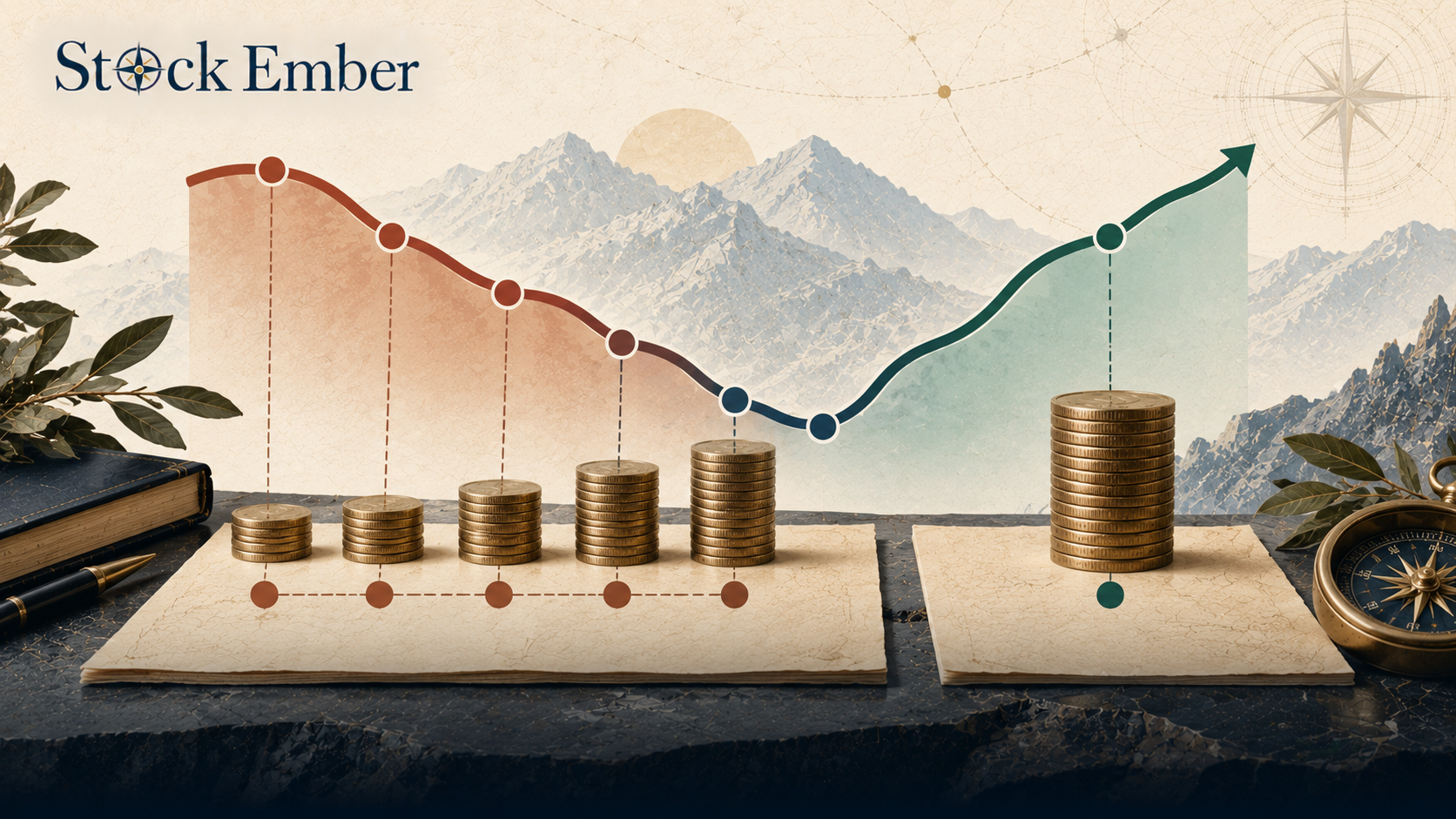
A bear market investing strategy focuses on maintaining long-term discipline during market declines of 20% or more. Key techniques include continuing regular contributions through dollar-cost averaging, rebalancing back to target asset allocations, and holding a dedicated cash reserve to avoid liquidating equities at depressed prices.
Bear market investing strategies focus on preserving capital, maintaining dollar-cost averaging, and rebalancing assets during prolonged stock market declines of 20% or more. These approaches help buy-and-hold investors build resilience without timing market troughs.
Watching your portfolio balance fall during a market drawdown can test the discipline of even experienced investors. When prices drop sharply, fear often drives people to sell at the worst possible time, turning paper losses into permanent capital damage. Understanding how to manage your allocation during these periods keeps your long-term plan on track. This guide covers practical, buy-and-hold methods for managing market downturns and building future wealth.
Quick Takeaways
01A bear market occurs when major stock indices fall 20% or more from recent peak levels.
02Continuing regular contributions through dollar-cost averaging lowers your average share cost over time.
03Portfolio rebalancing restores target asset allocations while purchasing quality assets at reduced valuations.
04Maintaining a dedicated cash buffer prevents forced asset sales during extended market declines.
What Is a Bear Market?
A bear market is defined as a sustained decline of 20% or more in major stock indices from their most recent peak levels. Unlike a market correction, which is a minor pullback between 10% and 19%, a bear market can be associated with broader economic headwinds, shifting investor sentiment, and extended price drops.
According to historical S&P 500 drawdown data compiled by S&P Dow Jones Indices, these drawdowns typically last anywhere from a few months to over a year, with peak-to-trough declines averaging around 35%.
Understanding the broader market cycle is key to setting realistic expectations. During economic downturns, central bank policies shift, influencing borrowing costs, corporate earnings, and valuation multiples. Seeing how interest rates affect the stock market helps explain why equity valuations compress rapidly during these cycles.
For long-horizon investors, the key is distinguishing between paper volatility and permanent loss. Paper volatility is the temporary drop in account values while holding productive assets. Permanent loss happens when an investor sells during a trough or holds speculative assets that never recover.
Core Bear Market Investing Strategies for Buy-and-Hold Portfolios
Managing a market downturn requires structural discipline rather than emotional reactions. Below are four core strategies designed for long-term buy-and-hold portfolios.
1. Maintain Dollar-Cost Averaging (DCA)
Dollar-cost averaging involves investing a fixed sum of money at regular intervals, regardless of market movements. When prices fall, your fixed contribution purchases more shares. When prices rise, it buys fewer.
This systematic process eliminates the urge to time the market, a practice that consistently fails over long horizons. Continuing regular contributions during a drawdown steadily lowers your average cost per share.
2. Practice Disciplined Portfolio Rebalancing
Over time, market drops distort your asset allocation. If equities drop significantly, your portfolio becomes overweight in fixed income or cash. Rebalancing involves selling a portion of outperforming assets (such as bonds or cash) to buy equities back up to your target mix. This disciplined process forces you to sell high and buy low without guessing when market trends will reverse.
3. Maintain a Dedicated Cash Reserve Buffer
The biggest risk during a market decline is being forced to sell equities at depressed prices to pay for personal expenses or unexpected emergencies. Keeping three to six months of living expenses in cash or short-term liquid funds shields your long-term assets. When your income and immediate cash needs are secure, you can hold through market pullbacks without liquidating stock holdings.
4. Focus on Quality and Broad-Market Allocation
Down markets expose weak companies with heavy debt loads and fragile business models. Long-term investors protect their portfolios by tilting toward broad-market index ETFs or high-quality, cash-generative equities. Broad index funds hold hundreds of established companies, ensuring that individual business failures do not destroy your entire nest egg.
Chart showing how dollar-cost averaging buys more shares as stock prices fall
The 10-Year Advantage: Accumulating Assets During Market Drawdowns
While drawdowns are painful in the short term, they provide a powerful compounding engine for long-horizon investors. To see how this works over a ten-year timeline, consider an illustrative example.
Imagine you invest $500 every month into a broad market index ETF. In a steady or rising market, your $500 buys fewer shares as prices rise. However, if a bear market causes prices to fall by 25% over a two-year period, your $500 monthly purchase buys 33% more shares each month during that trough.
Over a 10-year horizon, accumulating these additional shares at lower average prices significantly boosts your total share count. When the market eventually recovers and enters its next expansion phase, those extra shares compound on a larger base. The temporary discomfort of holding through a drawdown transforms into accelerated portfolio growth over the decade that follows.
Common Bear Market Pitfalls to Avoid
Avoiding critical mistakes during market declines is just as important as choosing the right strategy.
Panic Selling at Troughs: Converting unrealized paper declines into permanent capital loss is one of the most common and costly mistakes retail investors make. Selling near market bottoms locks in losses and removes you from the market when recovery begins.
Trying to Time the Market Bottom: Waiting for the absolute bottom before investing again usually leads to missing the sharpest recovery days. Historically, the best market days often occur right after severe declines.
Speculative Drift: Straying from a well-established buy-and-hold strategy into market-shorting, high debt, or options trading introduces extreme downside risk. These complex tactics often lead to capital destruction for individual investors.
Conclusion
Managing a market downturn requires emotional patience, cash flow discipline, and adherence to your overall plan. By continuing regular contributions through dollar-cost averaging, maintaining a protective cash buffer, and systematically rebalancing, long-term investors turn periods of market stress into compounding opportunities.
When you're ready to review low-cost index funds for your target asset allocation, our ETF reviews provide a practical starting point. Investing always involves the risk of capital loss, and past market recoveries do not guarantee future performance, so treat these strategies as foundational concepts for your ongoing financial research.
FAQ
5 questions
What Is the Best Investing Strategy During a Bear Market?
For long-term investors, one of the most effective strategies is maintaining a buy-and-hold approach through dollar-cost averaging and portfolio rebalancing. Continuing periodic contributions allows you to acquire shares at lower valuations, while systematic rebalancing realigns your portfolio with your target risk profile without market timing.
Should you keep dollar-cost averaging in a bear market?
Yes, continuing dollar-cost averaging during a bear market systematically lowers your average cost per share over time. By purchasing fixed dollar amounts at regular intervals, you acquire more shares when prices drop, enhancing your portfolio's compounding potential when markets eventually recover.
How long do bear markets typically last?
Historically, bear markets in major stock indices have lasted anywhere from a few months to over a year, with peak-to-trough declines averaging around 35%. Because predicting the exact market bottom is difficult, long-term investors often focus on maintaining a consistent investment strategy rather than trying to time the market.
What assets hold up best in a bear market?
Defensive sectors such as consumer staples, healthcare, and utilities, along with high-quality dividend equities and cash buffers, tend to exhibit lower downside volatility. However, broad-market index ETFs remain the core foundation for maintaining long-term diversification across full market cycles.
Is a bear market a good time to buy stocks?
For investors with long time horizons and established cash buffers, bear markets offer opportunities to accumulate shares of broad-market index funds at discounted prices. Continuing investments during market declines builds a larger share base that compounds as economic expansion resumes.
Disclaimer
This guide was written with AI assistance and reviewed by the StockEmber editorial team for accuracy. StockEmber provides independent education, not personal financial advice. Some links may support our work at no additional cost to you.
The StockEmber Team is our in-house desk of independent research writers. We test brokerage platforms, read the fine print on fees and custody, and cover ETFs and long-horizon investing for people who plan to hold for decades — not days.