Understanding how do interest rates affect the stock market starts with two forces: borrowing costs and valuation models. Interest rates affect the stock market by changing corporate borrowing costs, shifting discounted cash flow valuations, and altering the yield competition between stocks and fixed-income assets. Higher interest rates increase corporate interest expenses and lower the present value of future earnings, whereas rate cuts lower borrowing costs to encourage business growth.
Interest rates affect the stock market by changing corporate borrowing costs, altering economic expansion speeds, and shifting how investors value future cash flows relative to cash or bonds.
When central banks adjust policy rates, stock prices often move quickly as investors reevaluate earnings growth potential and asset yields. For long-term investors, understanding these economic mechanics helps maintain portfolio discipline through market swings. This guide explains how rate cycles work, why stock valuations adjust, and how to maintain balance across central bank policy shifts.
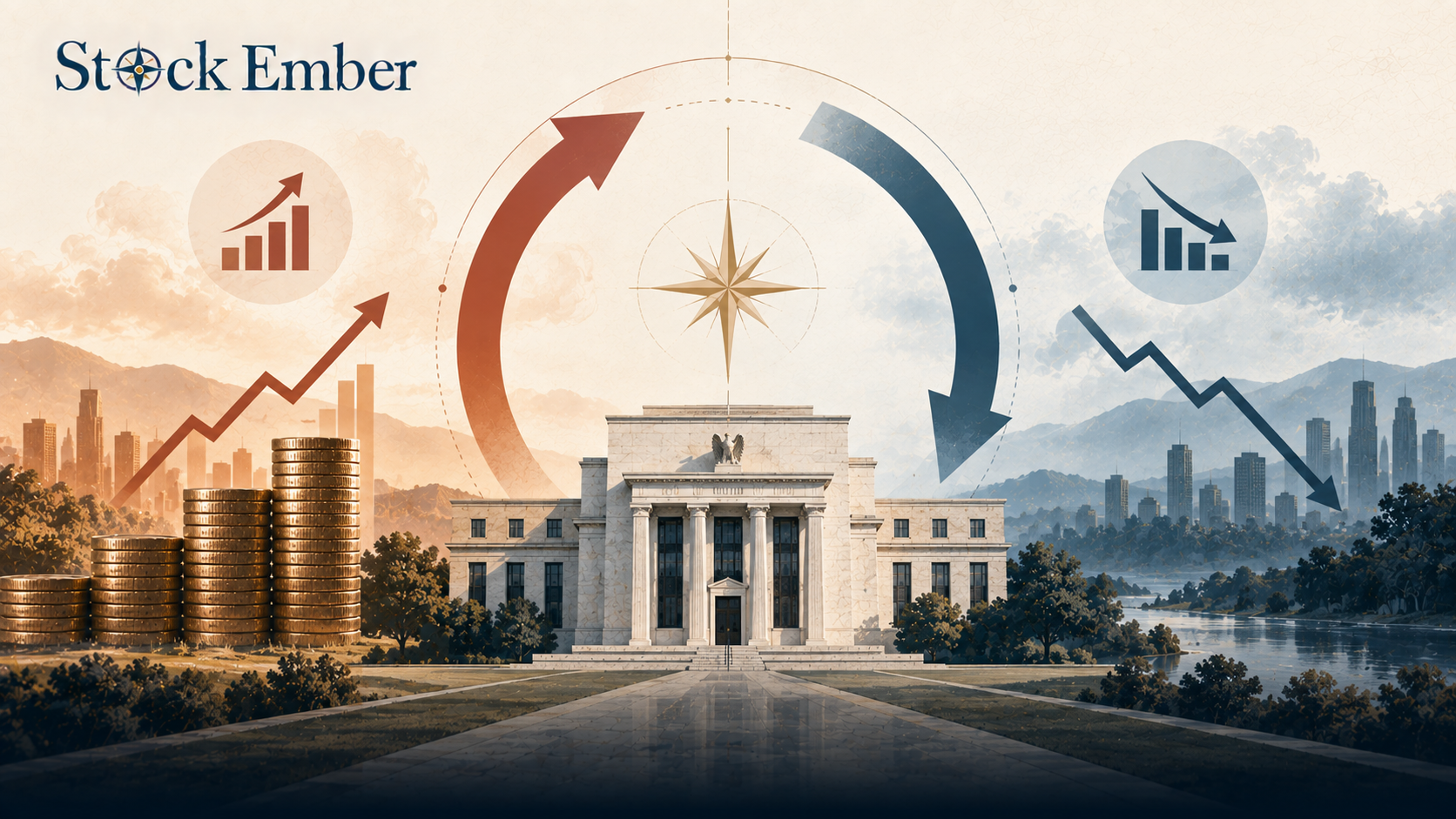
Diagram of central bank rate hikes and cuts during macroeconomic cycles
Quick Takeaways
01Higher interest rates increase corporate debt costs, reducing profit margins and making future cash flows less valuable today.
02Rate cuts lower borrowing costs to encourage economic expansion, which often supports equity earnings and market valuations.
03Growth stocks suffer larger valuation drops during rate hikes, whereas mature value stocks often show stronger cash flow resilience.
04Central bank rate moves do not guarantee immediate stock trends because markets actively price in expected decisions in advance.
What Are Interest Rates and How Do Central Banks Use Them?
Interest rates represent the cost of borrowing money, set at a baseline level by central banks to manage inflation and guide economic momentum.
Controlling Inflation
Central banks set a benchmark policy rate to guide credit conditions across the banking system. When economic activity heats up and inflation threatens purchasing power, central banks raise policy rates. This rate adjustment makes loans for business expansion, real estate, and consumer credit more expensive, slowing spending to cool rising prices.
Stimulating Economic Growth
Conversely, when economic growth stalls, central banks lower policy rates. Cheaper credit encourages businesses to invest and consumers to spend, helping restore economic activity.
Driving the Market Cycle
These central bank adjustments form a core driver of the broader market cycle. To better understand how do interest rates affect the stock market, investors must look at how rates dictate the pace of economic activity and capital flow. Understanding inflation's impact on stock prices helps clarify why central banks intervene so decisively when price stability is threatened. Rate policy is the primary tool used to balance inflation control against economic growth.
How Rising Interest Rates Squeeze Stock Prices
Rising interest rates reduce stock prices by increasing corporate borrowing expenses, shrinking profit margins, and making fixed-income assets more competitive against equities.
When interest rates rise, companies face direct pressure across four financial channels:
Higher Borrowing Expenses: Companies carrying variable-rate debt or refinancing existing corporate bonds face higher annual interest charges. This added cost lowers net earnings, leaving less profit for reinvestment or dividend payouts.
Reduced Consumer Spending: As mortgage payments and loan rates climb, household disposable income drops, directly reducing sales revenues for consumer-facing businesses.
Valuation Compression: Analysts value stocks using discounted cash flow models, calculating the present value of future earnings. The discount rate in these models relies directly on benchmark interest rates. When benchmark rates rise, distant future earnings are worth less in today's dollars, compressing valuation multiples.
Increased Asset Competition: When interest rates sit near zero, cash and government bonds offer negligible returns, driving capital into equities. Higher benchmark rates allow investors to earn fixed yields on low-risk bonds or cash products, creating competition for stock market capital.
In practice, many long-term investors find that market drops during rate hikes reflect shifting sentiment and valuation math rather than immediate operational failure inside underlying businesses.
How Interest Rate Cuts Impact the Stock Market
When evaluating how do interest rates affect the stock market, rate cuts provide a clear example: they generally support stock prices by lowering corporate debt service costs, expanding profit margins, and encouraging capital to shift from cash into growth assets.
When central banks lower benchmark rates, market conditions shift in favor of risk assets:
Lower Debt Service Charges: Companies refinance existing credit at lower rates, expanding net profit margins without needing an immediate surge in sales.
Cheaper Capital Expansion: Businesses finance new hiring, software development, and facilities at lower rates, accelerating long-term growth projects.
Higher Valuation Multiples: Lower discount rates increase the present value of future earnings, lifting equity price multiples.
Capital Flow Out of Cash: Declining yields on short-term bonds prompt investors to move capital back into equity markets seeking higher return potential.
Rate cuts do not always trigger an immediate stock market rally. Central banks often cut rates during economic recessions. If corporate earnings fall rapidly due to weak demand, rate cuts can take several quarters to restore business confidence and stock market performance.
Growth Stocks vs. Value Stocks: How Rate Cycles Drive Sector Returns
Another critical aspect of how do interest rates affect the stock market is sector divergence. Growth stocks and value stocks react differently to interest rate changes due to differences in earnings timing, profit margins, and corporate debt structures.
The structure of a company's financial model determines how rate changes alter its valuation:
Factor
Growth Stocks
Value Stocks
Earnings Profile
Weighted toward future years
Current, steady cash flows
Debt Dependence
Often higher external financing needs
Low to moderate
Discount Rate Sensitivity
High
Low to Moderate
Rate Hike Impact
Greater valuation pressure
Lower price impact, yield competition
Growth companies reinvest capital heavily to build future market share. Because most expected earnings sit far in the future, rising discount rates penalize their present valuations. A higher discount rate significantly reduces what investors pay for future earnings today, according to the Bank for International Settlements (BIS).
Conversely, mature value companies generate steady, current cash flows. Their valuations suffer less from rising discount rates. However, dividend-paying value stocks face yield competition when short-term bond yields match corporate dividend yields.
Common Investor Mistakes During Changing Interest Rate Environments
Investors frequently harm their long-term performance during rate shifts by trying to time central bank actions or overreacting to short-term market noise.
Managing shifting rate environments requires avoiding common behavioral traps:
Attempting Central Bank Market Timing: Trading stocks based on predicted interest rate decisions is difficult. Markets are forward-looking and typically price in rate expectations months before official announcements occur.
Panic Selling During Tightening Cycles: Selling equities during valuation contractions locks in temporary losses and removes capital from subsequent recoveries.
Ignoring Corporate Debt Levels: Assuming all stocks suffer equally during rate hikes is incorrect. Companies with low debt loads and strong balance sheets handle higher borrowing costs far better than heavily leveraged businesses.
Abandoning Portfolio Structure: Shifting an entire portfolio into cash during rate hikes leaves capital exposed to purchasing power loss once central bank policies pivot.
Over complete economic cycles, portfolio success comes from holding broad index assets rather than trading in and out of sectors behind every policy meeting.
Conclusion
Ultimately, understanding how do interest rates affect the stock market reveals that rates shape equity valuations, corporate debt costs, and market sentiment, though they do not control long-term business productivity.
While rising rates squeeze valuation multiples and lower rates encourage expansion, high-quality businesses adapt across economic environments over multi-year horizons. Rather than attempting to trade around central bank decisions or short-term yield swings, long-term investors can build resilience through disciplined diversification and periodic rebalancing.
When you are ready to build a resilient long-term strategy across changing market conditions, exploring our ETF reviews provides a clear starting point for selecting low-cost, broad-market index funds.
Investing always involves risk of loss, and past market reactions to interest rate changes do not guarantee future performance. Use this guide as an educational foundation for your portfolio strategy.
FAQ
5 questions
Do stocks go down when interest rates go up?
Rising interest rates often create short-term downward pressure on stock prices because higher borrowing costs reduce corporate profit margins and increase yields on lower-risk bonds. However, stock prices do not drop automatically, as financial markets frequently price in expected central bank rate hikes months before official policy decisions occur.
Why do interest rate hikes affect tech stocks more than other stocks?
Tech stocks and growth companies rely heavily on future earnings to justify their valuations. Higher interest rates increase the discount rate used to calculate the present value of those distant future cash flows, resulting in larger valuation drops. In addition, growth companies frequently rely more on corporate debt to fund early business expansion.
Do stocks rise when interest rates are cut?
Interest rate cuts generally lower corporate debt service charges and encourage economic expansion, which can support stock prices over time. However, if a central bank cuts rates during a severe economic recession, falling corporate earnings can cause stocks to drop despite lower borrowing costs.
How do interest rates affect high-dividend stocks?
High-dividend stocks face increased competition when interest rates rise because yield-seeking investors can earn competitive returns in low-risk government bonds or cash accounts. As risk-free yields increase, investors may demand higher yields from dividend stocks, driving their share prices down.
How long does it take for an interest rate change to impact the stock market?
Stock markets are forward-looking and adjust quickly to expected rate changes based on central bank guidance. However, the real economic impact of an interest rate change, such as higher corporate debt service charges or reduced consumer spending, typically takes several quarters to fully filter through corporate financial statements.
Disclaimer
This guide was written with AI assistance and reviewed by the StockEmber editorial team for accuracy. StockEmber provides independent education, not personal financial advice. Some links may support our work at no additional cost to you.
The StockEmber Team is our in-house desk of independent research writers. We test brokerage platforms, read the fine print on fees and custody, and cover ETFs and long-horizon investing for people who plan to hold for decades — not days.