A stockbroker is a licensed financial professional or corporate entity authorized to execute buy and sell orders for equities and ETFs on public exchanges. In modern digital markets, traditional human brokers have largely been replaced by execution-only software utilities that route trades automatically without providing personalized advice. For long-term investors, choosing a stockbroker means evaluating execution quality and structural fee drag to protect 10-year portfolio compounding.
A stockbroker is a licensed financial professional or corporate entity authorized to execute buy and sell orders for equities and exchange-traded funds (ETFs) directly on public securities exchanges.
So what is a stockbroker really doing behind the screen when you build a portfolio for long-horizon wealth? This gateway serves as the critical regulatory layer managing your brokerage account. Understanding how this intermediary system executes your orders is essential, as the efficiency of your transactional pipeline determines how much of your capital survives to compound over time. This guide traces the structural evolution of market access, operational expenses, and asset custody frameworks.
Quick Takeaways
01A stockbroker is a regulated execution gateway required by law to route retail buy and sell orders onto public equity exchanges.
02The modern financial landscape has shifted from expensive, human-centric full-service brokers to automated, digital execution-only utilities.
03Selecting the right type of brokerage account establishes your structural fee relationship and baseline market access model.
04Commission-free platforms are not entirely cost-free; hidden frictions like execution slippage, bid-ask spreads, and low cash yields drain value over a ten-year horizon.
05Commission-free platforms are not entirely cost-free; hidden frictions like execution slippage, bid-ask spreads, and low cash yields drain value over a ten-year horizon.
The Evolution of Market Access: A Stockbroker Definition
A stockbroker exists fundamentally to bridge the regulatory and technological gap between individual retail clients and institutional public equity ledgers.
Historically, the term invoked images of human representatives working at physical trading desks, manually processing orders via phone calls to an exchange floor. In modern markets, this infrastructure has evolved into automated, digital execution-only software platforms — services that route your order to an exchange without offering personalized advice. These systems function as pure transactional utilities, executing your exact directives without providing personalized market timing, stock tips, or tactical investment advice. This automation dramatically lowers the barrier to entry, transforming a complex institutional process into a seamless utility for self-directed investors.
Full-Service vs. Discount Brokers: Choosing Your Structural Pipeline
The choice between a full-service broker and a discount broker determines whether you are paying for comprehensive human advisory services or a self-directed digital execution framework.
Feature
Full-Service Broker
Discount / Digital Broker
Advisory support
Dedicated human advisor and bespoke institutional research
Self-directed; no personalized advice
Typical fee model
Asset-under-management (AUM) fee
Low or zero commission per trade
Extra features
Integrated banking, tailored planning
Standardized tools, automated recurring investing
Best suited for
Investors who want hands-on guidance
Patient, self-directed index/ETF investors
Full-service representatives offer high-touch management and integrated banking features, but they accompany these services with significant administrative overhead and AUM fees. For patient investors focusing on low-cost index assets or broad ETFs, automated discount and digital brokerages provide a far more efficient pipeline. The specific type of brokerage account you select within these platforms dictates your baseline access fees, margin availability, and automated recurring investment settings. Aligning this gateway with your personal behavioral framework ensures you don't overpay for structural features you don't require.
How Modern Stockbrokers Process Your Trade Orders
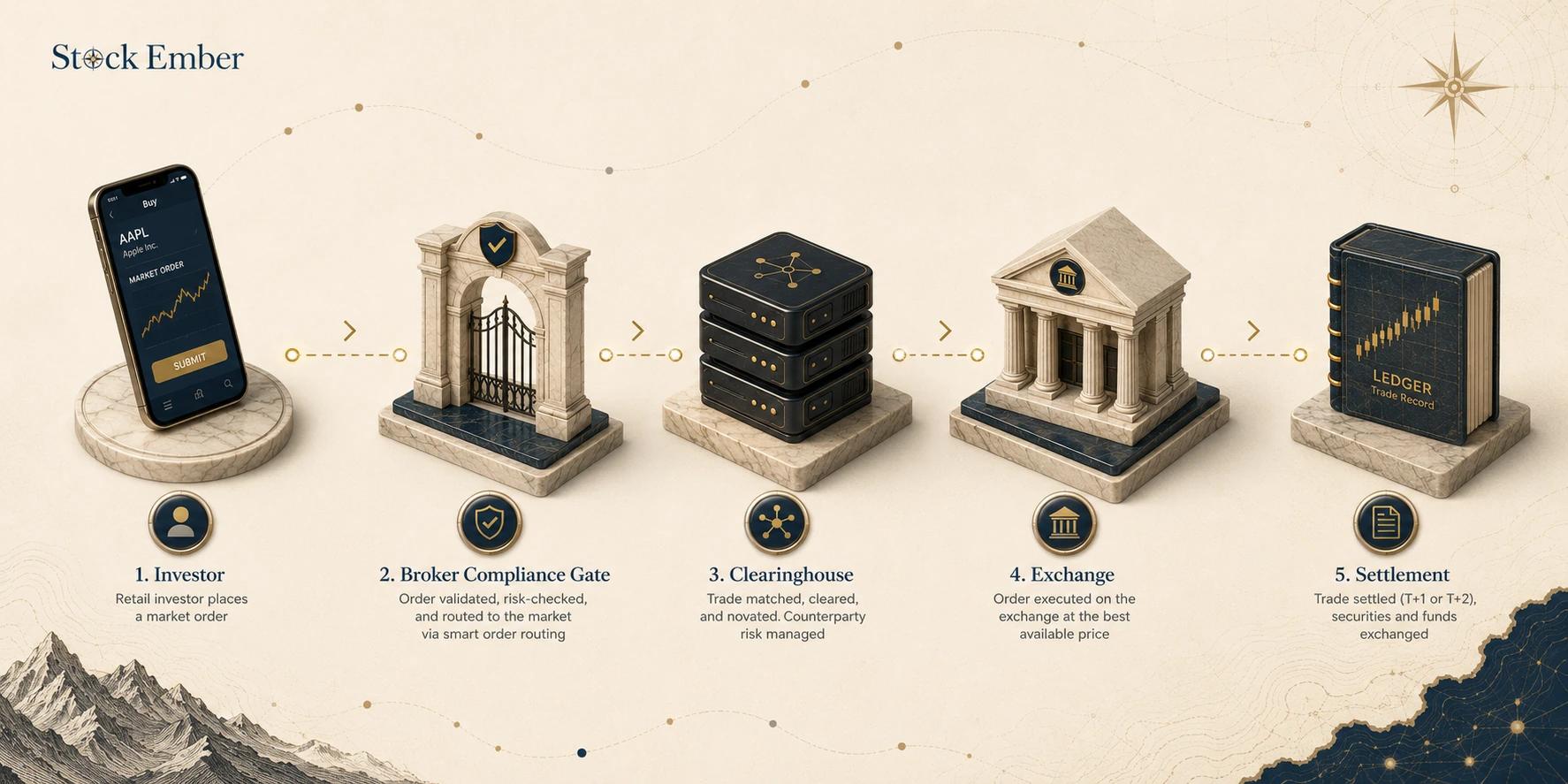
Modern stockbrokers process your trade orders by translating your digital interface request into an institutional format and routing it through clearinghouses — the intermediary organizations that verify and finalize each trade between buyer and seller — for formal settlement.
When you click the execution button on your screen, the front-end user interface passes the instruction to backend institutional frameworks. The broker acts as your agent, directing the trade to public exchanges or to wholesale market makers — firms that buy and sell securities directly from their own inventory to fill your order quickly.
In practice, many long-term investors overlook that electronic execution is separate from legal trade settlement, which under contemporary rules takes one business day — known as the T+1 settlement cycle — before ownership is fully recorded.
During this window, strict asset segregation regulations mandate that the broker-dealer hold your investment capital entirely separate from its own corporate operational ledger, ensuring your assets remain insulated from external counterparty risk.
Diagram showing how a stockbroker routes and settles a stock trade order
The True Cost of an Execution Gateway: A 10-Year Outlook
The true cost of an execution gateway is rarely zero, as modern discount stockbrokers substitute upfront commissions with indirect monetization channels embedded inside the order pipeline.
The rise of "commission-free" trading has removed visible entry friction, but platforms continue to monetize your volume.
One primary channel is the bid-ask spread — the microscopic pricing delta between what buyers offer and what sellers accept. When a broker routes your order through specific wholesale networks, a fractionally wider spread can quietly raise your purchase price per share.
Furthermore, foreign exchange (FX) markup penalties applied when purchasing international assets can add unexpected frictional costs.
For illustration only, a silent execution leakage or minor account fee structure of, say, 0.3% per annum can appear completely trivial on a daily basis, but its long-term consequence is not. On a patient, buy-and-hold portfolio maintained over a 10-year holding timeline, a steady 0.3% structural drag of this kind can quietly siphon away thousands of dollars in cumulative wealth — capital that is permanently stripped from your compounding trajectory. Actual drag will depend on your specific broker's real fee schedule and spread, not the illustrative figure above.
Safeguarding Your Assets: Account Drag and Custody Protections
Safeguarding your assets requires an understanding of how stockbrokers monetize idle account balances and what structural regulatory nets protect your capital during institutional insolvencies.
A widespread industry pitfall is the default settlement cash sweep. Brokers often pay exceptionally low interest yields on uninvested cash resting in your account balance, capturing a highly profitable net interest margin — the difference between the low rate they pay you and the higher rate they earn by lending or investing that same cash — by lending your capital out at prevailing market rates. Managing this cash drag is vital to prevent inflation from eroding your purchasing power while you wait for market opportunities.
Fortunately, underlying asset safety remains robust due to institutional safety nets. In the rare event of intermediary insolvency, regulatory frameworks such as the Securities Investor Protection Corporation (SIPC) provide legal custody protections and facilitate the orderly transfer of segregated client securities to stable, licensed institutions.
Conclusion
A stockbroker is a mechanical infrastructure choice rather than a strategic portfolio planner or financial guide. For the disciplined, long-horizon investor, selecting a transactional gateway requires looking past gamified user interfaces and marketing slogans to evaluate baseline execution quality, hidden pipeline frictions, and transparent custody safety metrics. By optimizing this technical connection to public exchanges, you protect your capital from unnecessary structural degradation. When you are ready to evaluate specific transactional platforms under a strict long-term lens, our broker reviews provide the independent cost breakdowns needed to choose your ideal pipeline.
FAQ
4 questions
What is the primary operational difference between a full-service broker and a discount broker?
Full-service brokers provide personalized advice, portfolio planning, and research for higher fee structures or asset percentages. Discount brokers focus strictly on trade execution, giving self-directed investors digital platform access with lower fees.
How do stockbrokers earn money if trades are advertised as commission-free?
Commission-free brokers generate revenue through interest earned on uninvested customer cash, securities lending programs, margin loan interest, currency conversion markups, and Payment for Order Flow (PFOF) from market makers.
What regulatory registrations should investors check before using a stockbroker?
In the US, investors should verify that a broker is registered with the SEC and FINRA using FINRA’s BrokerCheck tool. In the UK, investors should confirm registration on the FCA Financial Services Register.
Do stockbrokers manage investments or just execute trades?
Standard stockbrokers act as order executors, completing buying and selling instructions initiated by the account holder. Registered investment advisors (RIAs) or discretionary wealth managers provide active ongoing portfolio management.
Disclaimer
This guide was written with AI assistance and reviewed by the StockEmber editorial team for accuracy. StockEmber provides independent education, not personal financial advice. Some links may support our work at no additional cost to you.
The StockEmber Team is our in-house desk of independent research writers. We test brokerage platforms, read the fine print on fees and custody, and cover ETFs and long-horizon investing for people who plan to hold for decades — not days.