A high-yield bond is a corporate debt security issued by a company with a credit rating below investment grade (below BBB- or Baa3). These bonds offer higher coupon interest payments to compensate investors for an increased risk of default or financial restructuring.
A high-yield bond is a corporate debt security issued by a company with a credit rating below investment grade, offering higher interest payouts to compensate investors for elevated credit risk.
When a corporation needs to fund expansion, acquire a competitor, or refinance existing debt but carries a weaker credit profile, standard investors demand higher coupon payments before lending money. These securities, traditionally referred to as "junk bonds", can increase portfolio income, but they carry distinct default risks during economic recessions. This guide explains how high-yield bonds operate, credit rating thresholds, and key risk factors to evaluate.
Quick Takeaways
01High-yield bonds are corporate debt obligations rated below investment grade (below BBB- or Baa3) by major credit rating agencies.
02Issuers pay higher interest rates (coupons) to compensate investors for elevated risks of corporate default or financial restructuring.
03The difference in yield between a high-yield corporate bond and a risk-free government Treasury is known as the credit spread.
04While default rates rise during economic downturns, senior bondholders historically recover a portion of their capital during restructuring rather than suffering a total loss.
What Is a High-Yield Bond?
A high-yield bond is a debt obligation issued by a corporation whose credit rating falls below investment grade, specifically below BBB- from Standard & Poor's and Fitch, or below Baa3 from Moody's.
Credit rating agencies evaluate a company's financial health, debt levels, cash flow predictability, and likelihood of repaying debt. Bonds rated at or above BBB-/Baa3 are classified as "investment grade," representing relatively stable corporate borrowers. Ratings below that threshold, ranging from BB+ down to C or D, are classified as non-investment grade, speculative, or high yield.
Companies issuing high-yield bonds generally fall into two primary categories:
Fallen Angels: Corporations that previously held investment-grade ratings but were downgraded due to business setbacks, falling revenues, or excessive debt accumulation.
Original-Issue Speculative Debt: Younger growth firms, capital-intensive businesses, or companies structured through leveraged buyouts (LBOs) that borrow directly in the speculative-grade market.
High-yield debt represents one specialized segment within the wider selection of types of bonds available in fixed-income markets.
How High-Yield Bonds Work (and the Credit Spread)
To understand what is a high-yield bond in practice, it helps to see how these bonds operate: they pay fixed periodic interest payments (coupons) to investors, with bond prices fluctuating based on corporate creditworthiness, interest rate moves, and broader economic conditions.
Because borrowing companies present higher credit risk, they must offer an interest rate premium above safe benchmark assets. This extra yield is measured through the credit spread.
Credit Spread = High-Yield Bond Yield − Treasury Bond Yield
For example, if a 10-year US Treasury bond yields 4.0% and a high-yield corporate bond index yields 8.0%, the credit spread is 4.0 percentage points (or 400 basis points). When economic conditions are calm, credit spreads tend to narrow as investor confidence grows. During recessions or market stress, credit spreads widen significantly as investors demand greater yield to offset rising default fears.
High-yield bonds also exhibit different interest rate sensitivity compared to government bonds. Because they carry higher coupon payouts and generally feature shorter maturities (often 5 to 10 years), their prices are less sensitive to basic interest rate changes. Instead, shifts in corporate credit spreads drive the majority of high-yield bond price movements.
Official guidelines on corporate debt structures, credit ratings, and payment terms are maintained by investor protection regulators like SEC.gov.
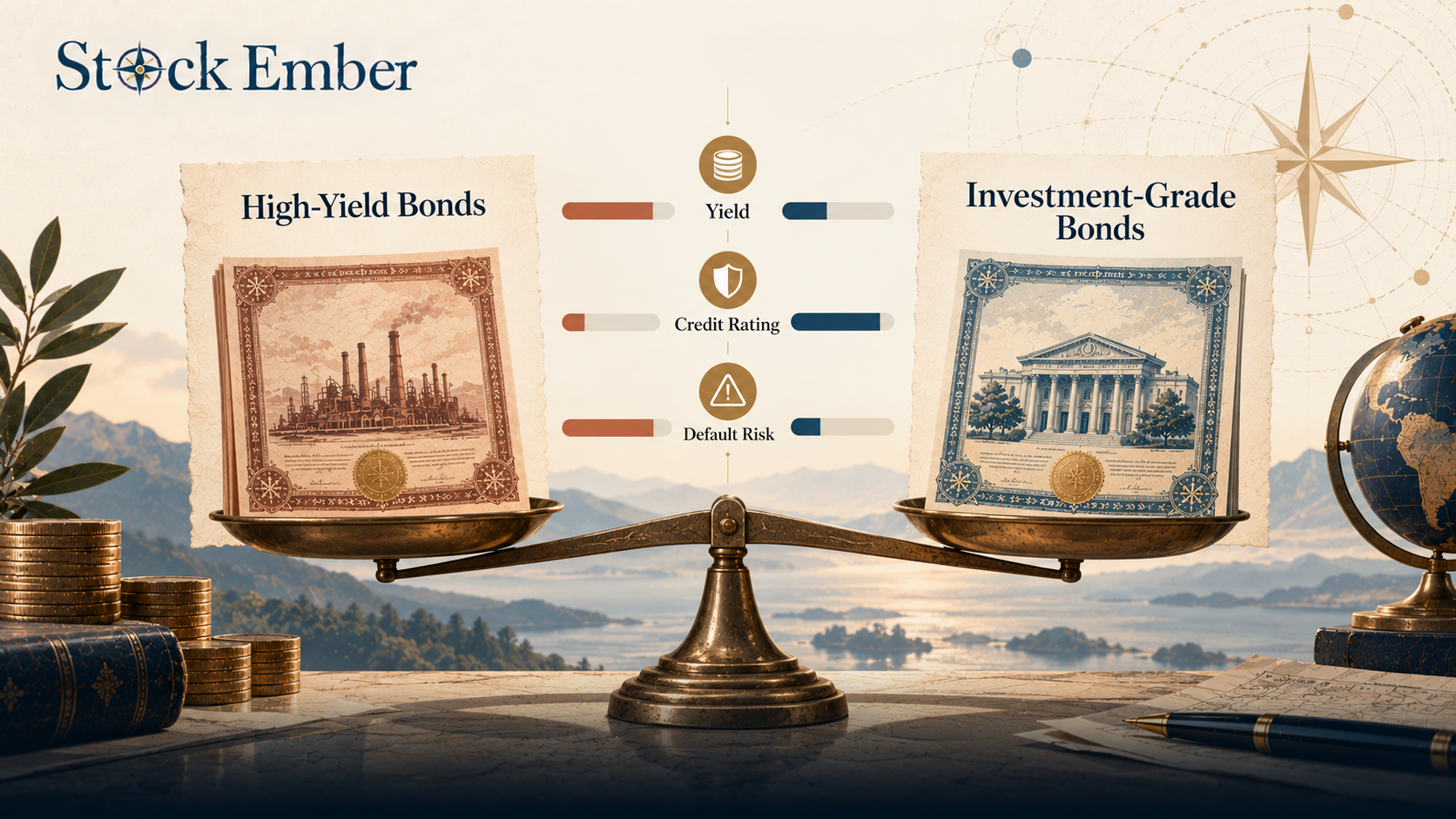
Matrix comparing high-yield and investment-grade corporate bonds.
High-Yield Bonds vs. Investment-Grade Bonds
Comparing high-yield bonds to investment-grade corporate bonds highlights the direct trade-off between higher income yield and increased price volatility.
Feature
Investment-Grade Bonds
High-Yield Bonds
Credit Rating
BBB- / Baa3 or higher
BB+ / Ba1 or lower
Default Probability
Historically low (under 1% annually)
Higher (historically 3%–5% average)
Primary Price Driver
Benchmark interest rate movements
Corporate credit health & economic cycle
Equity Market Correlation
Low
Moderate to high
Investment-grade bonds are held primarily for principal stability and dependable income. High-yield bonds behave more like a hybrid asset class, combining income generation with equity-like price sensitivity during economic shifts.
Because researching individual corporate balance sheets requires specialized credit analysis, many investors gain exposure through a pooled high-yield bond fundrather than buying single corporate bonds.
Key Risks and Pitfalls to Watch
Now that we've covered what is a high-yield bond and how it's priced, it's worth examining the risks: while elevated coupon rates attract income-focused investors, high-yield bonds carry credit default risk, economic cycle vulnerability, and call provisions that can erode total returns.
Default risk is the primary concern. A default occurs when a corporate borrower fails to make scheduled interest or principal payments. However, a default does not automatically mean a total loss of principal. Official investor resources from FINRA note that senior debt holders often recover 30% to 40% of face value through bankruptcy reorganizations.
Evaluating returns over a 10-year holding period requires accounting for credit default drag:
Gross Coupon Yield: 8.0%
Annualized Default Rate: 3.5%
Recovery Rate on Defaulted Debt: 40%
Net Default Loss: 3.5% × (1 − 0.40) = 2.1% per year
Over ten years, credit default losses and fund management fees reduce gross yields to a lower net return. Understanding this drag prevents investors from treating headline yields as guaranteed income.
Economic cycles also heavily influence high-yield prices. During recessions, corporate revenues fall, default rates rise, and high-yield bond prices drop alongside stock markets. Finally, many high-yield bonds carry call options, allowing issuers to pay off debt early if market interest rates fall or corporate credit improves.
In practice, many long-term income investors view high-yield debt not as a safe substitute for Treasuries, but as an income-heavy hybrid asset that requires disciplined credit diversification.
Conclusion
High-yield bonds deliver higher income distributions by taking on credit risk from corporate issuers rated below investment grade. By evaluating credit spreads, default recovery rates, and economic cycle sensitivity, long-term investors can determine how non-investment grade debt fits into their broader allocation strategy.
When you are ready to evaluate pooled fund options, our ETF reviews provide a detailed look at low-cost options, index tracking, and portfolio construction. Investing always involves risk, including the loss of principal, so treat this guide as educational research rather than individual financial advice.
FAQ
5 questions
What credit rating defines a high-yield bond?
A high-yield bond carries a credit rating below investment grade, specifically lower than BBB- from Standard & Poor's and Fitch, or lower than Baa3 from Moody's. Ratings in the BB, B, CCC, or lower tiers signify speculative credit quality.
Are high-yield bonds the same as junk bonds?
Yes. The terms "high-yield bond" and "junk bond" refer to the exact same asset class: corporate debt rated below investment grade that pays elevated coupon yields to balance higher credit risk.
What happens when a high-yield corporate bond defaults?
When an issuer defaults, scheduled interest or principal payments stop. However, senior bondholders usually do not suffer a 100% loss; historically, they recover approximately 30% to 40% of the bond's face value through bankruptcy reorganizations.
Why do high-yield bond prices drop during economic recessions?
During economic downturns, corporate revenues decline and default concerns increase. This causes credit spreads to widen significantly, driving down high-yield bond prices as investors demand higher yields to hold speculative debt.
How does a high-yield bond differ from an investment-grade bond?
Investment-grade bonds are issued by financially stable corporations with low default probabilities and lower interest yields. High-yield bonds carry higher default risks, offer higher interest payments, and behave with higher correlation to equity markets.
Disclaimer
This guide was written with AI assistance and reviewed by the StockEmber editorial team for accuracy. StockEmber provides independent education, not personal financial advice. Some links may support our work at no additional cost to you.
The StockEmber Team is our in-house desk of independent research writers. We test brokerage platforms, read the fine print on fees and custody, and cover ETFs and long-horizon investing for people who plan to hold for decades — not days.