When evaluating time in the market vs timing the market, time in the market refers to maintaining continuous exposure to broad index assets, whereas timing the market attempts to predict short-term price swings. Decades of data show continuous exposure yields superior results by eliminating tax drag, fees, and the risk of missing top trading days.
Time in the market means maintaining continuous, long-term exposure to broad market index funds, whereas timing the market involves jumping in and out of assets to predict short-term price tops and bottoms.
Many investors waste significant energy trying to guess when the stock market will rise or crash. Attempting to time price swings frequently leads to cash drag, unexpected tax bills, and missed compounding days. Broad-market buy-and-hold strategies trade the stress of market timing for systematic exposure, helping disciplined investors capture economic expansion over long horizons.
Understanding why continuous exposure outperforms market prediction is essential for constructing a stress-free portfolio.
Quick Takeaways
01Time in the market focuses on long-term compound growth by holding diversified index assets through normal market cycles.
02Timing the market requires predicting both the exact moment to sell before a decline and the exact moment to buy back in before a rally.
03Missing just a handful of the stock market's best-performing trading days can severely degrade total portfolio returns over a decade.
04Dollar-cost averaging removes the anxiety of timing price entry points by automating regular investments over time.
What Is Market Timing (and Why Is It Hard)?
Market timing is an active investment strategy where an investor attempts to predict short-term price movements to buy at market lows and sell at market highs. While the concept sounds appealing, successfully timing the market requires making two consecutive, precise predictions every single cycle: knowing exactly when to exit before a downturn and knowing exactly when to re-enter before a recovery.
In practice, timing the market introduces substantial friction that quietly erodes wealth. When you move capital into cash to wait for a price drop, that cash earns minimal yield while inflation erodes its purchasing power. Furthermore, frequent trading triggers short-term capital gains taxes and transaction costs.
Because short-term price movements are driven by unpredictable economic news and investor sentiment, consistent market timing remains statistically improbable for retail and professional investors alike, as evidenced by persistence data from the SPIVA (S&P Indices Versus Active) Scorecard.
Because short-term price movements are influenced by unpredictable economic news and investor sentiment, consistently timing market exits and re-entries is extremely difficult, even for professional investors.
What Is Time in the Market?
Time in the market is a passive, buy-and-hold strategy centered on purchasing broad-market assets and holding them across multi-year or multi-decade horizons. Instead of trying to guess daily price fluctuations, this approach relies on the long-term upward trajectory of broad corporate earnings, productive capital, and dividend reinvestment.
When you practice what is passive investing, you accept that short-term volatility is a normal feature of equity ownership. By remaining invested during both market rallies and temporary pullbacks, your capital benefits from uninterrupted compound interest. Over long periods, overall market expansion historically outweighs short-term price drops, turning duration into an investor's greatest structural advantage.
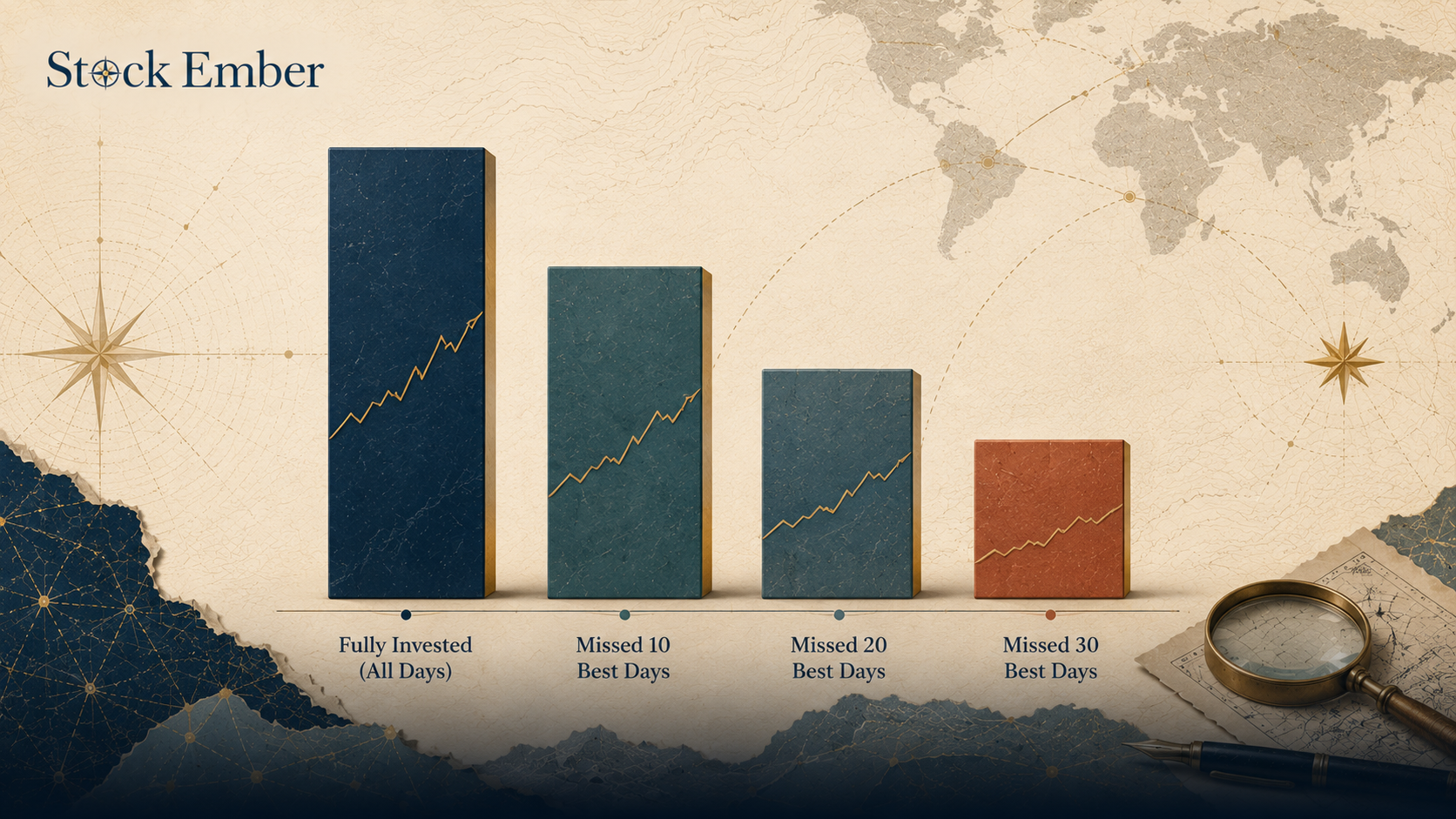
Chart showing the portfolio return penalty from missing the market's best trading days.
The High Cost of Missing the Market's Best Days
The primary risk of sitting in cash to wait for a crash is the permanent damage caused by missing the stock market's strongest trading days. Historical stock market analysis from J.P. Morgan Asset Management shows that equity returns are heavily concentrated in a surprisingly small number of single-day trading surges.
The figures below are a hypothetical illustration based on historical S&P 500 index data and are not a guarantee of future performance; actual results will vary, and all investing carries the risk of loss.
Fully Invested (20-Year Horizon): A hypothetical $10,000 investment in a broad S&P 500 index fund held continuously over 20 years grows significantly, delivering strong annualized compounding.
Missing the 10 Best Days: Missing just the 10 best-performing days over that entire two-decade period reduces total portfolio returns by roughly half.
Missing the 30 Best Days: Missing the 30 best days cuts the final portfolio value by more than 70%.
Crucially, historical data reveals that market timing fails because the best trading days almost always occur during severe bear markets frequently within days or weeks of the worst market drops. Investors who panic and exit to cash during a market crash usually miss the initial rebound, permanently locking in paper losses.
Dollar-Cost Averaging: Solving "When to Invest"
For many beginners, deciding when to invest fresh savings creates intense decision paralysis out of fear of buying right before a market drop. Dollar-cost averaging (DCA) solves this friction by replacing market timing with a simple, automated routine.
Instead of deploying a lump sum all at once or sitting in cash waiting for a market correction, dollar-cost averaging involves investing a fixed dollar amount on a regular schedule such as monthly or bi-weekly regardless of market headlines. When prices are high, your fixed contribution buys fewer shares; when prices drop during market pullbacks, your contribution automatically buys more shares at lower prices.
This mechanical process takes emotion out of the equation and ensures capital enters the market systematically.
Common Pitfalls: When "Time in the Market" Fails
While staying invested is a proven long-term framework, investors must avoid misinterpreting the strategy. Holding assets blindly without proper diversification or discipline can still lead to poor financial outcomes:
Applying "Time in the Market" to Single Speculative Stocks: Holding a single company's stock through years of decline does not guarantee a recovery. Individual companies can go bankrupt or suffer permanent fundamental deterioration. Time in the market works because broad market index ETFs hold hundreds of profitable companies, ensuring that failed firms are automatically replaced by growing ones.
Panic Selling During Drawdowns: The strategy fails if an investor holds through quiet periods but panics and sells during a 20% or 30% market correction. Converting temporary market fluctuations into permanent cash losses defeats the purpose of buy-and-hold investing.
Ignoring Personal Horizon and Cash Needs: Remaining 100% invested in volatile equities when you need money for a short-term goal (such as a home purchase within two years) exposes essential cash to sequence-of-returns risk.
In practice, many long-term investors find that checking portfolio balances daily during volatile market cycles creates unnecessary anxiety. Setting up automated contributions into broad index funds and turning off financial news channels helps maintain the emotional discipline required to let compounding work over decades.
Conclusion
When it comes to time in the market vs timing the market, staying invested wins because long-term economic growth is far more predictable than short-term price movements. Attempting to guess market peaks and troughs exposes investors to cash drag, higher taxes, and the severe penalty of missing the market's strongest trading days.
By automating regular contributions into broad-market index vehicles, you eliminate prediction stress and let time and compounding build lasting wealth. When you're ready to select the core funds for your long-term portfolio, exploring our ETF reviews is a practical next step.
FAQ
5 questions
Is time in the market always better than timing the market?
For the vast majority of long-term investors holding broad index funds, yes. Decades of historical market performance show that broad market benchmarks trend upward over multi-year horizons, whereas active market timing consistently fails due to trading costs, tax friction, and the statistical difficulty of predicting short-term price movements.
What happens if you miss the 10 best days in the stock market?
Missing just the 10 best-performing trading days over a 20-year period can reduce total portfolio returns by roughly half compared to staying fully invested. Because the best trading days typically occur in the middle of volatile bear market drawdowns, sitting in cash during pullbacks often severely degrades long-term compounding.
Does "time in the market" work for individual stock picking?
No, the principle of time in the market applies specifically to broad, diversified market indices and index ETFs, not single speculative stocks. Individual companies can face permanent business failure or bankruptcy, whereas broad index funds mitigate single-stock failure risk by holding hundreds of leading firms simultaneously.
How does dollar-cost averaging help avoid market timing?
Dollar-cost averaging (DCA) automates investments by deploying a fixed dollar amount into broad index funds on a regular schedule, regardless of market headlines. This systematic routine eliminates the urge to guess market tops or bottoms, ensuring you automatically buy more shares when prices drop and fewer when prices rise.
Why is market timing so difficult to execute successfully?
Market timing requires making two accurate predictions during every market cycle: knowing precisely when to sell before a decline and when to buy back in before a rebound. Because major market rallies often happen suddenly during economic downturns, investors who exit to cash usually miss the initial recovery.
Disclaimer
This guide was written with AI assistance and reviewed by the StockEmber editorial team for accuracy. StockEmber provides independent education, not personal financial advice. Some links may support our work at no additional cost to you.
The StockEmber Team is our in-house desk of independent research writers. We test brokerage platforms, read the fine print on fees and custody, and cover ETFs and long-horizon investing for people who plan to hold for decades — not days.