The summer doldrums refer to a recurring seasonal slowdown in stock market trading volume during July and August. This decline occurs as institutional investors take vacations and corporate news cycles slow down, leading to lower market liquidity.
The summer doldrums describe a seasonal period in July and August when stock market trading volume slows down significantly. During these weeks, major equity indices often post their thinnest trading days of the calendar year.
If you check your portfolio during mid-August, you might notice that trading activity feels unusually quiet or that minor news causes surprisingly sharp price movements. This seasonal lull happens every year across global markets. Understanding the summer doldrums in the stock market helps long-term investors distinguish between temporary seasonal noise and meaningful shifts in business fundamentals.
Quick Takeaways
01The summer doldrums refer to a predictable seasonal drop in market trading volume during July and August.
02Reduced trading activity is caused by institutional fund manager vacations, sparse earnings schedules, and light news flow.
03Thin trading volume can widen bid-ask spreads and cause temporary price swings on individual stocks.
04Long-term investors benefit from staying the course rather than trying to time seasonal volume fluctuations.
What Are the Summer Doldrums in the Stock Market?
The term "summer doldrums" refers to the low-volume trading environment that typically takes over financial markets in late summer.
Why is stock market volume low in August? The primary driver is human behavior at institutional financial firms. Large institutional investors such as pension funds, mutual funds, and hedge funds account for the vast majority of daily stock market transactions. During July and late August, many fund managers, institutional traders, and equity analysts take summer vacations. When key decision-makers are away from their trading desks, institutional order flow declines sharply.
In addition to vacation schedules, the corporate calendar naturally cools down. The second-quarter earnings season wraps up by late July, creating an information lull where companies release fewer financial reports and major announcements. With fewer catalysts and less institutional money moving around, total daily shares traded across major exchanges drop. Trading activity generally returns to normal levels in early September, when market participants return from summer breaks, corporate earnings preparation begins, and institutional capital re-enters the market.
Historical Patterns: How Major Indices Perform in August
Historical market data shows that low summer volume does not mean stock prices are guaranteed to fall or rise.
A common question among beginners is whether the stock market usually goes up or down in August. Historically, performance during the month has varied widely across different economic cycles. In some years, quiet August markets drift higher on light trading. In other years, thin market liquidity amplifies unexpected economic news, leading to sharp pullbacks.
Many market participants associate the summer slowdown with the old Wall Street phrase, "Sell in May and go away." This adage implies that investors should exit the stock market in late spring and return in autumn. However, historical tracking demonstrates that trying to time the market around seasonal volume dips is unreliable. Missing a few strong trading days in August can meaningfully reduce long-term portfolio growth, a pattern that long-term performance research consistently highlights. While August historically experiences higher price fluctuation compared to quieter months, low trading volume itself is an operational condition rather than a signal that a market downturn is imminent.
How Lower Volume Impacts Index Swings and Single-Stock Volatility
Lower trading volume impacts price stability by reducing the number of active buyers and sellers in market order books.
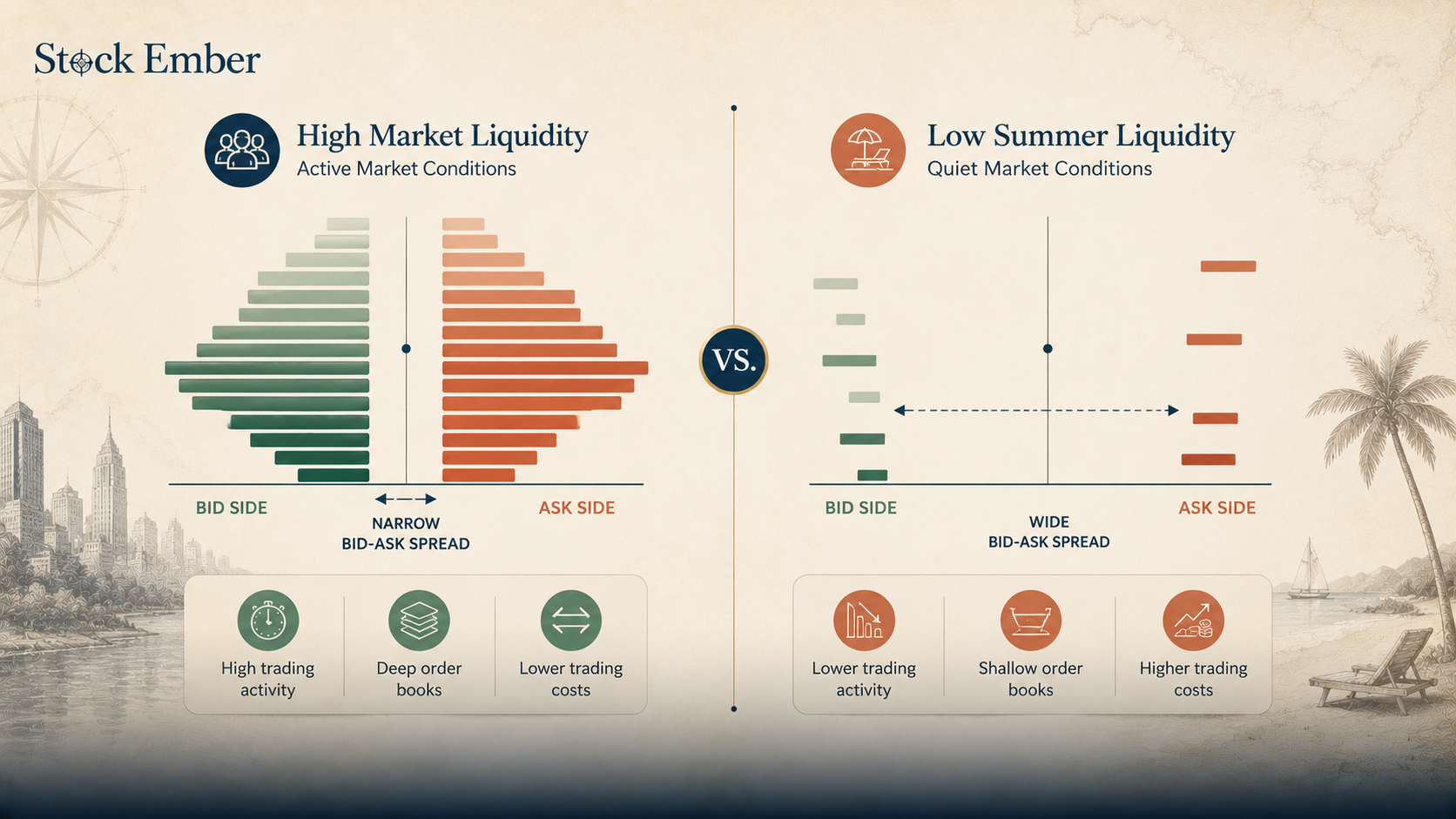
When trading volume drops, market liquidity decreases. Liquidity represents how easily an asset can be bought or sold without changing its market price. In a high-volume environment, thick order books mean that large orders are absorbed smoothly with minimal price movement. However, during thin summer trading, fewer limit orders sit waiting at various price points.
This lack of market depth affects broad indices and individual stocks differently:
Broad Index Swings: Major benchmark indices may experience wider daily price swings on days when unexpected economic data or central bank statements arrive, as fewer institutional trades exist to absorb the news.
Single-Stock Volatility: Individual company stocks, especially mid-cap or small-cap shares, can experience exaggerated price spikes or dips on small news announcements or modest trade sizes.
Additionally, reduced trading activity often causes bid-ask spreads to widen. The bid-ask spread is the difference between the highest price a buyer is willing to pay and the lowest price a seller is willing to accept. When spreads widen, execution friction increases slightly for anyone trading during thin market windows.
Diagram illustrating how thin trading volume widens bid-ask spreads during summer doldrums
What Thin Summer Volume Means for Long-Term Investors
For investors holding positions through the summer, thin trading volume is a temporary operational backdrop rather than a fundamental change in business value.
When viewing daily account balances during late August, seeing erratic price movements can feel unsettling. However, it is essential to distinguish between market price fluctuations driven by thin order books and true changes in a company's underlying financial health. A sudden drop in a stock price on low trading volume often reflects a temporary lack of active buyers rather than deteriorating company fundamentals.
In practice, many long-term investors find that checking portfolio valuations less frequently during July and August helps prevent emotional decision-making. Recognizing that thin summer markets magnify minor news prevents premature selling during temporary price dips.
Holding quality stocks and broad index funds through low-volume periods allows your portfolio to stay fully invested for compound growth. Exiting positions to avoid summer quiet periods creates transaction costs, potential taxable events, and the risk of missing market recoveries.
Practical Tips for the Season: Navigating Low Summer Liquidity
Navigating low summer market liquidity requires operational discipline and patience rather than active portfolio repositioning.
Key guidelines for managing positions
Avoid Overtrading Illiquid Stocks: If you purchase individual shares during August, be aware that smaller companies with low average daily volume can experience larger execution slippage.
Exercise Caution with Tight Stop Orders: Setting tight automated stop-loss orders in thin markets can be risky. Temporary liquidity gaps can trigger your sell order at an artificially depressed price before the market stabilizes.
Maintain Automated Dollar-Cost Averaging: Is August a good month to invest? For long-term investors, August is as good as any other month to stick to a regular investment schedule. Consistently buying shares through automated contributions neutralizes short-term price noise.
Focusing on foundational concepts in stocks and investing basics ensures your strategy remains grounded in business fundamentals rather than short-term market conditions.
Conclusion
The summer doldrums represent a normal, recurring period of lower trading volume driven by seasonal institutional vacations and lighter corporate news flow. While thin summer order books can widen bid-ask spreads and trigger brief price volatility, these fluctuations do not alter the underlying strength of quality long-term investments. Staying invested through quiet seasonal periods protects your long-term compound gains from execution friction and market-timing errors.
When you are ready to evaluate core investment options for a long-term portfolio, our ETF reviews provide a clear place to start your research.
Investing always involves risk to your capital and past market performance does not guarantee future results, so treat this guide as an educational foundation for your personal financial research.
FAQ
4 questions
Why is stock market volume low in August?
Stock market volume drops in August primarily because institutional fund managers, traders, and equity analysts take summer vacations. Furthermore, corporate news cycles slow down after second-quarter earnings reports finish, leading to fewer corporate announcements and daily market catalysts across major exchanges.
Does the stock market usually go up or down in August?
The stock market does not follow a guaranteed directional pattern in August. Historically, equity index returns during August have varied widely depending on broader economic trends. While lower trading volume can lead to wider price swings, quiet summer markets can drift higher or experience pullbacks on thin liquidity.
Is August a good month to invest?
August is as suitable for investing as any other month for long-term investors. Attempting to time market entries around seasonal volume dips is historically unreliable and can lead to missed returns. Sticking to a disciplined, automated dollar-cost averaging strategy remains effective regardless of seasonal volume changes.
When does trading volume return to normal after summer?
Trading volume typically returns to normal levels in early September. As institutional market participants return from summer breaks, central bank schedules resume, and corporations prepare for third-quarter earnings releases, overall trading activity and market liquidity increase across major exchanges.
Disclaimer
This guide was written with AI assistance and reviewed by the StockEmber editorial team for accuracy. StockEmber provides independent education, not personal financial advice. Some links may support our work at no additional cost to you.
The StockEmber Team is our in-house desk of independent research writers. We test brokerage platforms, read the fine print on fees and custody, and cover ETFs and long-horizon investing for people who plan to hold for decades — not days.