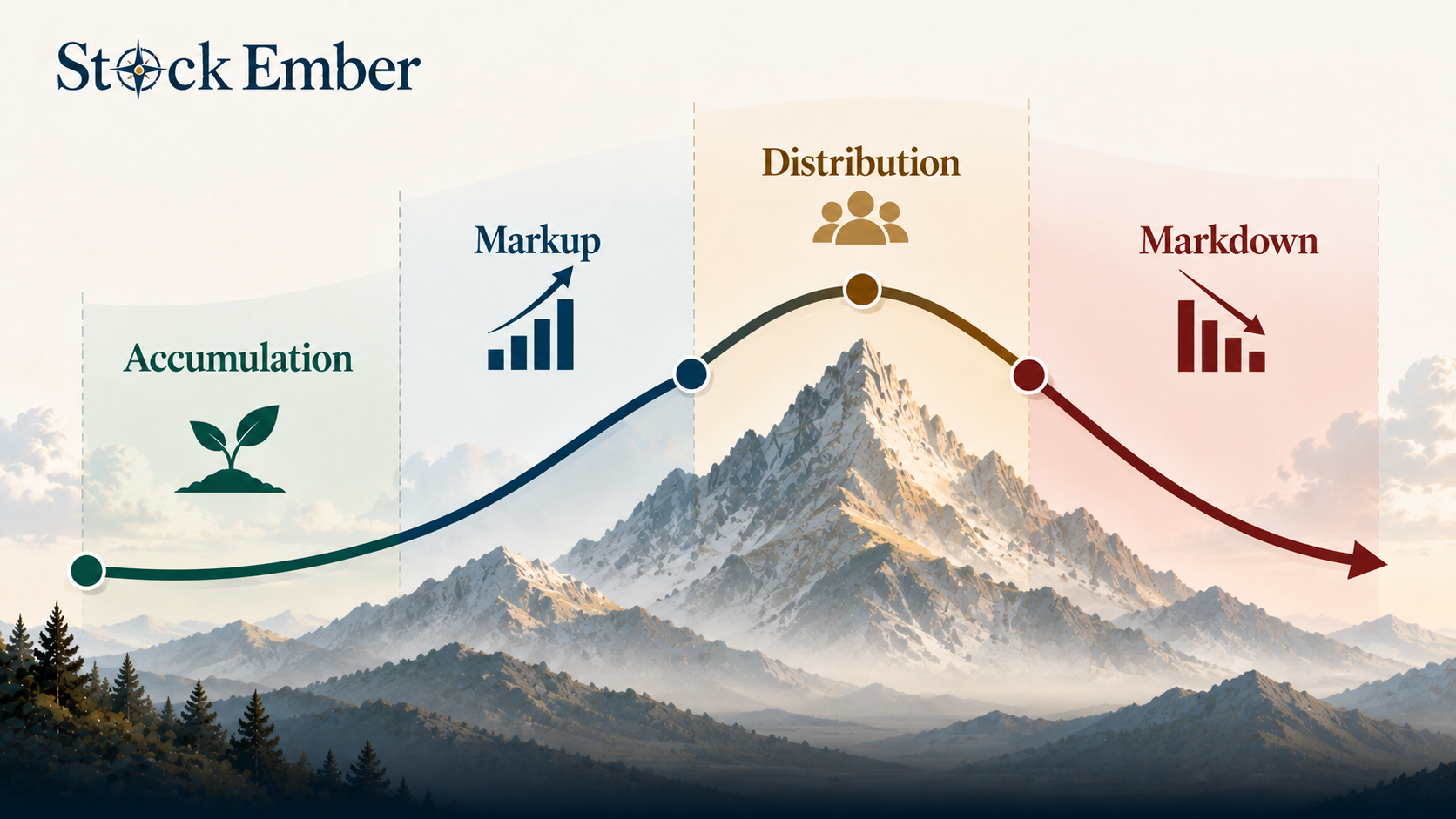
A stock market cycle is the long-term movement of stock prices through four recurring phases: accumulation, markup, distribution, and markdown. These phases reflect changing corporate earnings, interest rate expectations, and investor sentiment over time. Because equity markets are forward-looking, stock market cycles often turn before official economic data reflects a recovery or slowdown.
This cyclical pattern reflects the long-term price movement of stocks through recurring expansion and contraction phases. It is driven by changing corporate profits, interest rates, and investor expectations.
Watching stock prices swing up and down can tempt anyone to sell in a panic or buy out of fear. Understanding how these price swings repeat helps long-term investors stay disciplined through temporary downturns. This guide breaks down how cycles work, the four key phases, and how to avoid costly timing mistakes.
Quick Takeaways
01Stock market cycles move through four recurring stages: accumulation, markup, distribution, and markdown.
02These cycles lead the real economy because stock prices reflect forward-looking expectations rather than lagging economic data.
03Central bank interest rates and corporate earnings growth are the primary drivers of cycle shifts.
04Attempting to time market cycles often leads to missing the strongest recovery days, reducing 10-year portfolio returns.
What Is a Stock Market Cycle?
A stock market cycle represents the broad rise and fall of equity prices over time. Stock markets rarely move in a straight line. Instead, they swing between extended periods of optimism and periods of pessimism. Over full cycles, these price movements reflect how investors evaluate business growth, borrowing costs, and economic stability.
It is essential to distinguish between this pattern and an economic business cycle. An economic business cycle tracks actual economic output. It is measured by official figures such as gross domestic product (GDP), employment levels, and manufacturing output. Because official economic reports record past activity, economic cycles are backward-looking.
In contrast, a market cycle is forward-looking. Stock prices reflect what investors expect corporate earnings and interest rates to look like six to twelve months into the future. Educational guidelines from the U.S. SEC emphasizes how markets price in future risk and growth long before official data confirms them.
Because stock markets look ahead, market cycles often bottom and begin recovering while economic headlines remain negative. Likewise, stock markets can reach a peak and start falling while current economic data still appears strong.
The 4 Market Cycle Stages
Every full market cycle contains four distinct market cycle stages. Each phase reflects shifting balances between buyers and sellers, as well as changing investor sentiment.
Diagram of the four stock market cycle stages from accumulation to markdown.
1. Accumulation Phase
The accumulation phase occurs after a market decline. Prices have hit bottom, and general news sentiment remains negative. During this stage, institutional investors quietly begin buying undervalued shares. Price movements remain relatively flat because general retail investor enthusiasm is still low.
2. Markup Phase (Bull Market)
In the markup phase, stock prices begin moving consistently higher. Company earnings improve, credit conditions loosen, and investor confidence returns. As broader participation grows, price momentum builds, creating extended bull and bear markets conditions.
Historically, bull market phases last significantly longer than bear market contractions – according to Hartford Funds, average S&P 500 bull markets have lasted around 3 to 5.5 years, compared to just 9.5 to 14 months for bear markets.
3. Distribution Phase
The distribution phase marks the cycle peak. Investor optimism reaches high levels, and financial headlines are overwhelmingly positive. Behind the scenes, early investors begin selling their holdings to late-arriving buyers. Price volatility increases, but overall market upward progress stalls as buying pressure equals selling pressure.
4. Markdown Phase (Bear Market)
The markdown phase is the final stage of the cycle, commonly known as a bear market. Stock prices decline rapidly as negative earnings or macroeconomic news accumulates. Panic selling often increases near the bottom of this phase, right before the next accumulation phase begins.
In practice, many long-term investors find that the distribution peak feels like the safest time to buy, while the accumulation phase feels the most dangerous. Recognizing this emotional trap is often key to maintaining portfolio discipline.
What Drives Stock Market Cycles?
Stock market cycles do not follow fixed calendar dates. Instead, they shift in response to macroeconomic changes and investor psychology.
Central Bank Policy and Interest Rates
Interest rates act as gravity on stock prices. When central banks lower interest rates, borrowing becomes cheaper for businesses and consumers. Lower rates also reduce the yield on fixed-income investments, making stocks relatively more appealing.
Conversely, when central banks raise interest rates to cool inflation, borrowing costs rise, corporate profit margins compress, and stock valuations contract.
Corporate Earnings Growth
Over long horizons, stock market valuations track aggregate corporate profits. When business revenue and profit margins expand, stock prices generally follow. When earnings growth stalls or drops, stock prices adjust downward to reflect lower future earnings expectations.
Investor Sentiment
Human emotion plays a major role in cycle intensity. During markup phases, fear of missing out drives investors to pay higher valuations for stocks. During markdown phases, panic selling forces prices down below underlying business values. This emotional swinging creates cycle tops and bottoms that move further than economic data alone would justify.
Market Cycles vs. Long-Term Buy-and-Hold Investing
Because cycle phases appear obvious in historical charts, investors are often tempted to time market cycles by selling before a markdown and buying before a markup. However, market timing rarely succeeds consistently over long periods.
Consider the ten-year impact of attempting to time cycle turning points. Missing just a small number of the market's best days can severely impair long-term compounding.
Investment Strategy
10-Year Annualized Return (Illustrative)
Growth of $10,000 Portfolio
Fully Invested (S&P 500)
8.0%
$21,589
Missed 10 Best Days
3.5%
$14,106
Missed 20 Best Days
0.5%
$10,511
Based on historical S&P 500 data analyzed by Hartford Funds, these figures are illustrative and based on past index performance; actual results will vary, and past performance does not guarantee future returns.
Because the strongest single-day gains frequently occur during the early accumulation phase, when economic news is still poor, investors who sit in cash waiting for clarity often miss the fastest part of a recovery. For index investors, remaining invested across full cycles provides far greater compounding consistency than attempting tactical exits.
Panic Selling in the Markdown Phase: Selling stocks after a drop locks in temporary paper losses and shifts capital into cash right when future expected returns are highest.
Buying at Distribution Peaks: Entering the market heavily when headlines are bright and valuations are stretched increases short-term downside risk.
Waiting for Total Economic Clarity: By the time economic data confirms a recovery is underway, the cycle has usually completed a major portion of its markup phase.
Investors who automate monthly index fund contributions bypass these timing traps naturally. By buying shares regularly across all four cycle phases, they acquire more shares during accumulation and fewer during distribution.
Conclusion
Stock market cycles are a natural structural feature of financial markets. They move through four distinct phases, accumulation, markup, distribution, and markdown, driven by interest rate trends, corporate profit growth, and changing investor sentiment. Because stock prices look forward to future economic conditions, market cycles almost always turn before official economic headlines change.
For buy-and-hold investors, the goal is not to predict the next phase or switch in and out of cash. Staying disciplined through full cycles and rebalancing periodically avoids costly market-timing errors.
When you are ready to choose broad index funds that let you invest across full market cycles cleanly, our ETF reviews are the place to start.
Investing always carries a risk of loss and past performance does not guarantee future results, so treat this guide as an educational starting point rather than personal financial advice.
FAQ
5 questions
What are the 4 stages of a stock market cycle?
The four stages of a stock market cycle are accumulation, markup (bull market), distribution, and markdown (bear market). Accumulation occurs near market bottoms when institutional buyers enter, markup brings widespread price gains, distribution happens at market peaks, and markdown is the price decline phase.
How long does a stock market cycle usually last?
These cycles vary significantly in duration, typically lasts around four to six years on average, though multi-year secular cycles can span decades. Historically, expansion or markup phases last considerably longer than contraction or markdown phases.
What is the difference between an economic cycle and a stock market cycle?
An economic cycle tracks actual historical GDP growth, employment, and manufacturing output, making it backward-looking. A stock market cycle is forward-looking, driven by investor expectations for corporate earnings and interest rates six to twelve months in advance.
How do interest rates impact stock market cycles?
Interest rates act as a primary catalyst for market cycles. Lower central bank interest rates reduce borrowing costs and make equities more attractive relative to bonds, triggering expansion. Higher interest rates increase corporate borrowing costs and cool stock valuations, often leading to markdown phases.
Can you time or predict stock market cycles?
Attempting to time these cycles consistently is extremely difficult because key inflection points occur when public economic sentiment is at its worst or best. Missing just a small number of the market's strongest recovery days during early cycle phases severely reduces long-term portfolio compounding.
Disclaimer
This guide was written with AI assistance and reviewed by the StockEmber editorial team for accuracy. StockEmber provides independent education, not personal financial advice. Some links may support our work at no additional cost to you.
The StockEmber Team is our in-house desk of independent research writers. We test brokerage platforms, read the fine print on fees and custody, and cover ETFs and long-horizon investing for people who plan to hold for decades — not days.