Stagflation is a macroeconomic condition marked by stagnant economic growth, high unemployment, and persistently high consumer price inflation. Over long-term investment horizons, holding a low-cost, broadly diversified portfolio helps protect purchasing power while avoiding expensive market timing.
The stagflation economics definition describes a macroeconomic condition characterized by stagnant economic growth, elevated unemployment, and persistently high consumer price inflation occurring at the same time.
Facing rising prices while economic output stalls creates a difficult environment for standard asset allocations. When both equities and fixed income face pressure, understanding macroeconomic cycles helps long-term investors stay disciplined. This guide explains what causes stagflation, how it impacts different asset classes, and how a low-cost passive strategy protects purchasing power over time.
Quick Takeaways
01The formal definition of stagflation combines slow economic growth, high unemployment, and persistent inflation.
02Rising interest rates during stagflationary shocks create severe interest rate risk for long-duration nominal bonds.
03Rapidly churning portfolios to chase short-term inflation hedges creates heavy fee and tax drag over a 10-year horizon.
04Maintaining a low-cost, broadly diversified portfolio rooted in passive investing has historically been one of the more reliable ways to help preserve real purchasing power.
What Is Stagflation in Economics? (Definition & Meaning)
To understand what stagflation is in economics, it helps to examine its two competing forces. The term's stagflation meaning combines "stagnation" and "inflation". Under a standard stagflation definition, an economy experiences weak or negative gross domestic product (GDP) growth alongside rising consumer prices.
In typical economic cycles, inflation accompanies strong economic expansion because high consumer demand pushes prices up. Conversely, economic slowdowns usually cool inflation as consumer demand drops.
Stagflation breaks this normal relationship. Under this framework, supply shocks or policy missteps cause prices to jump even as economic output contracts. This combination creates a difficult environment for households and businesses, as purchasing power declines while job security falls.
What Caused the Stagflation of the 1970s?
The most famous historical precedent is the stagflation 1970s era. During this decade, a series of global oil supply shocks drastically increased energy costs worldwide, driving up production and transportation expenses across all economic sectors.
Data from the US Bureau of Labor Statistics show that inflation remained elevated during parts of the 1970s. Combined with periods of weak economic growth, this contributed to the stagflationary environment.
This period highlighted the central bank double bind. If central banks raise interest rates to curb inflation, higher borrowing costs can deepen economic stagnation and increase unemployment. Conversely, if they lower rates to stimulate growth, they risk accelerating inflation further.
How Stagflation Affects Stocks, Bonds, and Real Assets
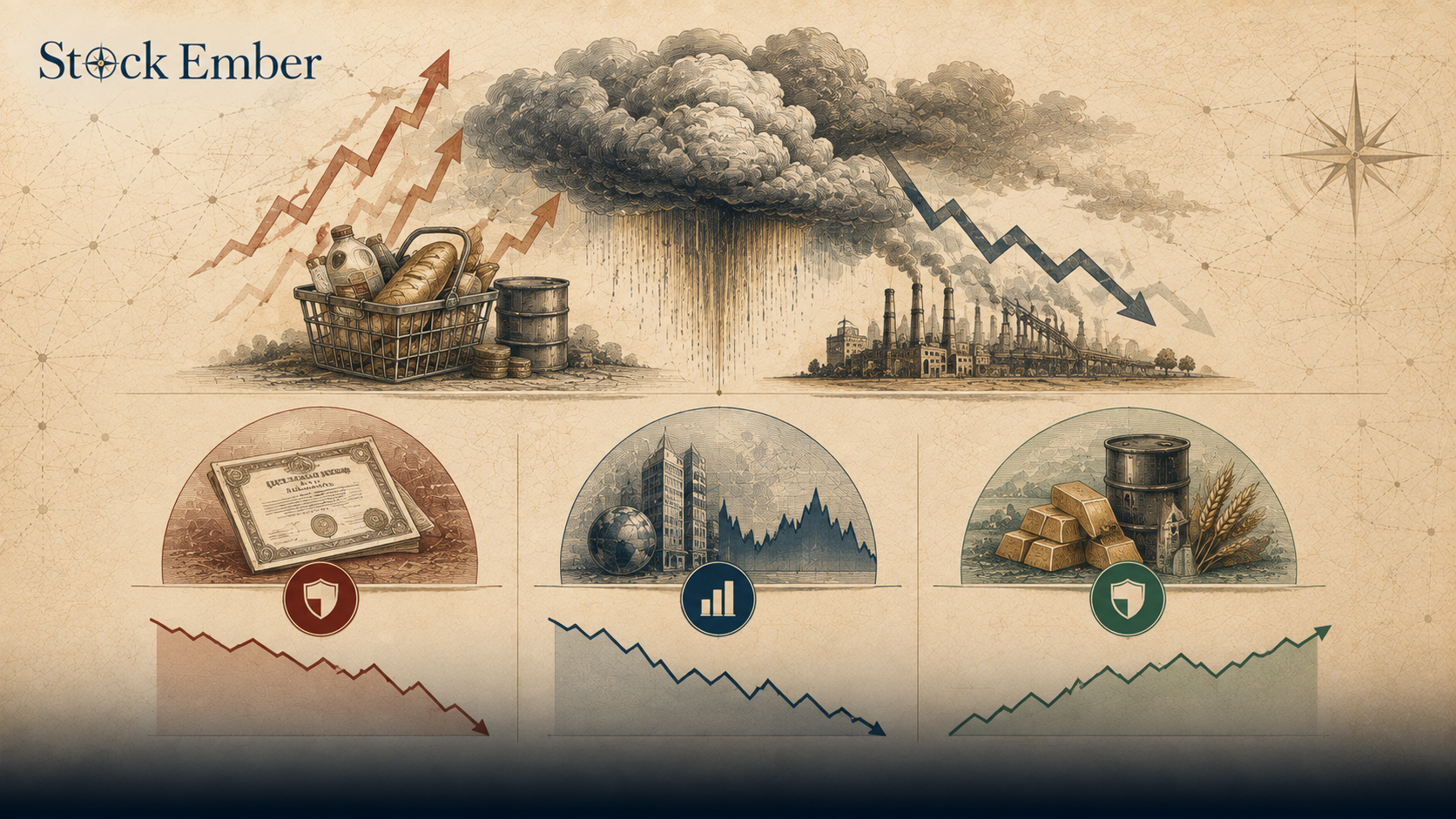
Stagflation creates simultaneous pressure across major asset classes, disrupting standard portfolio balance.
Fixed Income and Nominal Bonds Rising interest rates during stagflation increase interest rate risk, which pushes down the market value of existing nominal bonds precisely when investors need portfolio stability most.
Equities and Profit Margins Slower economic growth reduces sales volume while rising input costs compress corporate profit margins. Furthermore, higher interest rates lower the valuation multiples investors are willing to pay for future earnings, pulling stock prices down.
Real Assets and Defensive Equities Physical assets like commodities and inflation-linked bonds historically show relative resilience during supply-driven inflation. Among equities, companies with strong pricing power such as essential consumer staples, healthcare, and utilities can pass cost increases to customers better than speculative growth firms.
Diagram showing asset class performance dynamics during stagflation.
The 10-Year Cost of Reactive Market Timing
When economic stagnation dominates headlines, investors often feel tempted to make sudden portfolio changes, such as shifting into cash, commodities, or specialized funds.
However, rapid allocation changes create significant friction. Every trade incurs transaction costs, bid-ask spreads, and potential capital gains tax events.
For example, suppose an investor with a $100,000 portfolio attempts to trade around macroeconomic cycles. If frequent trading creates an additional 1% annual drag from fees and transaction costs, over a 10-year holding period, this additional drag would reduce the final portfolio value by roughly $17,600, assuming an illustrative 7% nominal annual return before these additional costs. This figure is a hypothetical example only. Actual returns are not guaranteed and will vary.
In practice, many long-term investors find that the transaction costs and missed recovery days caused by reactive market timing hurt compound returns far more than the temporary macroeconomic cycle itself.
Navigating Stagflation with a Passive Strategy
Navigating low growth and elevated inflation does not require guessing when central bank policies will shift. Instead, long-term investors rely on structural discipline.
A disciplined approach to passive investing focuses on three core practices:
Maintain broad asset allocation: Diversify across global equities, short-duration fixed income, and inflation-protected assets to limit single-sector exposure.
Rebalance systematically: Adjust portfolio weights back to target allocations on a set schedule, automatically selling relative outperformers to buy underperforming assets.
Dollar-cost average steadily: Continue adding capital at fixed intervals so you purchase more index shares when valuations drop.
Common Mistakes to Avoid
Avoiding emotional reactions helps preserve wealth through difficult macroeconomic regimes:
Moving entirely into cash: Holding cash prevents nominal losses but guarantees real purchasing power erosion during persistent inflation.
Chasing commodity price spikes: Buying commodities after a major price run-up often results in buying at cyclical peaks right before demand cools.
Over-concentrating in single sectors: Concentrating heavily in defensive sectors exposes portfolios to sector-specific downturns when economic growth eventually resumes.
Abandoning long-term plans: Selling diversified positions during market downturns locks in paper losses and misses the eventual economic recovery.
Conclusion
Stagflation is a challenging macroeconomic environment, but it remains a temporary regime within broader market history. By understanding how inflation and slow growth affect different asset classes, long-term investors can avoid panic selling and expensive market timing. Maintaining a low-cost, diversified index strategy ensures your portfolio stays positioned for compound growth across all economic cycles.
When you are ready to evaluate broad-market funds for your portfolio, our ETF reviews offer detailed, fee-focused analysis. Investing carries risk of loss and past economic patterns do not guarantee future results, so treat this educational guide as a foundation for your own research.
FAQ
5 questions
What is stagflation in economics and how is it defined?
In economics, stagflation is defined as the simultaneous presence of stagnant economic output (slow GDP growth or economic contraction), elevated unemployment, and high consumer price inflation.
What caused the stagflation of the 1970s?
The 1970s stagflation was primarily triggered by global oil supply shocks that drastically increased energy costs, combined with expansionary monetary policies that fueled persistent inflation while overall economic growth stalled.
How does stagflation affect stocks and bonds?
Rising interest rates during stagflation increase interest rate risk, driving down nominal bond prices. For stocks, slowing economic demand reduces revenue while higher input costs compress corporate profit margins.
What is the difference between inflation and stagflation?
Inflation refers to rising consumer prices across an economy, which often occurs during strong economic expansions. Stagflation specifically occurs when high inflation is accompanied by stagnant economic growth and rising unemployment.
How should passive long-term investors handle stagflation without market timing?
Passive long-term investors should maintain broad asset allocation across global equities and inflation-protected securities, rebalance on a set schedule, and continue dollar-cost averaging into low-cost index funds to prevent fee and tax drag.
Disclaimer
This guide was written with AI assistance and reviewed by the StockEmber editorial team for accuracy. StockEmber provides independent education, not personal financial advice. Some links may support our work at no additional cost to you.
The StockEmber Team is our in-house desk of independent research writers. We test brokerage platforms, read the fine print on fees and custody, and cover ETFs and long-horizon investing for people who plan to hold for decades — not days.