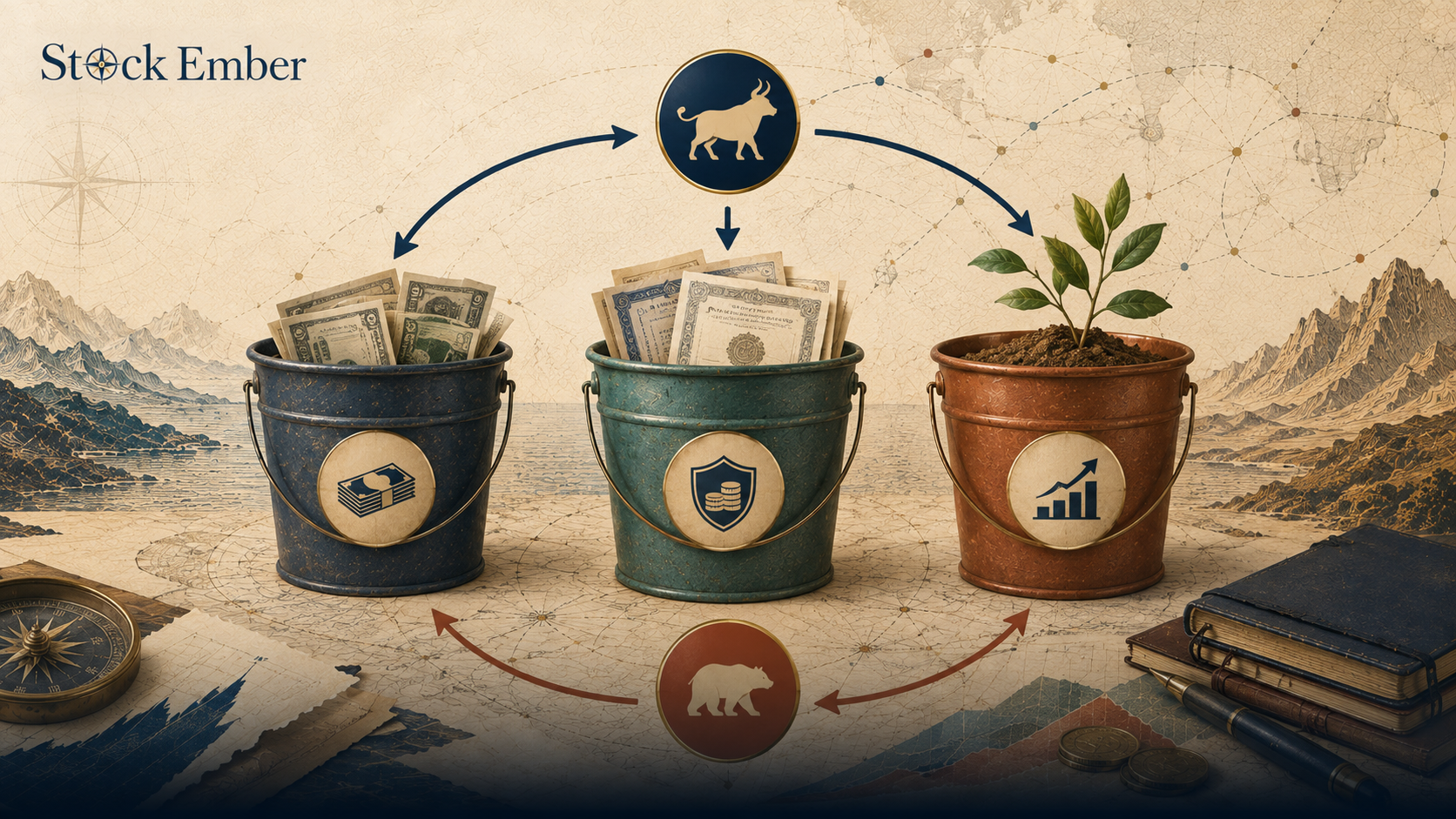
The retirement bucket strategy is a decumulation framework that divides a portfolio into short-term cash, medium-term fixed income, and long-term equities. It aims to provide steady liquidity for living expenses while shielding growth assets from market downturns.
The retirement bucket strategy is a decumulation framework, meaning a system for spending down savings, that divides a portfolio into distinct time horizons such as short-term cash, medium-term bonds, and long-term equities to meet spending needs while preserving capital growth.
Transitioning from accumulating wealth to spending it can feel unsettling when market downturns threaten your nest egg. Structuring assets into cash, income, and growth segments offers a structured way to draw down savings without panic selling during market drops. This guide breaks down how the bucket system works in practice, how to manage refilling, and how cash drag affects long-term portfolio growth.
Quick Takeaways
01The bucket model divides your portfolio into time horizons to match near-term spending and long-term growth needs.
02Bucket 1 typically holds one to three years of living expenses in cash to shield you from short-term market crashes.
03Maintaining excess cash creates cash drag, which can reduce portfolio growth over a ten-year horizon compared to a fully invested total-return strategy.
What Is the Retirement Bucket Strategy?
At its core, a bucket retirement strategy is a mental accounting tool built on top of a standard total-return portfolio. The underlying investments, typically broad-market index funds, fixed income, and cash equivalents, remain similar to a traditional portfolio. However, segmenting them psychologically helps retirees stay disciplined during market corrections. Knowing your next few years of groceries and bills are funded by liquid cash reduces the urge to sell growth equities when market prices fall.
How the 3 Bucket Retirement Strategy Works
Bucket
Time Horizon
Primary Goal
Asset Classes
Bucket 1 (Cash)
1 to 3 Years
Immediate Liquidity & Security
Cash, Money Market Funds, High-Yield Savings
Bucket 2 (Income)
3 to 7 Years
Capital Preservation & Income
Short-to-Intermediate Bonds, CDs, Dividend ETFs
Bucket 3 (Growth)
7+ Years
Purchasing Power & Capital Growth
Broad Market Stock Index ETFs, Global Equities
When implementing a bucket strategy for retirement, Bucket 1 acts as your emergency fund and monthly checking account feeder. If your annual shortfall, the amount needed beyond pension or Social Security payouts, is $40,000, you might keep $80,000 to $120,000 in Bucket 1. Bucket 2 absorbs medium-term market swings using conservative fixed-income assets. Bucket 3 stays invested entirely in equities, allowing seven or more years for market recoveries.
The Refilling Problem: Managing the Strategy Over Time
While setting up buckets is straightforward, maintaining them requires clear rules. Managing the strategy over decades requires a process called refilling.
During bull markets, Bucket 3 generates capital gains. To maintain the system, you sell a portion of your appreciated stock index funds and move the proceeds down into Buckets 2 and 1. Practicing passive investing through broad-market ETFs makes this process straightforward, as you harvest overall market gains rather than guessing individual stock movements.
In practice, many long-term investors find that establishing fixed annual rebalancing dates such as every December, prevents them from constantly checking portfolio balances or trying to time market peaks to refill their cash bucket.
When bear markets arrive, you pause equity sales entirely. Instead, you live off the liquid cash in Bucket 1. This protects your equity investments in Bucket 3 from sequence-of-returns risk, the danger of selling investments at a loss early in retirement, giving stocks time to recover. Once markets rebound, you resume refilling Bucket 1 from equity growth.
The Silent Drag: How Cash Holdings Impact Long-Term Growth
Holding one to three years of living expenses in Bucket 1 provides peace of mind, but it comes with a hidden financial trade-off, cash drag.
Cash drag occurs when uninvested or low-yielding cash reduces the overall return of a portfolio. Consider the ten-year cost of holding $100,000 in Bucket 1 earning an average 2% return, compared to keeping that money in a balanced growth portfolio earning an illustrative 7% average return. Over a ten-year holding period, that $100,000 in cash grows to roughly $121,900. In contrast, invested at 7%, it would grow to approximately $196,700.
That difference of over $74,000 represents the cost of safety. Over a multi-decade retirement, keeping Bucket 1 oversized can significantly pull down your total portfolio balance, making your money more vulnerable to inflation erosion over time.
Major Trade-Offs and Market Risks to Watch
Beyond cash drag, the bucket framework presents specific operational and macro challenges:
Rebalancing Friction: Refilling buckets requires continuous rebalancing. Moving money across accounts can trigger tax events in taxable accounts if capital gains are harvested outside of tax-advantaged shelters.
Simultaneous Asset Pullbacks: In rare periods such as stagflation, both equities and bonds can decline together, meaning Bucket 2 may not reliably cushion Bucket 3's losses as the model assumes.
Strict Rule Adherence: If a bear market lasts longer than three years, Bucket 1 will run dry. Retirees must then decide whether to liquidate depressed assets in Bucket 2 or adjust their living expenses downward.
The U.S. Securities and Exchange Commission notes that asset allocation should align with your personal time horizon and risk tolerance, as no cash-management method eliminates market volatility or guarantees continuous growth.
Diagram showing how capital flows between buckets in a retirement bucket strategy.
Conclusion
The bucket framework offers a psychological buffer against sequence-of-returns risk by securing near-term spending in safe, liquid assets. However, it is not a hands-off solution. Retirees must balance the emotional comfort of holding cash in Bucket 1 against the long-term drag it places on portfolio growth. Choosing low-cost index funds and establishing clear refilling rules helps maintain a balance between current income and future purchasing power.
When you are ready to evaluate diversified low-cost funds to construct your medium- and long-term buckets, our ETF reviews offer a practical starting point.
Investing always carries risk, and holding cash does not protect money from inflation loss. Treat bucket frameworks as behavioral tools to guide your planning rather than absolute guarantees of financial safety.
FAQ
5 questions
What is the 3-bucket strategy for retirement?
The 3-bucket strategy divides retirement savings into three time horizons: Bucket 1 holds cash for immediate expenses (1–3 years), Bucket 2 holds bonds for medium-term income (3–7 years), and Bucket 3 holds stock index funds for long-term growth (7+ years).
How many years of expenses should be in Bucket 1?
Most financial planners suggest keeping one to three years of living expenses in Bucket 1. This cash cushion ensures you can pay for immediate bills without having to sell stocks during an active market crash.
How do you refill the cash bucket in a retirement bucket strategy?
During bull markets, you refill Bucket 1 by selling gains from equity index funds in Bucket 3. During severe bear markets, you pause stock sales, living off Bucket 1 cash and drawing from Bucket 2 fixed income until equities recover.
What is the main downside of the bucket strategy?
The primary downside is cash drag. Holding one to three years of expenses in low-yielding cash equivalents reduces overall portfolio compounding compared to a fully invested strategy over multi-decade horizons.
How does the bucket strategy differ from the 4% rule?
The 4% rule specifies a fixed annual withdrawal percentage adjusted for inflation, whereas the bucket strategy organizes assets by time horizon to control liquidity and reduce the psychological stress of selling equities during downturns.
Disclaimer
This guide was written with AI assistance and reviewed by the StockEmber editorial team for accuracy. StockEmber provides independent education, not personal financial advice. Some links may support our work at no additional cost to you.
The StockEmber Team is our in-house desk of independent research writers. We test brokerage platforms, read the fine print on fees and custody, and cover ETFs and long-horizon investing for people who plan to hold for decades — not days.