A REIT dividend is a cash distribution paid by a Real Estate Investment Trust from the rental income and operational profits of its property holdings. Because REITs are legally required to distribute at least 90% of their taxable income to shareholders, they generally offer higher cash yields than traditional corporate stocks, though payouts are typically taxed at ordinary personal income rates.
A Real Estate Investment Trust (REIT) dividend is a cash distribution paid to shareholders from the rental income and operational profits generated by commercial property portfolios.
Investors seeking regular income often turn to real estate, but buying physical properties requires significant capital and landlord management. Real estate investment trusts solve this by collecting rent across office buildings, apartment complexes, and shopping centers, passing those earnings directly to investors. This guide explains how REIT dividends work, why their tax rules differ from standard stocks, and how to evaluate their long-term payouts.
Quick Takeaways
01REITs are legally required to distribute at least 90% of their taxable income to shareholders every year.
02Evaluating dividend safety requires looking at Funds From Operations (FFO) rather than standard corporate net income.
03REIT distributions are generally taxed as ordinary income rather than qualified dividend rates.
04High yields can sometimes signal falling property prices or rising debt costs rather than financial strength.
What Is a REIT Dividend?
To understand what a REIT dividend is, you must first look at how Real Estate Investment Trusts are structured by law. A REIT is a company that owns, operates, or finances income-generating real estate. Unlike traditional corporations that pay corporate taxes on their profits before deciding how much cash to return to shareholders, a REIT operates as a pass-through entity.
To maintain its legal tax-exempt status at the corporate level, a REIT must distribute at least 90% of its taxable income to shareholders each year as dividends. Under IRS rules for REIT taxation (Internal Revenue Code Section 857), this distribution requirement forces real estate trusts to pay out the vast majority of their cash flow directly to investors, a rule further explained in Nareit's investor education materials.
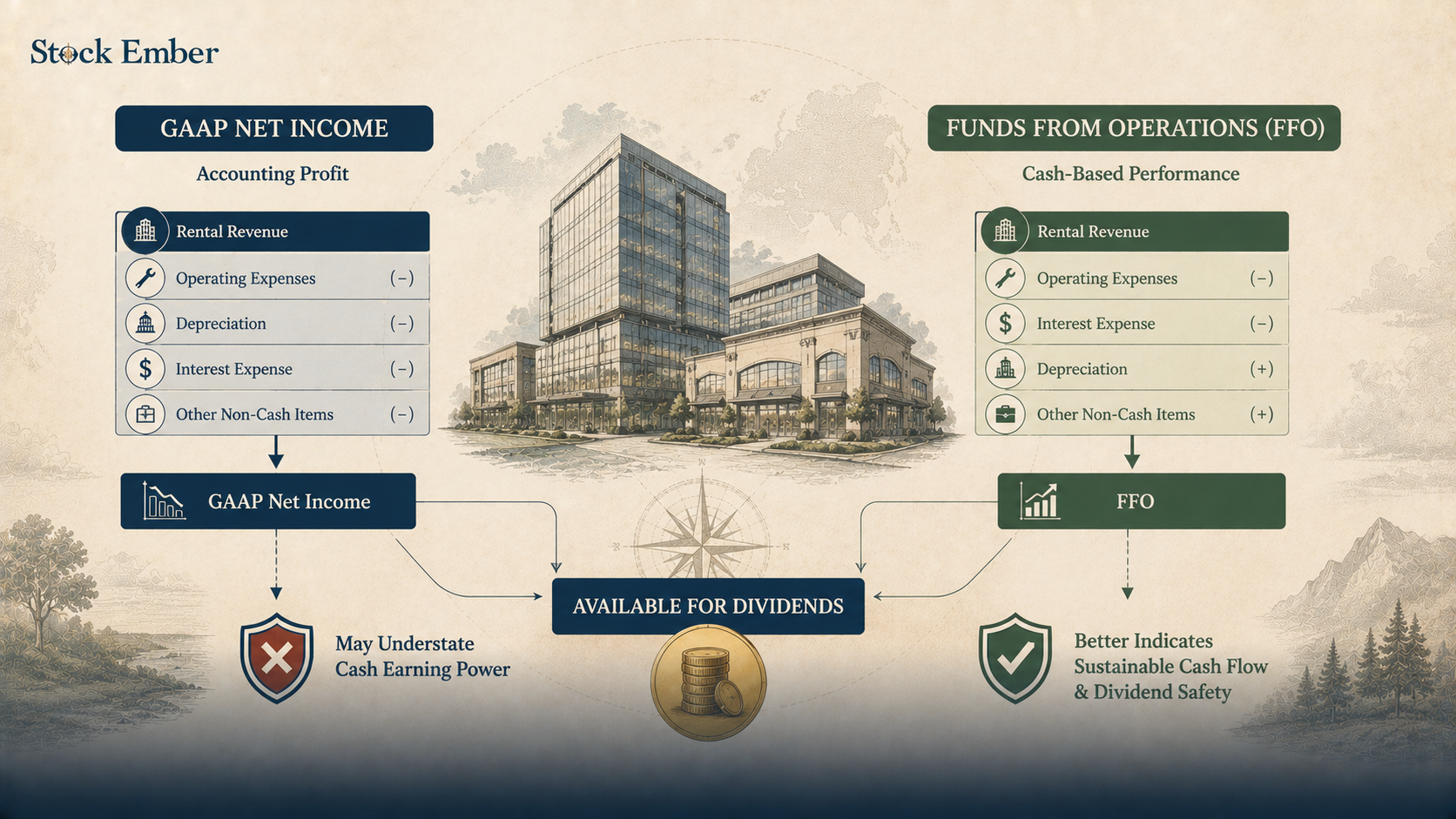
Because real estate accounting requires heavy depreciation deductions on physical buildings, standard net income figures can make a healthy REIT look unprofitable. To accurately measure how well a property trust covers its dividend, investors use a metric called Funds From Operations (FFO). FFO adds real estate depreciation back to net income and subtracts gains from property sales.
The plain text formula for measuring REIT payout safety is:
FFO Payout Ratio = Annual Dividend per Share / Funds From Operations per Share
75% = $3.00 / $4.00
Based on historical data tracked by the FTSE Nareit Index Series, an FFO payout ratio between 60% and 85% usually indicates a healthy cash balance that covers the dividend while leaving money aside for property upgrades.
How REIT Dividends Are Calculated and Paid
These payouts are calculated based on the total cash generated across a trust's property portfolio, minus property management costs, interest on mortgage debt, and administrative expenses. While traditional corporate stocks usually pay cash distributions four times a year, many property trusts distribute cash monthly to match regular tenant rental payments.
The average REIT dividend yield varies considerably depending on the specific property sector, real estate demand, and prevailing interest rates.
According to the FTSE Nareit All Equity REITs Index, yields across the broader real estate market typically range from 3% to 8%, though individual sectors show distinct characteristics:
Data Centers & Logistics (2% to 4%): Lower current yields, but higher rental growth potential driven by digital infrastructure and e-commerce expansion.
Retail & Residential (4% to 5.5%): Moderate, steady yields anchored by grocery-backed shopping centers and apartment leases that adjust with inflation.
Healthcare & Self-Storage (4.5% to 6%): Solid cash yields supported by long-term tenant contracts and steady demand.
Mortgage REITs (10% to 14%): Double-digit yields derived from holding property debt rather than physical buildings, carrying significantly higher risk.
REIT dividend payout ratio diagram comparing Net Income and FFO metrics for evaluating dividend health
Evaluating yield requires checking the underlying sector's health. A high distribution percentage is only as safe as the rental income supporting it.
Why REIT Dividends Behave Differently Than Regular Stock Dividends
REIT distributions behave differently from standard corporate dividends because of tax classification and sensitivity to interest rates.
When a standard corporation pays a dividend, it is usually classified as a "qualified dividend," which qualifies for lower long-term capital gains tax rates (typically 0%, 15%, or 20%). Because REITs do not pay corporate income tax, the tax burden passes through to the investor. As a result, REIT payouts are classified as non-qualified ordinary income, meaning they are taxed at your standard personal income tax bracket.
Furthermore, property trusts rely heavily on debt financing to purchase office parks, warehouses, and apartment complexes. When central banks raise interest rates, borrowing costs increase for property managers, which reduces profit margins. Rising interest rates also make fixed-income alternatives like government bonds more attractive, which can cause real estate stock prices to decline and push dividend yields upward.
The 10-Year Impact of Expense Ratios and Currency Risk
Over a ten-year holding period, fund management fees and foreign exchange rate movements can reduce the compound value of your real estate distributions.
When holding real estate through investment funds, high expense ratios reduce net cash payouts. Holding real estate assets through broad index funds built around passive investing helps lower overhead costs compared to paying high management fees in active funds. An active property fund charging a 0.85% expense ratio takes nearly a full percentage point out of your annual yield every year. Over ten years on a $50,000 portfolio, that fee difference can extract several thousand dollars in compound growth.
For investors holding international REIT ETFs, currency risk adds another variable to long-term returns. When a fund holds property trusts denominated in foreign currencies, a stronger U.S. dollar can reduce the real value of dividend income once it's converted back home, even if the underlying rental income remains stable. Currency-hedged REIT fund share classes can help offset this swing, though they typically carry a slightly higher expense ratio in exchange for that protection.
The simple math for calculating net dividend yield after fund costs is:
Net Dividend Yield = Stated Fund Yield - Annual Expense Ratio
3.60% = 4.10% - 0.50%
Choosing low-cost fund structures helps preserve the income your real estate holdings produce over long timelines.
Common REIT Dividend Pitfalls (and How to Avoid Them)
Investors seeking real estate income often run into predictable traps by focusing solely on headline yield numbers. Here are three common pitfalls and how to avoid them:
Falling for Yield Traps: A REIT dividend yield rises when its share price drops. If a property trust's yield suddenly jumps to 11% while its peers yield 4%, the market may be pricing in a dividend cut or property vacancies. Always verify that FFO covers the payout before buying.
Confusing Mortgage REITs with Equity REITs: Mortgage REITs (mREITs) buy property debt rather than physical real estate. They use high leverage to boost returns, making them vulnerable to interest rate shifts. Traditional equity REITs that own physical buildings offer far greater long-term stability.
Holding REITs in Taxable Accounts: Because REIT payouts are taxed as ordinary income, holding them in taxable accounts creates a recurring tax drag. Keeping REIT holdings inside tax-advantaged accounts protects payouts from yearly tax friction.
In practice, many long-term investors find that capping real estate exposure at 5% to 10% of a broader equity strategy provides useful income diversification without exposing their overall wealth to property sector downturns.
Conclusion
Understanding how a REIT dividend works helps investors add real estate cash flow to their portfolios without taking on the hassle of direct property management. While statutory pass-through rules create attractive cash yields, success requires evaluating Funds From Operations, accounting for ordinary income taxes, and keeping fund expenses low. Viewing real estate distributions as one part of a balanced, long-horizon allocation helps protect your wealth against inflation and market shifts.
When you are ready to explore low-cost index funds that hold real estate assets, checking our ETF reviews is a helpful next step. Investing involves risk, including the possible loss of principal, and past dividend payouts do not promise future cash distributions. Treat this guide as educational research rather than individualized financial advice.
FAQ
5 questions
What is a REIT dividend?
A REIT dividend is a regular cash distribution paid by a Real Estate Investment Trust to its shareholders. Sourced primarily from tenant rents and commercial lease revenues, these distributions must total at least 90% of the trust's taxable income each year to maintain its corporate tax-exempt status.
What is the average REIT dividend yield?
The average REIT dividend yield typically ranges from 3% to 8%, depending on the property sector, general interest rates, and economic conditions. Specialized sectors like logistics or data centers often feature lower yields with higher growth potential, whereas mortgage REITs can exhibit double-digit yields that carry significantly higher risk.
Why do REITs pay higher dividends than regular stocks?
REITs pay higher dividends because they operate as corporate pass-through entities. By distributing 90% or more of their taxable income directly to investors, REITs avoid paying corporate-level income taxes, leaving a larger portion of operational cash flow available for distribution.
How are REIT dividends taxed for individual investors?
Unlike standard corporate stock dividends that often qualify for lower capital gains tax rates, REIT dividends are generally non-qualified distributions. They are typically taxed as ordinary income at the investor's standard personal income tax bracket.
What metric is best for measuring REIT dividend safety?
Funds From Operations (FFO) per share is the standard metric used to evaluate REIT dividend safety. Because real estate accounting requires large property depreciation deductions that lower traditional GAAP (Generally Accepted Accounting Principles) net income, FFO adds depreciation back to provide an accurate measure of operational cash flow.
Disclaimer
This guide was written with AI assistance and reviewed by the StockEmber editorial team for accuracy. StockEmber provides independent education, not personal financial advice. Some links may support our work at no additional cost to you.
The StockEmber Team is our in-house desk of independent research writers. We test brokerage platforms, read the fine print on fees and custody, and cover ETFs and long-horizon investing for people who plan to hold for decades — not days.