Portfolio rebalancing is the practice of adjusting an investment portfolio's asset weights back to its target allocation when market movements cause allocations to drift. Rebalancing restores an investor's intended risk tolerance and enforces systematic discipline without trying to time market cycles.
Portfolio rebalancing is the practice of adjusting the asset weights in an investment portfolio back to their original target allocation when market movements cause them to drift.
When stock prices rise or fall sharply, your investment mix naturally shifts over time. A portfolio designed for moderate growth can quietly transform into a high-risk asset mix without your active choice. This guide explains how portfolio drift happens, three practical ways to reset your allocation, and how to manage fees and taxes along the way.
Quick Takeaways
01Portfolio rebalancing restores your portfolio to its intended target asset mix as market prices shift over time.
02Market price movements create portfolio drift, which can unintentionally increase your exposure to portfolio risk.
03Investors typically rebalance using set calendar schedules, percentage drift thresholds, or incoming cash flows.
04Rebalancing is a risk management discipline, not a strategy designed to time the market or maximize short-term returns.
What Is Portfolio Rebalancing?
Portfolio rebalancing is the process of buying and selling assets within a portfolio to bring your asset allocation back to its original target level.
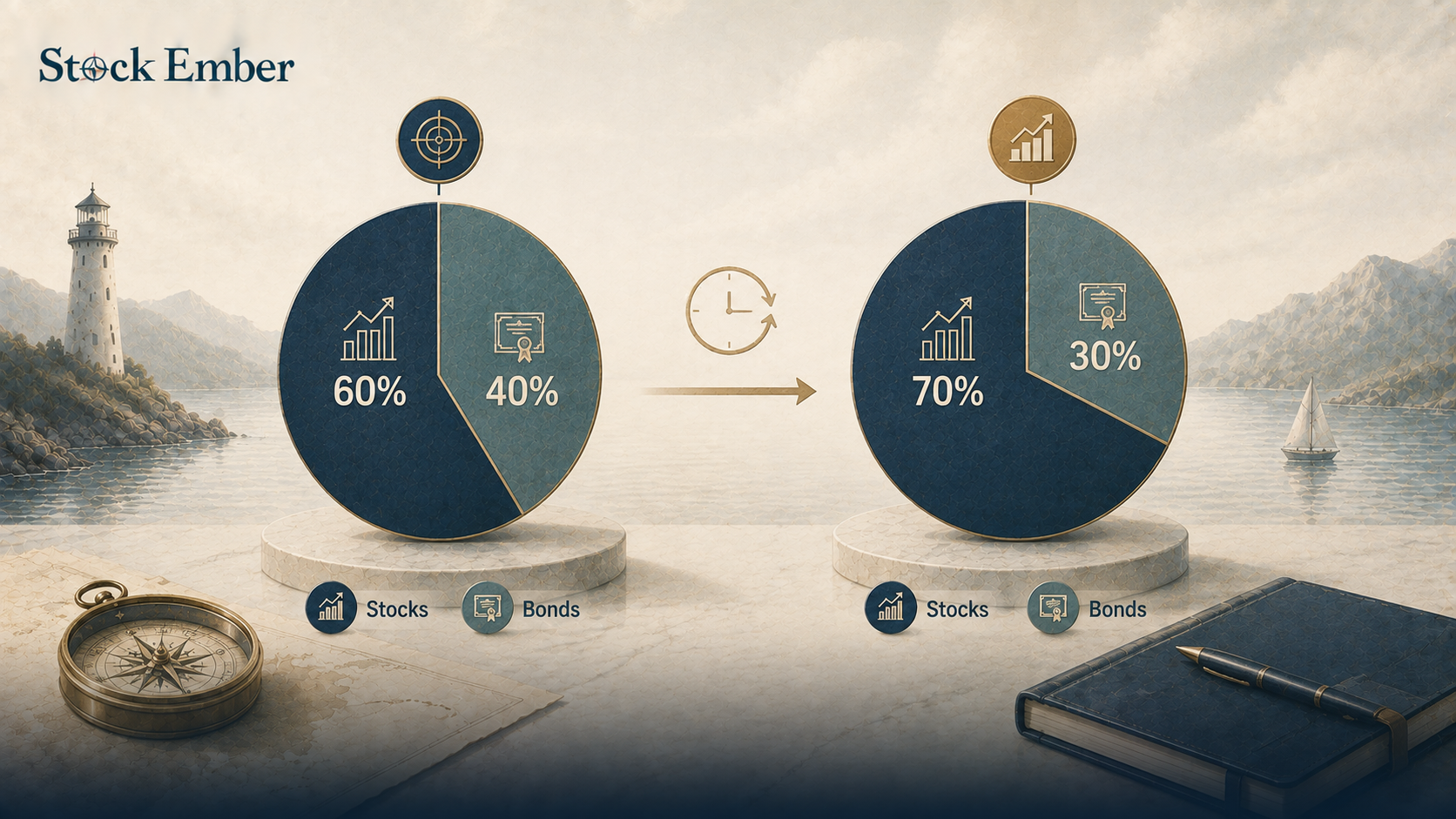
When you create an investment portfolio, you choose a target mix of assets based on your personal financial goals, time horizon, and risk tolerance. For example, a beginner investor might select a target mix of 60% stocks for long-term growth and 40% bonds for stability. Over time, as stocks and bonds deliver different returns, the actual percentage of each asset class in your portfolio changes. Rebalancing brings those percentages back into alignment with your starting plan.
Rebalancing is primarily a risk management mechanism rather than a tool to maximize short-term market returns. Its main purpose is to prevent your portfolio from taking on more volatility than you originally intended. Rebalancing forces a systematic habit: trimming assets that have grown beyond their target share and buying assets that have fallen below theirs.
Reviewing a portfolio after a strong market rally often reveals how easily risk exposure can creep upward unnoticed, reinforcing why systematic rebalancing keeps long-term investment plans on track.
Why Portfolios Drift (and Why It Matters)
Portfolios drift because different asset classes perform differently over any given period, shifting your actual asset weighting away from your plan.
Consider a simple hypothetical example of an investor who starts with $100,000 allocated 60% to stocks ($60,000) and 40% to bonds ($40,000). If stock markets experience a prolonged bull run while bond markets remain flat, the stock portion of the portfolio might grow to $90,000 while the bond portion stays at $40,000. The total portfolio value is now $130,000, but the asset mix has shifted from 60/40 to roughly 69% stocks and 31% bonds.
This shift, known as portfolio drift, exposes the investor to higher downside risk than originally planned. If a major stock market decline occurs next, aa portfolio holding 69% stocks will suffer a larger dollar drawdown (the drop in value from peak to trough) than a portfolio holding the target 60% stock allocation.
The fixed-income side of a portfolio also experiences drift as bond prices shift in response to economic conditions and interest rate risk. When central banks raise interest rates, existing bond prices typically fall, which can lower the bond percentage in a mixed portfolio even further. Rebalancing ensures that both asset classes remain balanced according to your comfort with market risk.
To correct this drift, investors typically choose one of three primary rebalancing strategies:
Strategy
Trigger
Best For
Calendar-Based
Fixed schedule (e.g., annually)
Hands-off investors
Threshold (Band)
Drift exceeds set % (e.g., 5pts)
Active monitors
Cash-Flow
New savings/dividends received
Tax-conscious savers
Visual diagram comparing a 60/40 target asset allocation with a drifted 69/31 portfolio allocation.
3 Common Strategies to Rebalance Your Portfolio
Investors generally use three main strategies to restore their target asset allocation, depending on their personal preferences and account types.
1. Calendar-Based Rebalancing
Under a calendar-based approach, you review and rebalance your portfolio on a fixed schedule such as once or twice a year. On your set date, you review your current holdings, compare them to your target percentages, and adjust your positions accordingly. The primary advantage of calendar rebalancing is its simplicity and predictable routine, which prevents constant portfolio monitoring.
2. Threshold (Band) Rebalancing
With threshold rebalancing, you rebalance only when an asset class strays from its target weight by a specific percentage, such as 5 percentage points. For example, if your target stock allocation is 60%, you rebalance whenever stock holdings fall below 55% or rise above 65%. This method responds directly to market movements rather than arbitrary calendar dates, reducing unnecessary trading during quiet market periods.
3. Cash-Flow Rebalancing
Cash-flow rebalancing uses new cash inputs such as monthly savings, dividend payouts, or interest income, to buy underweighted assets. Instead of selling overweighted holdings, you simply direct fresh capital toward the asset classes that have lagged behind. This approach is particularly effective for active savers because it realigns the portfolio without generating trading commissions or taxable events.
Managing Friction: Taxes, Fees, and the 10-Year Lens
Every time you rebalance by selling assets in a taxable investment account, you potentially trigger capital gains taxes and transaction fees that reduce your net returns.
Over a 10-year holding period, frequent trading friction can create a noticeable drag on total portfolio growth. For example, selling appreciated stock holdings every month in a taxable account generates short-term or long-term capital gains tax obligations each year. That tax money leaves your account immediately, removing funds that would otherwise continue compounding over the next decade.
To minimize friction over a 10-year horizon, long-term investors use tax-smart rebalancing techniques:
Rebalance inside tax-advantaged accounts: Execute asset sales inside tax-sheltered accounts like retirement plans where capital gains taxes do not apply to annual trading.
Use cash-flow rebalancing first: Add new savings to underweighted positions to adjust percentages without selling existing shares.
Set wider threshold bands: Avoid rebalancing for small 1% or 2% portfolio shifts to limit unnecessary transaction frequency.
Minimizing trading turnover aligns closely with the principles of passive investing, where low costs and broad market index holdings support steady compound returns over long horizons.
Overcoming Emotional Barriers in Rebalancing
The biggest obstacle to effective rebalancing is psychological: rebalancing requires you to sell assets that have recently performed well and buy assets that have lagged behind.
During a strong stock market rally, selling a portion of your best-performing stock funds to purchase lower-performing bond funds can feel counterintuitive. Human psychology tempts investors to hold onto winning assets in the hope that outperformance will continue indefinitely. Conversely, during a stock market crash, buying equities when headline news is negative requires strong emotional discipline.
Systematic rebalancing replaces emotional instinct with clear, repeatable rules. By setting predefined rebalancing triggers, you remove market noise from your decision-making process. Rebalancing does not predict market tops or bottoms; it simply ensures that your investment portfolio remains aligned with your personal risk capacity regardless of market sentiment.
Conclusion
Portfolio rebalancing is a fundamental risk management practice that keeps your investments aligned with your personal financial plan. By periodically addressing portfolio drift, you ensure that market movements do not quietly push your portfolio into a higher risk category than you intended. Whether you choose calendar intervals, percentage bands, or cash-flow adjustments, maintaining a disciplined approach helps control risk while keeping trading costs low.
When you are ready to evaluate core index funds for your target asset mix, our ETF reviews offer a structured starting point for comparing low-cost fund options. All investing carries the risk of loss, and maintaining a balanced allocation does not guarantee profits or protect against market declines, so use rebalancing as a practical tool for long-term portfolio discipline.
FAQ
5 questions
What is portfolio rebalancing and why is it important?
Portfolio rebalancing is the process of realigning your asset class weights back to your target allocation. It is important because market movements cause outperforming assets to grow faster, shifting your portfolio into a higher-risk mix than you originally intended.
How often should you rebalance your investment portfolio?
Most long-term investors rebalance annually, semi-annually, or whenever an asset class strays by a specific threshold (such as 5 percentage points) from its target weight. Rebalancing too frequently in taxable accounts can generate unnecessary transaction costs and tax drag.
Does portfolio rebalancing increase investment returns?
No, portfolio rebalancing is primarily a risk management discipline rather than a return-enhancement tool. While it systematically trims overweighted assets and buys underweighted ones, its primary purpose is keeping your portfolio's volatility aligned with your financial goals.
How do you rebalance a portfolio without triggering capital gains taxes?
You can rebalance tax-efficiently by using cash-flow rebalancing, directing new monthly savings, dividends, or interest toward underweighted assets instead of selling appreciated shares. Alternatively, you can execute asset sales inside tax-advantaged retirement accounts.
What is the difference between calendar and threshold rebalancing?
Calendar rebalancing resets asset weights on a fixed schedule (such as every December), regardless of market movement. Threshold rebalancing triggers adjustments only when an asset class deviates from its target percentage by a set margin (such as ±5%).
Disclaimer
This guide was written with AI assistance and reviewed by the StockEmber editorial team for accuracy. StockEmber provides independent education, not personal financial advice. Some links may support our work at no additional cost to you.
The StockEmber Team is our in-house desk of independent research writers. We test brokerage platforms, read the fine print on fees and custody, and cover ETFs and long-horizon investing for people who plan to hold for decades — not days.