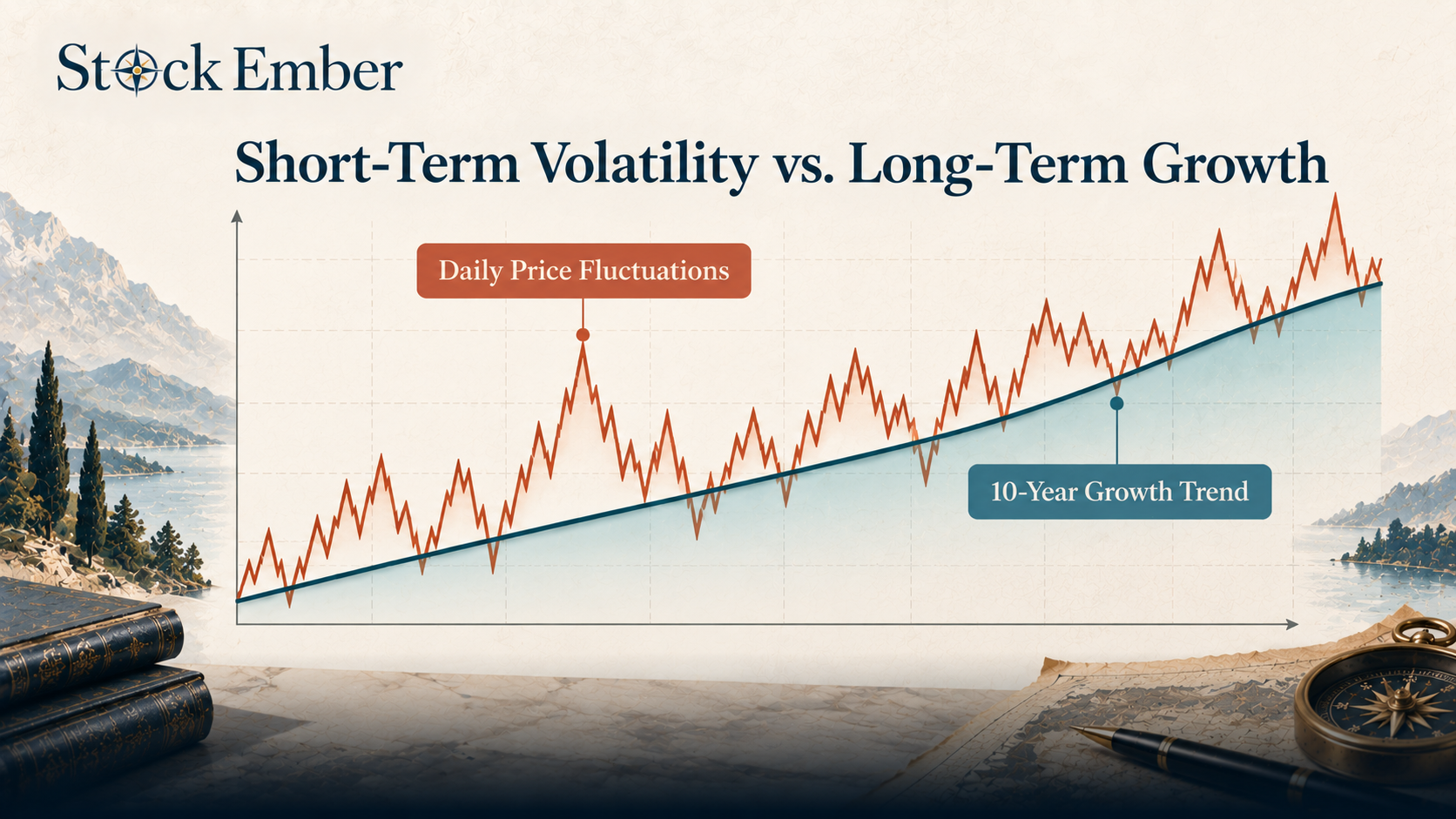
Myopic loss aversion is a behavioral bias where an investor evaluates portfolio performance over short time horizons while remaining highly sensitive to potential losses. Because short-term market movements contain frequent negative fluctuations, checking portfolio values too often causes investors to experience continuous psychological pain, leading to risk avoidance and panic decisions that harm long-term wealth compounding.
In practice, this means an investor who checks a brokerage app daily may react to routine price movements as if they were genuine warning signs, even when nothing about the underlying investment has changed. Over time, this habit can make normal market volatility feel like a constant threat and encourage decisions based on short-term emotions rather than long-term goals.
Checking your brokerage account every morning might feel like staying informed, but it often hurts your long-term returns. When everyday market drops trigger constant discomfort, investors tend to make panic decisions that undermine their wealth over time. This guide explains how myopic loss aversion works, why frequent monitoring creates false risk, and how to build habits that protect your 10-year compounding power.
Quick Takeaways
01Myopic loss aversion combines human pain sensitivity from losses with overly frequent portfolio checking.
02Daily stock price movements look like a coin flip, exposing short-term observers to constant negative noise.
03Extending your portfolio evaluation window from daily to annual dramatically reduces emotional distress.
04Checking account balances less often helps prevent panic selling during routine market drops.
What Is Myopic Loss Aversion?
Myopic loss aversion brings together two well-documented ideas from psychology and economics: loss aversion and evaluation myopia.
Loss aversion describes the human tendency to feel the pain of a financial loss twice as intensely as the pleasure of an equal gain. Losing $1,000 hurts far more than making $1,000 feels good. Evaluation myopia refers to a short-sighted focus, where an investor measures portfolio performance over brief windows, such as daily, weekly, or monthly.
When you combine these two traits, problems arise. Because short-term price moves are full of random ups and downs, checking your account frequently forces you to experience losses regularly. Even if an asset trends upward over decades, short-term drops create constant emotional friction. Understanding this pattern is a key part of behavioral finance, the study of how human psychology shapes financial choices.
How Short-Term Monitoring Distorts Risk
The frequency with which you look at your investments changes how risky those investments feel. Based on historical S&P 500 return data from 1929 to 2023, over a single day, the US stock market rises about 53% of the time and falls roughly 47% of the time. To a daily observer, holding equities feels almost as unpredictable as flipping a coin. Because losses hurt twice as much as gains feel good, watching daily fluctuations creates a net negative psychological experience.
However, as your evaluation horizon lengthens, the odds shift in your favor. Over a one-year period, historical stock market returns are positive roughly 75% of the time. Over a 10-year horizon, that positive frequency rises toward 95%.
Historical market research from Capital Group based on S&P 500 Index data demonstrates that holding equities over longer time horizons can help investors maintain perspective during market declines. The underlying asset risk has not changed, but your perception of risk shifts entirely based on your evaluation window.
Chart showing how evaluation frequency alters perception of market risk.
Modern technology amplifies this problem. Smartphone trading apps, push notifications, and real-time portfolio widgets tempt investors to check prices continuously throughout the day. This constant feedback loop transforms routine market noise into actionable panic, causing people to mistake normal volatility for permanent loss.
The Equity Premium Puzzle: What Research Shows
In the 1990s, economists Richard Thaler and Shlomo Benartzi used myopic loss aversion to solve a famous financial mystery known as the equity premium puzzle. Historically, stocks have delivered significantly higher returns than government bonds over long horizons. Classic economic models could not explain why investors needed such a massive extra return, or equity risk premium, to hold stocks instead of safe bonds.
Thaler and Benartzi showed that the puzzle makes sense once you account for investor evaluation habits. If investors evaluated their portfolios only once every one or two years, the historical equity premium would be far smaller.
But because many individual and institutional investors evaluate performance over short annual or quarterly cycles, the frequent pain of stock market dips makes equities feel far riskier than they actually are over a multi-decade career. Landmark research published through the National Bureau of Economic Research shows that evaluation frequency, rather than asset risk alone, explains why investors demand such high returns to hold equities.
How Myopic Loss Aversion Harms Long-Term Portfolios
When short-term loss aversion drives your investment decisions, your portfolio suffers in three main ways:
First, it triggers panic selling at market bottoms. Checking values during market downturns triggers emotional investing, leading investors to panic and sell at the worst possible time. An investor who checks their balance daily during a market correction feels intense pressure to "stop the bleeding." They sell broad index funds after a 15% drop, locking in actual losses right before prices recover.
Second, it causes excessive cash drag. Fearful of short-term drops, loss-averse investors often leave far too much capital in low-yield cash accounts. Over a 10-year period, cash held beyond a normal emergency fund loses purchasing power to inflation, quietly reducing long-term wealth compounding.
Third, it breaks asset allocation plans. Investors abandon sound, diversified portfolios after a single bad quarter, jumping between strategies in search of smooth, unrealistically steady returns.
Practical Remedies: Overcoming the Frequency Trap
Overcoming myopic loss aversion does not require changing your personality; it requires changing your environment and habits.
Establish a Fixed Review Schedule: Shift your evaluation frequency from daily or weekly to quarterly or annually. Set specific dates on your calendar for portfolio check-ins, such as every six months.
Remove Environmental Triggers: Delete stock tracking widgets from your phone home screen and turn off price alerts from financial news apps. Reducing daily exposure to market noise immediately lowers stress.
Automate Monthly Contributions: Set up automated transfers into low-cost index ETFs. Automation takes active decision-making out of the process, ensuring you continue buying regardless of short-term headlines.
In practice, many long-term investors find that deleting brokerage apps from their phones instantly cuts down panic-driven decisions during market drawdowns.
Conclusion
Myopic loss aversion proves that watching your investments too closely can be just as damaging as ignoring them entirely. By focusing on short-term price swings, investors expose themselves to unnecessary psychological pain and make choices that harm long-term wealth accumulation. Changing your evaluation window from days to years aligns your mindset with the true timeline of buy-and-hold investing.
When you are ready to build a steady core portfolio, our ETF reviews provide a clear starting point. Managing how often you check your account helps control behavioral risk, but it does not eliminate market risk, so treat these habits as part of a thoughtful long-term strategy.
FAQ
5 questions
What is myopic loss aversion in simple terms?
Myopic loss aversion is the combination of feeling the pain of losses more intensely than the joy of gains (loss aversion) and evaluating your portfolio over very short time periods (myopia). Checking your portfolio daily exposes you to constant price fluctuations, making normal market noise feel like serious financial risk.
Why does checking your portfolio too often hurt long-term returns?
Over short periods, stock market returns fluctuate almost like a coin flip. Because losses hurt roughly twice as much as gains feel good, watching daily price drops creates emotional distress. This discomfort frequently drives investors to panic sell quality assets during routine drawdowns or hide in cash, destroying long-term compounding.
Who discovered myopic loss aversion?
Economists Richard Thaler and Shlomo Benartzi introduced the concept of myopic loss aversion in 1995. Their research used this behavioral combination to explain the equity premium puzzle, demonstrating why investors historically required high expected returns to tolerate stock market volatility.
How does evaluation frequency affect perception of investment risk?
Short evaluation windows make long-term assets look artificially risky. While the U.S. stock market is positive on roughly 53% of individual days, its historical positive return rate rises toward 75% over one-year periods and nearly 95% over 10-year horizons. Extending your evaluation window changes your perception of risk without altering the asset itself.
How do you overcome myopic loss aversion as a long-term investor?
You can overcome this bias by establishing a fixed evaluation schedule (such as quarterly or annual reviews), deleting daily stock-tracking apps and mobile widgets, and automating monthly index ETF contributions. Removing short-term triggers helps maintain discipline during market fluctuations.
Disclaimer
This guide was written with AI assistance and reviewed by the StockEmber editorial team for accuracy. StockEmber provides independent education, not personal financial advice. Some links may support our work at no additional cost to you.
The StockEmber Team is our in-house desk of independent research writers. We test brokerage platforms, read the fine print on fees and custody, and cover ETFs and long-horizon investing for people who plan to hold for decades — not days.