Market liquidity is the speed and ease with which an asset can be converted into cash without causing a significant change in its market price. Highly liquid markets feature high trading volume, tight bid-ask spreads, and deep order books, minimizing trading friction for long-term investors.
Market liquidity is the ease and speed with which an asset can be bought or sold without causing a significant price change.
When you invest long term, market liquidity determines how smoothly you enter or exit a position and how much you pay in hidden trading costs. An illiquid asset can trap your capital or force steep discounts when you need cash. This guide breaks down how market liquidity works, why ETF liquidity differs from individual stocks, and how to protect your portfolio from trading friction.
Quick Takeaways
01Market liquidity measures how quickly an asset turns into cash at fair market value.
02Key indicators include trading volume, tight bid-ask spreads, and order book depth.
03Exchange-traded fund (ETF) liquidity depends primarily on underlying holdings, not just daily trading volume.
04Holding liquid index funds minimizes hidden transaction drag and protects long-term compounding returns.
What Is Market Liquidity?
This is the degree to which an asset converts into cash quickly without impacting its price.
In plain terms, a liquid market has plenty of active buyers and sellers ready to trade. Selling a share of a large company takes seconds at the market price.
Three core components define market liquidity:
Trading Volume: The total number of shares traded over a given period, such as a single day.
Bid-Ask Spread: The gap between the highest buyer price (bid) and the lowest seller price (ask). Tight spreads signal high liquidity.
Market Depth: The volume of orders waiting at different price levels. Deep markets absorb large orders without big price swings.
How Market Liquidity Works Across Asset Classes
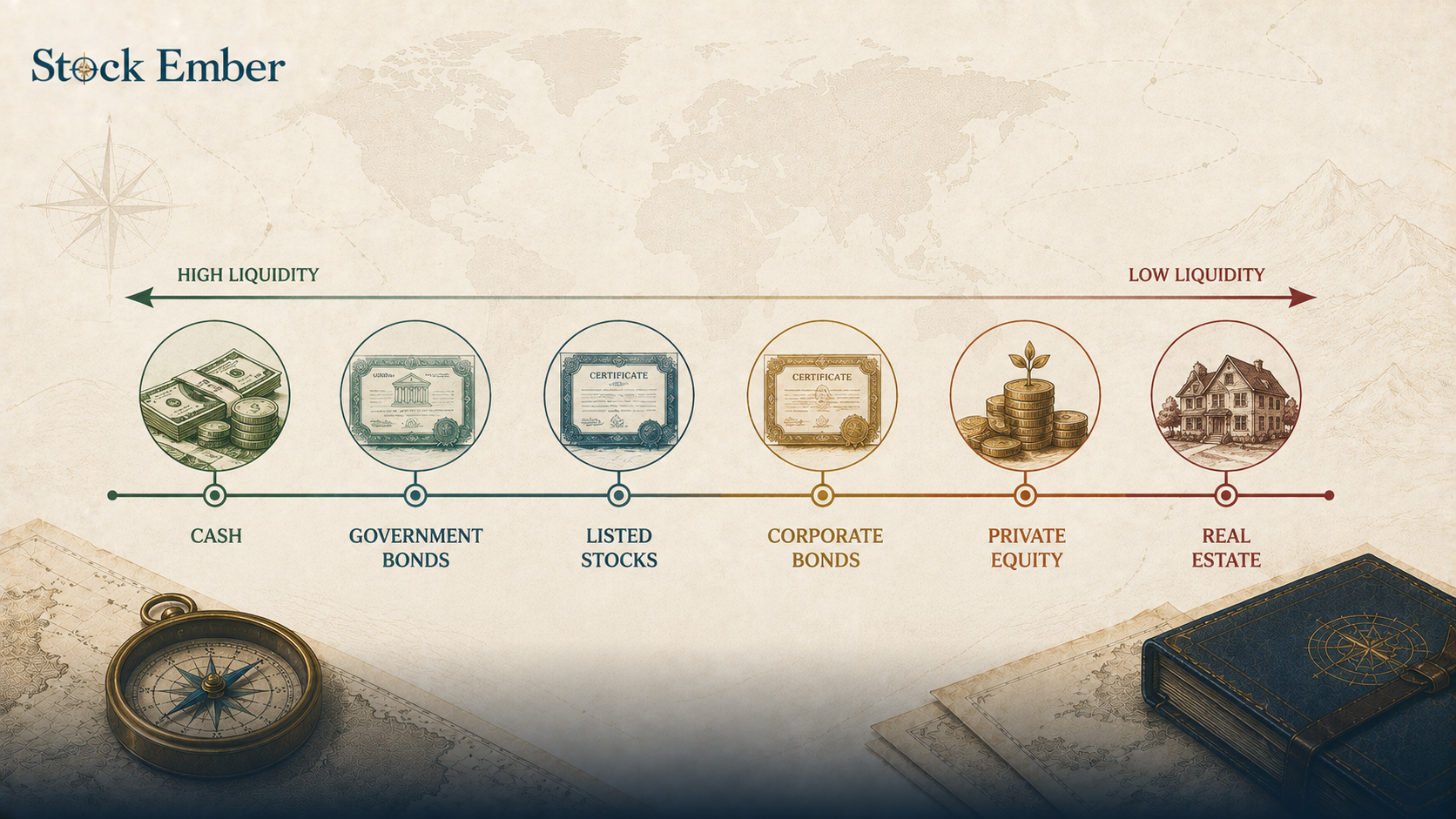
This concept exists on a broad spectrum, from instantly convertible cash to highly illiquid physical assets.
At the liquid end sit cash, short-term government bonds, large-cap stocks, and broad index funds. These assets trade in massive global markets with millions of daily transactions, keeping buying and selling costs low.
At the illiquid end sit real estate, private businesses, physical artwork, and rare collectibles. Selling a house or private company takes months of negotiation, listing fees, and paperwork. If you need cash immediately, selling an illiquid asset usually requires accepting a heavy price discount.
Chart showing the liquidity spectrum of different asset classes
In practice, many long-term investors find that true liquidity only matters when they actually need to rebalance or withdraw cash, making daily trading volume far less important than overall market depth.
How ETF Liquidity Really Works
Exchange-traded fund liquidity differs fundamentally from individual stock liquidity because ETFs have an open-ended creation and redemption structure.
When evaluating a single stock, daily share volume is the primary measure of liquidity. However, an ETF's liquidity depends on the liquidity of the underlying assets held inside the fund portfolio.
Specialized institutional firms, known as Authorized Participants, continuously create new ETF shares or redeem existing shares to meet demand. If a broad market ETF has low daily share volume but holds liquid large-cap stocks, an Authorized Participant can instantly create new fund shares at fair value. Therefore, long-term investors should evaluate the liquidity of the basket of securities inside the ETF rather than relying solely on average daily share volume.
Why Market Liquidity Matters During a Maximum Drawdown
It plays a major role during periods of severe market downturns or economic stress.
During a steep market drop, overall liquidity can dry up rapidly as buyers step back. In an illiquid environment, bid-ask spreads widen significantly, meaning sellers must take much lower prices to exit holdings.
If an investor panics during a maximum drawdown, the total percentage drop from a portfolio's peak value to its lowest point, and sells into an illiquid market, the resulting capital losses are amplified. The combination of falling prices and wide bid-ask spread friction creates unnecessary portfolio damage. Staying invested in deep, liquid market structures ensures that normal rebalancing transactions do not suffer from price distortion during volatile market periods.
Market Liquidity and Passive Investing Strategy
Adopting a systematic buy-and-hold strategy reduces the negative effects of trading friction on long-term wealth accumulation.
The core principle of passive investing is holding diversified, low-cost index funds over multi-decade horizons. Because broad index funds hold hundreds or thousands of liquid securities, they benefit from tight bid-ask spreads and deep trading markets.
Example
Bid-Ask Spread
Investor Impact
Highly liquid index fund
~0.01%
Lower trading friction
Less liquid fund
~0.50%
Higher trading friction
Over a 10-year holding period, trading friction like wide spreads and price slippage acts as a silent tax on capital. Imagine trading in and out of illiquid funds with an average bid-ask spread cost of 0.50% per transaction. Making frequent trades over a decade can erode thousands of dollars in compound returns.
Choosing broad, liquid index assets eliminates this hidden tax, keeping your capital compounding efficiently. Public regulatory bodies like the U.S. Securities and Exchange Commission (SEC) highlight order execution quality and trading spread impacts through investor education resources.
Common Liquidity Mistakes Long-Term Investors Make
Investors frequently misjudge liquidity in three common ways:
Avoiding Low-Volume ETFs Unnecessarily: Passing up a low-cost index ETF simply because its daily share volume looks low, ignoring that the underlying holdings are exceptionally liquid.
Using Market Orders in Volatile Hours: Executing market orders right at the market opening bell when bid-ask spreads are widest, causing execution friction.
Underestimating Illiquidity Risk in Niche Assets: Placing too much capital into specialized niche funds or private investments without accounting for the cost of selling during market stress.
Conclusion
Market liquidity is a fundamental feature that determines how efficiently you can convert assets into cash without sacrificing value. By focusing your portfolio on broad, highly liquid index funds and avoiding emotional trading during market downturns, you protect your capital from unnecessary transaction costs and price slippage. Maintaining a disciplined approach to asset selection keeps your long-term compounding path smooth and cost-effective.
When you are ready to explore low-cost, highly liquid index options for your portfolio, checking our ETF reviews is a great next step. Investing always involves risk of capital loss and past liquidity patterns do not guarantee future market behavior, so use these concepts as educational tools for personal portfolio discipline.
FAQ
5 questions
What is an example of a liquid asset vs. an illiquid asset?
Cash, short-term Treasuries, and large-cap stocks are highly liquid assets because they can be bought or sold in seconds at current market prices. In contrast, real estate, private business equity, and rare physical collectibles are illiquid assets that can take months to sell and often require steep price discounts for quick cash conversion.
Why does ETF liquidity depend on underlying holdings?
Exchange-traded fund liquidity relies on institutional Authorized Participants who create or redeem ETF shares based on demand. Even if an ETF trades low daily share volume, its true liquidity matches the liquidity of the underlying stocks or bonds inside the fund basket, ensuring fair execution prices.
How does market liquidity affect bid-ask spreads?
Higher liquidity creates narrower bid-ask spreads because numerous active buyers and sellers compete on price. In contrast, low liquidity causes spreads to widen, forcing buyers to pay higher prices and sellers to accept lower prices, which increases transaction costs for investors.
What is price slippage in stock trading?
Price slippage occurs when an order is executed at a different price than expected, usually due to low market liquidity or rapid market movements. Slippage happens when there are insufficient buy or sell orders at the quoted price, forcing the transaction to fill at worse price levels.
How does low liquidity impact long-term portfolio returns?
Low liquidity increases hidden trading costs through wider bid-ask spreads and price slippage. Over a 10-year holding period, paying high transaction friction on every purchase, sale, or rebalancing trade acts as a silent drag on compound wealth accumulation.
Disclaimer
This guide was written with AI assistance and reviewed by the StockEmber editorial team for accuracy. StockEmber provides independent education, not personal financial advice. Some links may support our work at no additional cost to you.
The StockEmber Team is our in-house desk of independent research writers. We test brokerage platforms, read the fine print on fees and custody, and cover ETFs and long-horizon investing for people who plan to hold for decades — not days.