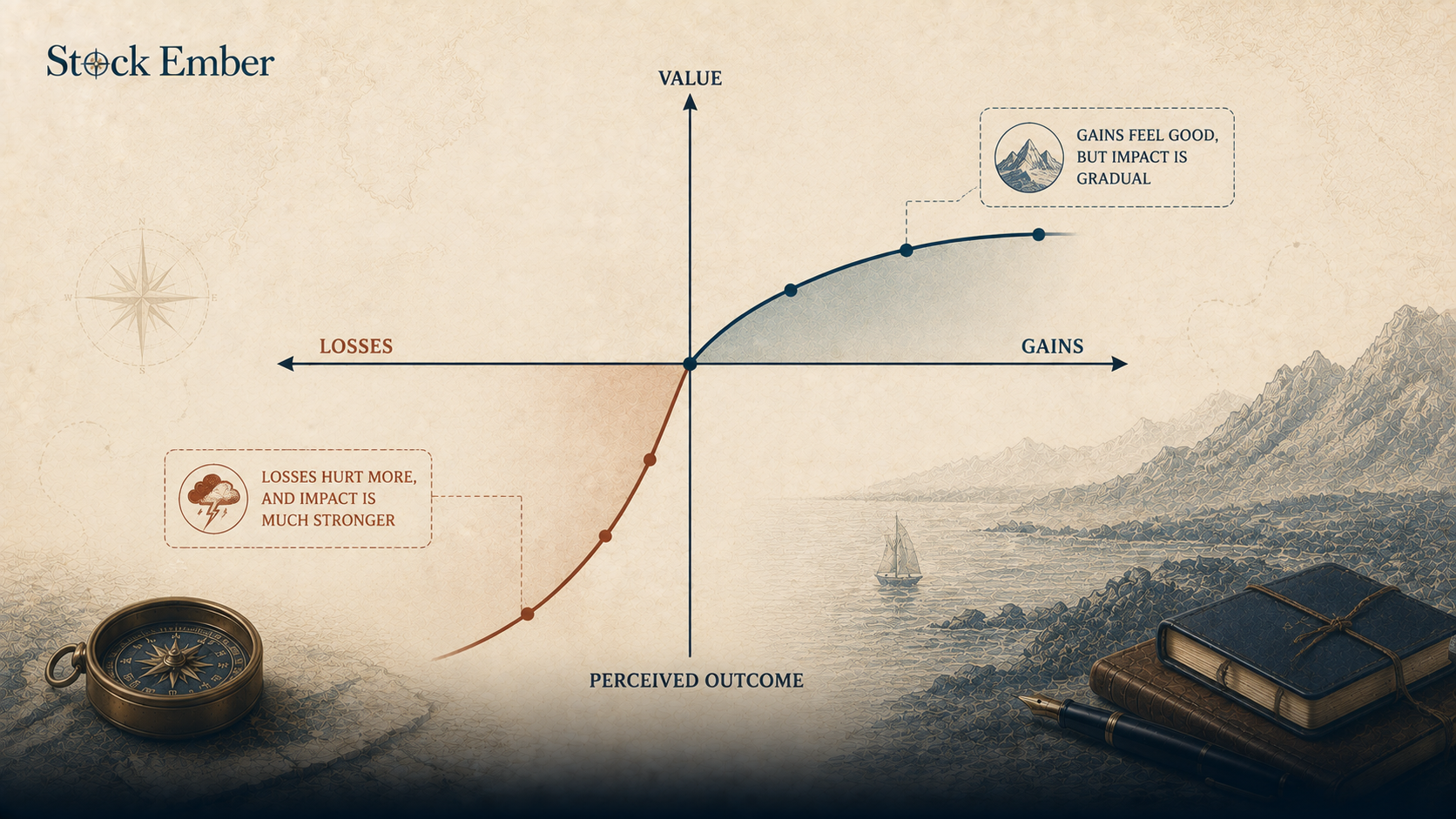
Loss aversion is a cognitive bias where the emotional pain of a financial loss is felt roughly twice as intensely as the pleasure of an equivalent gain. A classic loss aversion example is an investor panic-selling stocks during a market dip to avoid short-term pain, which locks in paper losses and harms long-term compounding.
This asymmetry shows up everywhere, from casual coin-flip bets to major portfolio decisions, which is why understanding it is the first step toward more rational, long-term investing.
Fearing a $1,000 portfolio drop far more than enjoying a $1,000 gain often leads investors to make reactive decisions during market downturns. This guide defines how this psychological principle works, examines a practical loss aversion example, highlights a classic loss aversion bias example in stock portfolios, and shows how to avoid panic-driven mistakes over a 10-year holding period., and shows how to avoid panic-driven mistakes over a 10-year holding period.
Quick Takeaways
01Loss aversion causes investors to fear potential losses far more than they value equivalent gains.
02Panic-selling during market drawdowns locks in paper losses and harms long-term portfolio compounding.
03Holding excess cash out of fear exposes long-term savings to inflation drag.
04Automated index investing helps distance daily portfolio decisions from emotional reactions.
What Is Loss Aversion in Behavioral Finance?
In the field of behavioral finance, loss aversion describes the human tendency to weigh financial losses far heavier than equal financial gains.
First introduced by psychologists Daniel Kahneman and Amos Tversky in their 1979 Prospect Theory, loss aversion describes how losses tend to carry greater psychological weight than equivalent gains. Later research by Tversky and Kahneman (1992) estimated a loss-aversion coefficient of about 2.25, although the strength of this effect can vary across individuals and situations.
This psychological wiring evolved to help humans avoid physical danger, but in financial markets, it often causes irrational choices. Instead of evaluating investments using clear probabilities and long-term expected returns, loss-averse investors focus primarily on avoiding short-term drops in account value.
Real-World Loss Aversion Examples
A classic everyday example of loss aversion is refusing a coin-toss bet where losing costs $100 while winning pays $150, even though the mathematical odds favor the player.
Because the threat of losing $100 causes greater emotional weight than winning $150, most people reject the offer despite the positive statistical edge.
In stock investing, a clear loss aversion bias example occurs when you panic-sell shares during a temporary market downturn to stop the immediate emotional pain of declining account values. By selling at the bottom of a decline, you convert a temporary paper loss into a permanent capital loss.
Another common example of loss aversion is keeping long-term retirement savings in low-yielding bank accounts rather than stock index funds. While holding cash avoids short-term market price fluctuations, it accepts an almost certain loss of purchasing power to inflation over multi-year horizons.
Graph illustrating asymmetry between emotional pain of loss and pleasure of gain.
The 10-Year Opportunity Cost: Panic Selling vs. Staying Invested
The 10-year opportunity cost of loss aversion is the cumulative growth you lose by moving into cash during market pullbacks rather than staying invested in broad market index funds.
When market volatility increases, loss aversion creates a strong urge to escape further price drops. However, exiting the market during drawdowns usually means missing the subsequent market recovery.
Consider this hypothetical, illustrative $50,000 portfolio held over a 10-year period (actual returns will vary):
The Loss-Averse Investor: Exits to cash during a market drop, earning an average 1% annual yield in savings over ten years. The $50,000 grows to roughly $55,200.
The Disciplined Index Investor: Remains invested through market swings, assuming an average 7% annual net return. The $50,000 grows to approximately $98,350 over ten years.
Fleeing to cash to avoid short-term emotional pain costs the loss-averse investor over $43,000 in lost compounding growth over a single decade.
After market prices recover, investors often convince themselves, falsely, that they predicted the crash all along. This false belief reinforces their fear, making them hesitant to reinvest until stock prices reach new highs. Research from Vanguard highlights that staying invested through periods of market volatility can help investors avoid missing strong recovery days that may be important to long-term returns.
Common Pitfalls: The Disposition Effect and Cash Drag
The most frequent investor traps driven by loss aversion are holding declining assets too long to avoid recognizing a loss and keeping excess money in cash.
Loss aversion directly drives the "disposition effect", the tendency for investors to sell winning investments too early to secure a profit while holding onto losing investments far too long. Selling a losing stock forces you to accept that the decision failed. To avoid that emotional discomfort, investors keep holding declining assets, hoping to break even, while better opportunities pass by.
Another major pitfall is long-term cash drag. Keeping large sums in cash feels safe because the nominal dollar balance does not decline on a statement. However, over a 10-year horizon, inflation steadily reduces what those dollars can buy, creating a silent real loss.
In practice, many long-term investors automate their monthly contributions to broad index funds, removing daily price checking from their routines to reduce emotional stress.
Conclusion
Recognizing every loss aversion example in your daily choices helps you build mechanical systems that protect your portfolio from panic-driven decisions. By understanding that emotional fear exaggerates short-term market drops, you can focus on multi-decade goals rather than temporary portfolio swings. When you are ready to explore broad index funds that make long-term buy-and-hold investing simple, our ETF reviews offer a clear starting point. All investing carries risk including potential capital loss, so treat this guide as educational context rather than personalized financial advice.
FAQ
5 questions
What is a simple example of loss aversion in everyday life?
A classic everyday example of loss aversion is rejecting a coin-toss bet where losing costs $100 while winning pays $150. Even though the mathematical odds favor the player, the emotional fear of losing $100 outweighs the potential joy of winning $150.
How does loss aversion affect stock market investors?
Loss aversion causes investors to react emotionally to short-term market drops. Investors often panic-sell at market troughs to stop immediate emotional pain, locking in real losses and missing out on subsequent market recoveries.
What is the difference between loss aversion and risk aversion?
Risk aversion is a rational preference for lower uncertainty or volatility when evaluating prospective investments. Loss aversion is an emotional bias where an investor evaluates choices based primarily on avoiding losses relative to a reference point, even when taking on the risk is mathematically favorable.
What is the disposition effect in loss aversion?
The disposition effect is an investor behavior driven by loss aversion where individuals sell winning investments too quickly to secure a gain while holding onto losing investments far too long to avoid admitting a loss.
How can long-term investors overcome loss aversion bias?
Long-term investors overcome loss aversion by automating monthly investments into broad market index funds, focusing on multi-decade horizons, and removing daily price checking to distance decisions from short-term emotional swings.
Disclaimer
This guide was written with AI assistance and reviewed by the StockEmber editorial team for accuracy. StockEmber provides independent education, not personal financial advice. Some links may support our work at no additional cost to you.
The StockEmber Team is our in-house desk of independent research writers. We test brokerage platforms, read the fine print on fees and custody, and cover ETFs and long-horizon investing for people who plan to hold for decades — not days.