If your portfolio leans toward growth and technology names, expect more price swings around the keynote than if you hold mostly value or defensive stocks.
The Jackson Hole Fed meeting is an annual macroeconomic policy symposium hosted by the Federal Reserve Bank of Kansas City rather than an official interest-rate-voting meeting. Keynote speeches at the event influence stock market valuations because central bank signals alter interest rate expectations and equity discount rates across growth and value sectors.
Understanding the Jackson Hole impact on market pricing helps investors separate short-term noise from long-term signal.
The jackson hole fed meeting—officially the Jackson Hole Economic Symposium—is an annual macroeconomic conference hosted by the Federal Reserve Bank of Kansas City, where global central bankers discuss monetary policy frameworks rather than vote on interest rates.
Wall Street tends to hold its breath every year around one speech delivered in a small town in Wyoming, as rate expectations set at the podium feed directly into equity valuation models. For long-term buy-and-hold investors, understanding how these policy signals influence growth and value sectors helps separate temporary single-day market swings from true decade-long portfolio performance. Here is what to expect from Jackson Hole 2026 and how to prepare without overreacting.
Quick Takeaways
01The jackson hole fed meeting is an annual academic policy forum hosted by the Kansas City Fed, not an official rate-setting Federal Open Market Committee (FOMC) decision meeting.
02Keynote speeches at the jackson hole economic symposium influence stock valuations because monetary policy signals alter interest rate expectations and equity discount rates.
03High-duration growth and technology stocks experience greater price sensitivity to central bank speeches than value or defensive sectors.
04Single-day market swings following jackson hole stock market keynotes average out over a 10-year holding period, making tactical portfolio changes counterproductive for index investors.
What Does Jackson Hole Have to Do With Stocks?
Jackson Hole affects the stock market because central bank keynote speeches set global expectations for future interest rates, which directly determine the discount rates used to calculate corporate equity valuations.
The event, officially known as the jackson hole economic symposium, has been organized annually by the Federal Reserve Bank of Kansas City at Jackson Lake Lodge in Grand Teton National Park, Wyoming, since 1982. Why does the Fed go to Jackson Hole? Originally chosen partly to attract Paul Volcker with premier fly-fishing, the remote mountain setting provides central bankers, finance ministers, and academic economists an informal venue to discuss structural economic challenges away from Washington, D.C.
Crucially, investors must distinguish between an academic conference and a decision-making summit:
Academic Forum: The jackson hole symposium features policy research papers and high-level speeches. No official votes are taken, and no interest rate targets are formally changed during the conference.
Valuation Engine: Although non-binding, the Fed Chair’s keynote address serves as a primary vehicle for signaling future monetary policy direction. When central bank leaders hint at higher or lower benchmark rates, financial markets adjust the risk-free rate used in discounted cash flow (DCF) valuation models.
When interest rate expectations rise, future corporate earnings are discounted at a higher rate, which reduces present equity valuations. Conversely, when the Fed signals lower future borrowing costs, equity multiples tend to expand.
Does the Stock Market Move on Jackson Hole? Historical Patterns
The stock market frequently experiences sharp short-term price moves during the jackson hole fed meeting, with major stock indices reacting dynamically to whether the Federal Reserve Chair signals supportive or restrictive policy.
Historically, market volatility surrounding the summit reflects how closely keynote remarks match prior investor expectations. When the Fed Chair’s tone aligns with what financial markets have already priced in, index reactions remain muted. However, unexpected shifts in rhetoric regularly trigger pronounced swings across major benchmarks:
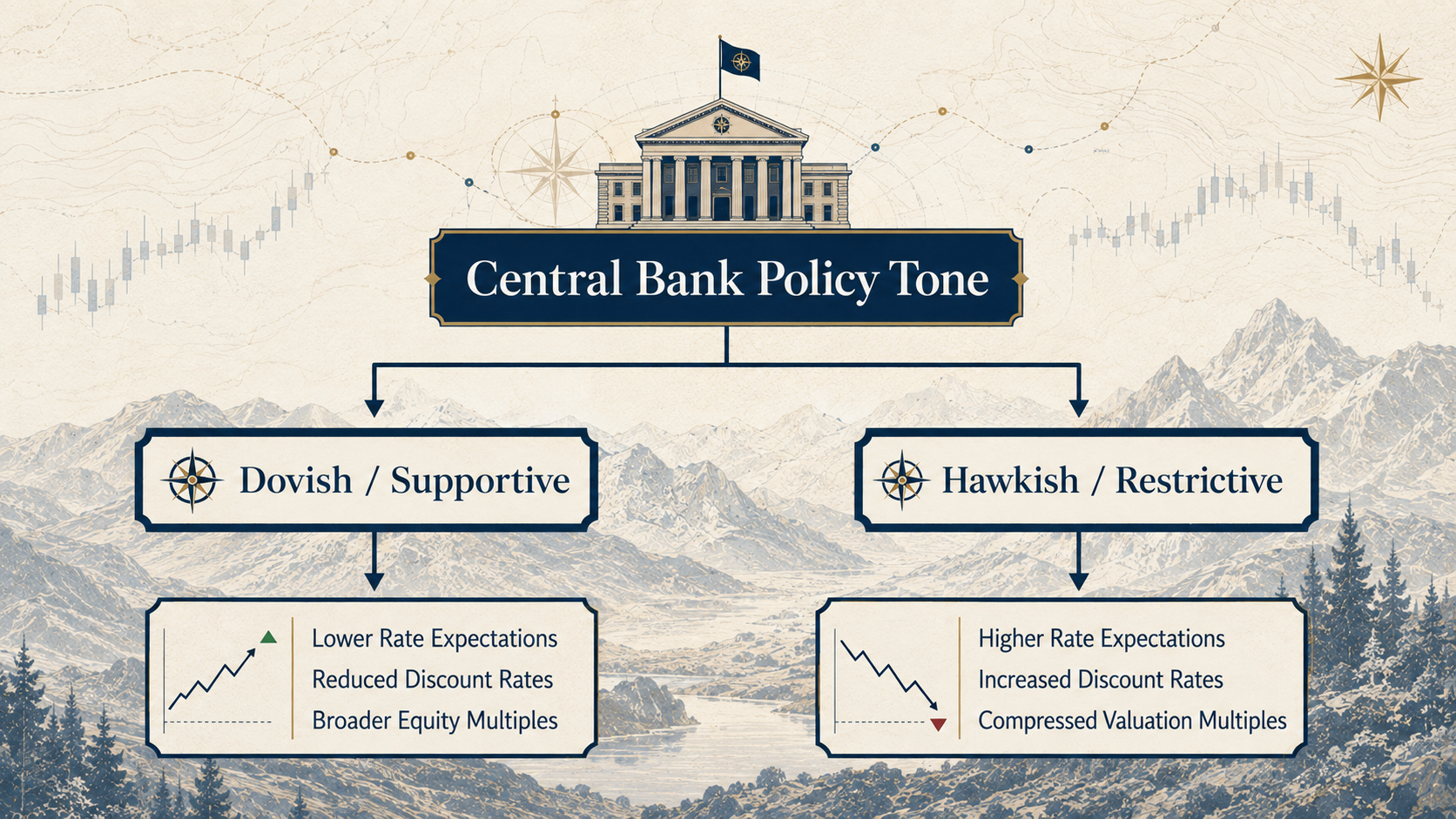
Central bank policy tone
Supportive (Dovish) Signals: Hints of easing monetary policy, rate cuts, or economic support generally lower bond yields and bolster the jackson hole stock market sentiment, pushing broad indices higher.
Restrictive (Hawkish) Signals: Firm commitments to higher interest rates or persistent inflation containment often lead to rising bond yields and short-term equity pullbacks.
Is Jackson Hole typically bullish or bearish for stocks? The historical record shows no inherent bias toward positive or negative returns. The outcome depends entirely on prevailing macroeconomic conditions, prevailing inflation dynamics, and whether the policy tone turns out softer or stricter than Wall Street anticipated.
What Sectors Are Most Affected by Fed Policy Speeches?
Growth and technology stocks are the most sensitive sectors to Federal Reserve policy speeches because their long-duration future earnings are heavily impacted by changes in interest rate discount rates.
Monetary policy signals do not affect all corners of the stock market equally. Understanding sector-level sensitivity helps long-term investors anticipate where headline volatility will concentrate:
Growth and Technology (High Sensitivity)
Technology and high-growth companies often derive a substantial portion of their valuation from cash flows expected far into the future. When policy speeches signal elevated interest rates, those distant cash flows are discounted more aggressively, leading to larger percentage drops in share prices. Conversely, dovish signals provide a disproportionate boost to high-valuation growth names.
Value and Cyclical Sectors (Moderate Sensitivity)
Value equities—such as industrial firms, consumer staples, and traditional manufacturing—typically generate steady, immediate cash flows. Because their valuations rely less on distant future growth, they generally display lower price volatility during central bank keynotes, though cyclical businesses remain sensitive to overall economic growth signals.
Rate-Sensitive Segments (High Sensitivity)
Real Estate & Utilities: Highly leveraged sectors that rely on debt financing or compete directly with fixed-income yields suffer when interest rate expectations rise.
Financials: Commercial banks often see net interest margins adjust alongside yield curve shifts, creating complex price reactions depending on whether rate moves signal economic expansion or credit tightening.
Small-Cap Stocks: Smaller businesses with floating-rate debt or frequent refinancing requirements face immediate borrowing-cost pressures when policy tones harden.
When Will Markets React to Jackson Hole 2026—and How to Prepare
Financial markets will react to Jackson Hole 2026 in real time during the Federal Reserve Chair’s keynote address in late August 2026, as trading algorithms digest policy signals within seconds of delivery.
When preparing for the 2026 symposium, buy-and-hold investors must focus on decade-long strategy rather than single-day price action:
To avoid costly behavioral mistakes during the 2026 event, keep three principles in mind:
Avoid Overreacting to Single-Day Swings: Attempting to sell equities ahead of the keynote to "buy back lower" introduces significant friction. Over a 10-year holding period, short-term speech reactions smooth out into minor blips on a long-term return chart.
Account for the 10-Year Cost of Market Timing: Liquidating positions around macro headlines triggers bid-ask spreads, trading fees, and capital gains taxes. On a $100,000 portfolio held over ten years, frequent panic-selling and re-entry introduces real, compounding frictional costs — bid-ask spreads, fees, and taxes — that can meaningfully erode long-term wealth accumulation compared to staying invested.
Review Sector Exposure Ahead of Time: Rather than trading the speech, ensure your portfolio already maintains a balanced asset allocation across broad market index funds. If you're holding a long-term index portfolio, the healthiest response is simple — check your allocation ahead of time, then let the speech pass without touching your positions.
Disciplined dollar-cost averaging through macroeconomic speeches ensures your portfolio continues compounding without falling prey to headline-driven anxiety.
Conclusion
The Jackson Hole Fed meeting remains one of the most closely watched macroeconomic events on the financial calendar, providing critical insight into interest rate trajectories, discount rate mechanics, and central bank policy frameworks. However, while keynote speeches routinely generate short-term volatility across growth and rate-sensitive sectors, single-day market swings carry little structural weight for a 10-year investment horizon. Avoiding emotional reactions, maintaining broad index diversification, and letting long-term corporate earnings drive compounding remain a historically resilient approach for long-term equity investors, based on the decade-long patterns discussed above.
For a quick Jackson Hole meeting result, dovish tone typically lifts growth stocks, while hawkish tone pressures them lower — read our full Fed Chair Jackson Hole speech summary above for the historical pattern.
When evaluating how macro policy shifts fit into a long-horizon financial plan, exploring disciplined investment strategies helps keep your portfolio aligned with decade-long goals rather than short-term headline swings.
FAQ
6 questions
What does Jackson Hole have to do with stocks?
The Jackson Hole Fed meeting influences stock market valuations because central bank keynote speeches signal future monetary policy directions. When the Federal Reserve Chair discusses inflation or interest rate paths, financial markets update the discount rates used to calculate present stock valuations, impacting growth and value equities alike.
Why does the Fed go to Jackson Hole?
The Federal Reserve Bank of Kansas City has hosted its annual economic symposium at Jackson Lake Lodge in Wyoming since 1982. The scenic, informal mountain setting allows global central bankers, finance ministers, and academic economists to discuss long-term structural economic issues outside Washington, D.C., without the immediate pressures of voting on official interest rate decisions.
Does the stock market move on Jackson Hole?
Yes, the stock market frequently experiences short-term volatility surrounding the Jackson Hole keynote speech. Market reactions depend on whether the Federal Reserve Chair's remarks align with existing investor expectations or signal unexpected shifts toward supportive (dovish) or restrictive (hawkish) interest rate policies.
What sectors are most affected by Fed policy speeches?
Growth and technology stocks are the most sensitive to Federal Reserve speeches because their long-duration valuations depend heavily on interest rate discount rates. Rate-sensitive sectors like real estate, utilities, and small-cap stocks with floating-rate debt also experience elevated volatility, while defensive value equities generally show greater resilience.
Is Jackson Hole typically bullish or bearish for stocks?
Jackson Hole is neither inherently bullish nor bearish. Stock market direction following the event depends entirely on prevailing macroeconomic conditions, current inflation trends, and whether the Federal Reserve Chair's keynote tone turns out softer or stricter than Wall Street investors had previously priced in.
When will markets react to Jackson Hole 2026?
Stock markets will react to Jackson Hole 2026 in real time during and immediately following the Federal Reserve Chair's keynote speech in late August 2026. Automated trading algorithms digest speech transcripts within milliseconds, generating short-term volatility that typically stabilizes as corporate earnings data resumes driving equity markets.
Disclaimer
This guide was written with AI assistance and reviewed by the StockEmber editorial team for accuracy. StockEmber provides independent education, not personal financial advice. Some links may support our work at no additional cost to you.
The StockEmber Team is our in-house desk of independent research writers. We test brokerage platforms, read the fine print on fees and custody, and cover ETFs and long-horizon investing for people who plan to hold for decades — not days.