Investing in emerging markets involves allocating capital to stocks or funds in developing nations undergoing rapid industrial growth. While these markets offer higher economic expansion potential, investors must navigate currency swings, political shifts, and corporate share dilution.
Investing in emerging markets means buying stocks or funds in developing nations that are rapidly expanding their industrial bases, financial systems, and consumer economies.
When looking for higher growth outside developed economies, adding international exposure can be appealing. However, developing economies present unique challenges, including currency swings and political shifts. This guide explains how emerging market equities function, how to evaluate their 10-year holding costs, and how to manage foreign risk in a buy-and-hold portfolio.
02National economic GDP growth does not guarantee stock market returns due to currency drops and stock dilution.
03Broad-market index funds help investors gain international exposure while managing individual country risks.
04Higher fund management fees and currency fluctuations can reduce net returns over a 10-year holding period.
What Are Emerging Markets?
Emerging markets are economies with developing capital markets that are more established and accessible than frontier markets but do not yet meet developed-market classification standards.
Index providers like MSCI classify countries based on market size, liquidity, and operational accessibility for foreign investors. Common examples include Brazil, India, South Africa, and Mexico. These markets typically feature expanding industrial capacity, rising urbanization, and growing domestic consumer bases.
While these markets include some of the world's most populous and economically significant countries, their financial markets are generally smaller and less mature than those in the United States or Western Europe. As a result, regulations, trading volumes, and investor protection standards vary widely across borders.
Advantages of Investing in Emerging Markets
The main advantages of investing in emerging markets include access to faster-growing economies, favorable demographics, and broader portfolio diversification.
Developing countries often experience faster gross domestic product (GDP) growth than mature economies, driven by young workforces and expanding domestic consumption. As household incomes rise across these regions, consumer spending on technology, healthcare, and financial services increases.
From a portfolio perspective, holding equities across emerging regions provides geographic diversification. Because developing stock markets do not always move in tandem with major US or European indexes, adding an international equity allocation can help smooth out long-term portfolio swings across different market cycles.
The Core Risks: Why High GDP Growth Doesn't Equal High Stock Returns
High national GDP growth does not automatically lead to strong stock market returns because currency devaluation, political changes, and corporate share dilution can erode investor profits.
Many investors assume that a fast-growing economy guarantees rising stock prices. However, economic growth measures national output, whereas stock returns depend on earnings per share and valuation changes. In many developing countries, fast GDP growth occurs alongside frequent issuance of new company shares, which dilutes existing shareholders.
Key risk factors include:
Currency Risk: If a developing country's currency depreciates against the US dollar, gains earned in local stock markets shrink when converted back into your home currency.
Political and Governance Risk: Changes in government regulations, foreign ownership caps, or state intervention can suddenly impact corporate profitability.
Global Macroeconomic Shifts: Global credit cycles affect emerging economies heavily. For instance, when fixed-income markets signal economic shifts through an inverted yield curve, capital often flows out of developing markets back into safer developed-nation assets.
The 10-Year Portfolio Lens: Passive Allocation and Holding Costs
Evaluating emerging market investments over a 10-year horizon highlights the impact of ongoing fund expenses and trading fees on compounding returns.
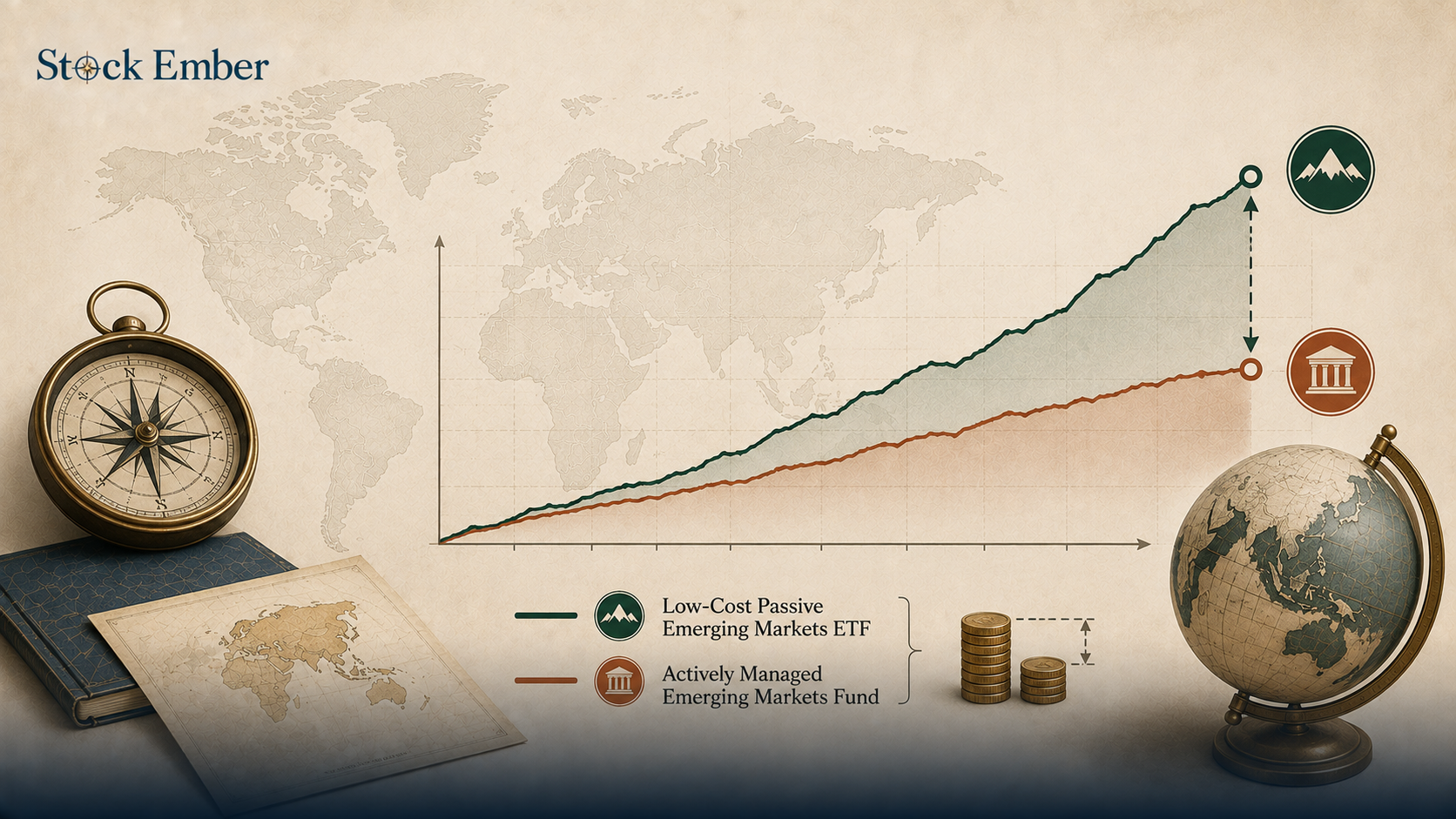
Because investing directly in individual foreign stocks involves complex tax filings, foreign exchange fees, and restricted market access, most investors use exchange-traded funds (ETFs). Over a decade, ongoing fund fees can create noticeable fee drag on your total wealth.
For example, consider a $20,000 investment held over ten years:
Active Emerging Markets Fund: An actively managed fund charging a 0.85% annual expense ratio costs approximately $1,700 in direct management fees over a decade, assuming a 5% average annual return.
Passive Index ETF: A low-cost broad index fund charging a 0.12% expense ratio costs roughly $240 over the same 10-year period.
Choosing a disciplined passive investing approach allows you to capture broad market exposure across dozens of countries while avoiding high active management fees. Holding a broad index fund also reduces the risk of overexposure to any single country's political turmoil.
Chart showing 10-year fee comparison between active and passive emerging market funds.
Common Pitfalls: The GDP Growth Trap and Single-Country Concentration
The most frequent mistake investors make in developing markets is placing large bets on a single country or confusing rapid GDP figures with corporate profit growth.
Concentrating capital in one developing country exposes your entire investment to local political decisions and economic shocks. Broad regional diversification spreads this risk across hundreds of companies in multiple nations.
Another common error is chasing recent performance. Emerging markets often experience multi-year cycles of strong outperformance followed by extended periods of flat or negative returns. Attempting to time these entry and exit points often results in buying at market peaks and selling during temporary pullbacks.
In practice, long-term investors often maintain a modest, fixed allocation such as 5% to 10% of their total equity portfolio rebalancing periodically to keep risk levels steady.
Conclusion
Investing in emerging markets offers long-term growth potential and global diversification, provided you manage currency risks, political volatility, and fund expenses. Keeping holding costs low through broad-market index funds protects your portfolio from unnecessary fee drag while maintaining exposure to expanding economies. When you are ready to compare broad international index funds for your portfolio, our ETF reviews provide a clear breakdown of low-cost options. Investing involves risk including potential loss of principal, so treat this guide as educational context rather than individual financial advice.
FAQ
5 questions
What are the main advantages of investing in emerging markets?
The key advantages include exposure to faster economic growth, favorable population demographics, expanding middle-class consumption, and geographic portfolio diversification that can reduce long-term portfolio swings.
Is economic GDP growth directly linked to emerging market stock returns?
No, national GDP growth measures total economic output, whereas stock returns depend on corporate profit growth and valuations. High GDP growth often occurs alongside currency devaluation, state regulation, or share dilution, which can erode net equity returns.
How do currency fluctuations affect emerging market investments?
If an emerging nation's currency depreciates against your home currency, your investment gains earned in local markets shrink when converted back to your home currency, creating currency drag on your total return.
What is the difference between MSCI and FTSE emerging market indexes?
The main difference lies in country classification. For instance, FTSE classifies South Korea as a developed market, whereas MSCI classifies it as an emerging market. Consequently, broad index funds tracking these different benchmarks hold slightly different country weightings.
What portion of a portfolio should be allocated to emerging markets?
Many long-term investors maintain a modest allocation of 5% to 10% of their total equity portfolio in broad emerging market index funds to balance growth opportunities against currency and political risks.
Disclaimer
This guide was written with AI assistance and reviewed by the StockEmber editorial team for accuracy. StockEmber provides independent education, not personal financial advice. Some links may support our work at no additional cost to you.
The StockEmber Team is our in-house desk of independent research writers. We test brokerage platforms, read the fine print on fees and custody, and cover ETFs and long-horizon investing for people who plan to hold for decades — not days.