Investing during a recession involves maintaining a disciplined, long-term asset allocation by continuing to buy broad-market equities at depressed prices using ongoing income. Successful market participation requires holding an accessible emergency cash fund first to avoid selling shares during temporary downturns or job disruptions.
Investing during a recession means sticking to a disciplined asset allocation strategy by continuing to buy diversified assets at reduced prices using excess income while keeping core cash reserves safe.
When economic growth shrinks and negative headlines multiply, buying stocks often feels uncomfortable. Many investors feel tempted to pause their contributions or sell holdings to avoid further losses. However, sitting on the sidelines can permanently hurt long-term growth. This guide explains how economic downturns affect equity markets, why stock recoveries start early, and how to maintain portfolio discipline without taking unnecessary risk.
Quick Takeaways
01Stock markets are forward-looking mechanisms that usually trough months before an economic recession officially ends.
02Securing a liquid emergency cash fund is a necessary prerequisite before putting fresh income into equities.
03Dollar-cost averaging into broad index funds helps investors buy shares at lower valuations without attempting market timing.
04Panic selling during market drawdowns permanently locks in paper losses and hurts 10-year compounding performance.
Recession vs. Market Drawdown: What Changes for Equities?
An economic recession is a broad decline in economic activity across two or more consecutive quarters, whereas a market drawdown refers specifically to the percentage drop in stock prices from their previous peak.
While recessions reflect real economic contraction, such as rising unemployment and falling corporate earnings, stock prices represent collective expectations about future profits. Consequently, market drawdowns often begin well before an official economic contraction is declared. When equity prices fall, long-term investors face lower asset valuations, which increases long-term expected returns for fresh capital.
Before putting additional money into stocks during a downturn, you must protect your baseline household security. Equity prices can remain volatile or fall further during prolonged contractions. Holding three to six months of living expenses in an accessible high-yield savings account ensures you will not be forced to sell shares at depressed prices during an unexpected job loss or income disruption.
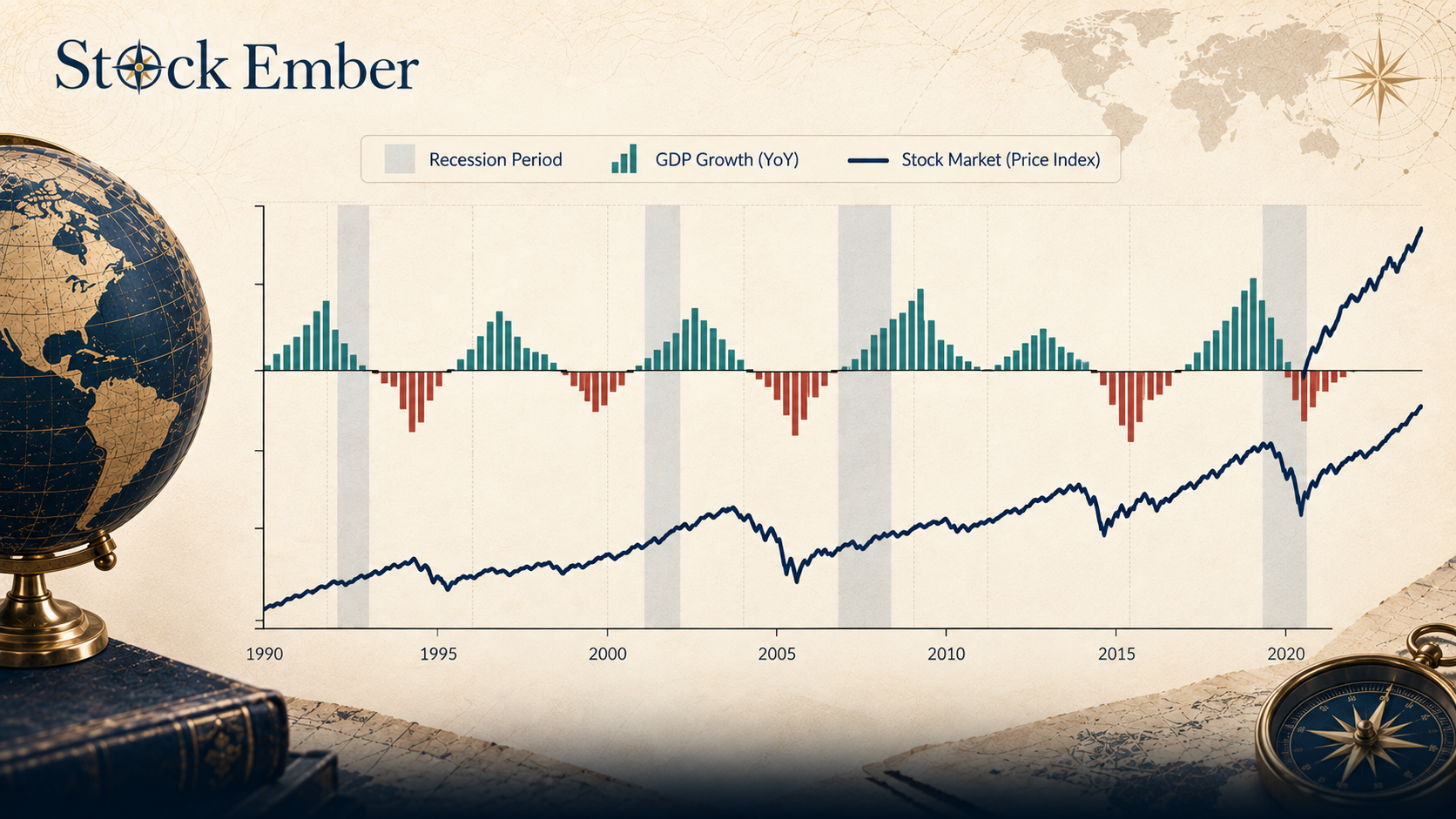
Visual chart showing difference between GDP contractions and stock market drawdowns
The Forward-Looking Market: Why Stocks Recover Before Recessions End
Stock markets act as discounting mechanisms, pricing in future economic recovery long before official economic reports confirm that conditions have improved.
Backward-looking indicators likeGross Domestic Product (GDP) and employment figures report what has already happened over previous months. By the time official data confirms a recession is underway, equity markets have often priced in much of the damage. Historically, stock indices hit their lowest point and begin recovering several months before economic contractions reach their official end, with a historical average lead time of 3 to 6 months.
Investors who wait for good economic news before buying often miss the earliest, strongest days of a market recovery. Missing those initial rally days can significantly lower overall multi-year returns. Understanding where equity price swings sit within the broader market cycle helps long-term investors remain patient when headlines sound worst. Equities adjust to future expectations, meaning buying opportunities frequently appear when economic reports look discouraging.
Core Strategies for Investing During an Economic Downturn
The most reliable strategy for investing during an economic downturn is consistent dollar-cost averaging into low-cost, broad-market index funds or ETFs.
Dollar-cost averaging involves investing a fixed sum of money at regular intervals, regardless of whether stock prices are rising or falling. When markets drop, your fixed contribution automatically buys a larger number of fund shares at lower prices. When markets rise, the same contribution buys fewer shares. This systematic process removes emotional decision-making and prevents you from trying to guess short-term price movements.
Focusing on broad market exposure, such as funds tracking total stock market indices, reduces individual company risk. During a deep economic contraction, individual businesses can suffer severe earnings drops or balance sheet strain. Broad index funds hold hundreds of companies, ensuring that your portfolio stays diversified without relying on single stock picking.
Portfolio Maintenance: Rebalancing and Capital Allocation
Portfolio maintenance during a downturn involves systematically rebalancing your asset classes to restore your original risk targets.
When equity prices drop sharply, your overall portfolio balance naturally shifts. For instance, a target mix of 80% equities and 20% bonds might shift to 70% equities and 30% bonds after a stock market drawdown (the decline in value from a peak).
Rebalancing requires reallocating a portion of your stable assets, such as short-term bonds or cash equivalents, to buy equities at lower valuations. Alternatively, you can direct new regular savings into equities until your target ratios return.
In practice, systematic rebalancing feels counterintuitive because it requires moving capital into asset classes that have recently fallen in value. However, adhering to fixed allocation targets creates a disciplined mechanism to buy assets when prices are depressed.
Proper capital allocation relies on preparing for a recession well in advance by organizing household debt and spending habits. Over a ten-year horizon, small differences in execution add up. If you hold a $10,000 portfolio and stop regular contributions during a two-year downturn out of fear, you lose years of potential compounding. Reallocating capital methodically ensures your portfolio catches the full slope of the eventual economic expansion.
Pitfalls to Avoid: Market Timing, Panic Selling, and Sitting in Cash
The biggest risks for long-term investors during a recession stem from emotional reactions, such as panic selling at market bottoms or holding excess cash indefinitely.
Panic selling turns temporary paper losses into permanent capital losses. When you sell equities during a drawdown, you exit the market at depressed prices and miss the eventual recovery. Attempting to time the market, selling before a drop and buying back at the absolute bottom, is notoriously difficult. Investors who exit to cash often struggle to identify the right moment to re-enter, usually waiting until stock prices have already rebounded sharply.
Holding excessive cash beyond your required emergency fund creates its own quiet loss. While cash feels safe during market volatility, sitting on the sidelines exposes wealth to inflation drag. Equities have historically provided inflation protection over long horizons, making disciplined equity ownership essential even during difficult economic periods.
Conclusion
Investing during a recession requires a clear separation between short-term economic news and long-term portfolio management. By maintaining an emergency cash buffer, dollar-cost averaging into broad index funds, and systematically rebalancing, long-term investors can manage economic contractions without jeopardizing their financial goals.
Building a resilient portfolio depends heavily on selecting diversified, low-cost asset classes. When you are ready to evaluate core holdings for your portfolio, our ETF reviews provide a practical starting point for comparing low-cost index funds.
Remember that all investing involves risk of loss, and past market recoveries do not guarantee future performance. Treat these strategies as educational principles for structuring a patient, long-term approach to market cycles.
FAQ
5 questions
Is it better to hold cash or invest during a recession?
Holding emergency cash is essential for living expenses, but keeping all your capital in cash during a recession exposes wealth to inflation drag. Once you secure a cash buffer covering three to six months of expenses, directing surplus income into broad-market index funds allows you to purchase quality assets at lower valuations for long-term growth.
How long does a stock market recovery usually take compared to an economic recession?
Equity markets are forward-looking mechanisms that typically trough and begin recovering several months before an official economic recession officially ends. While economic contractions can last anywhere from several months to over a year, stock prices often bounce back rapidly once markets price in future economic expansion and corporate profit growth.
Should I stop contributing to my index funds during a downturn?
Pausing regular contributions during a market downturn prevents you from buying shares at discounted prices. Continuing automated contributions allows dollar-cost averaging to lower your average purchase price per share. Unless you experience a loss of income or need to replenish your emergency savings, stopping contributions often harms multi-year compounding.
What are the main risks of trying to time the market bottom?
Attempting to time the exact market bottom is extremely difficult because the strongest rally days often occur unpredictably near equity troughs. If you move capital to cash and wait for positive economic headlines before reinvesting, you risk missing the initial recovery phase, which permanently reduces overall long-term portfolio performance.
How does dollar-cost averaging help investors during a recession?
Dollar-cost averaging automatically allocates a fixed cash amount into investments at regular intervals. In a falling market, this strategy forces you to buy more fund shares when prices are cheap and fewer shares when prices are high. This disciplined mechanism eliminates emotional decision-making and protects your long-term wealth plan.
Disclaimer
This guide was written with AI assistance and reviewed by the StockEmber editorial team for accuracy. StockEmber provides independent education, not personal financial advice. Some links may support our work at no additional cost to you.
The StockEmber Team is our in-house desk of independent research writers. We test brokerage platforms, read the fine print on fees and custody, and cover ETFs and long-horizon investing for people who plan to hold for decades — not days.