Inherited IRA rules dictate how beneficiaries must withdraw funds from an inherited individual retirement account following the original owner's death. Under the SECURE Act framework, most non-spouse beneficiaries must fully deplete traditional or Roth inherited IRAs within 10 years, with annual distributions required if the owner passed away on or after their Required Beginning Date.
Inherited IRA rules are the IRS regulations governing how beneficiaries must withdraw funds from an inherited individual retirement account. These rules establish mandatory withdrawal schedules, tax obligations, and account transfer requirements based on your beneficiary status and relationship to the deceased owner.
When you inherit a retirement account, you face precise tax laws that dictate when and how you must take distributions. The SECURE Act and SECURE 2.0 Act reshaped these mandates, replacing lifetime distribution strategies for most non-spouse heirs with a strict 10-year withdrawal window. This guide breaks down current distribution schedules, tax implications across traditional and Roth accounts, and strategies to protect your savings from bracket spikes and IRS penalties.
Quick Takeaways
01Most non-spouse beneficiaries inheriting accounts after December 31, 2019, must fully deplete the inherited IRA within 10 years.
02If the original owner died on or after their Required Beginning Date, beneficiaries must take annual Required Minimum Distributions in Years 1 through 9.
03Inherited Roth IRAs must also be emptied by Year 10, but qualified withdrawals remain entirely tax-free and free of annual minimums during that window.
04Failing to take a mandatory distribution results in a 25% IRS penalty on the missed amount, which drops to 10% if corrected in a timely window.
What Are Inherited IRA Rules?
Inherited IRA rules establish the legal framework for transferring and distributing assets held inside a deceased person's retirement account. When an account holder passes away, their traditional or Roth individual retirement account transforms into a special account wrapper known as a beneficiary IRA or inherited IRA.
Understanding inheritance IRA withdrawal rules starts with account structure. You cannot simply combine inherited retirement funds with your personal traditional or Roth IRA. The inherited assets must sit in a separately titled account that names both the original owner and you as the beneficiary (for example, "Jane Doe IRA, deceased, for the benefit of John Doe").
These rules apply across all beneficiary types, but your specific relationship to the original owner determines your exact withdrawal schedule. While surviving spouses receive maximum flexibility, non-spouse heirs face structured depletion timelines designed to collect tax revenue sooner.
New Rules for Inherited IRA Distributions: The 10-Year Rule
If you are asking what are the new rules for inherited ira distributions, the answer centers on the SECURE Act. This landmark legislation eliminated the traditional "stretch IRA" for most non-spouse beneficiaries, replacing lifetime distributions with a fixed 10-year liquidation window.
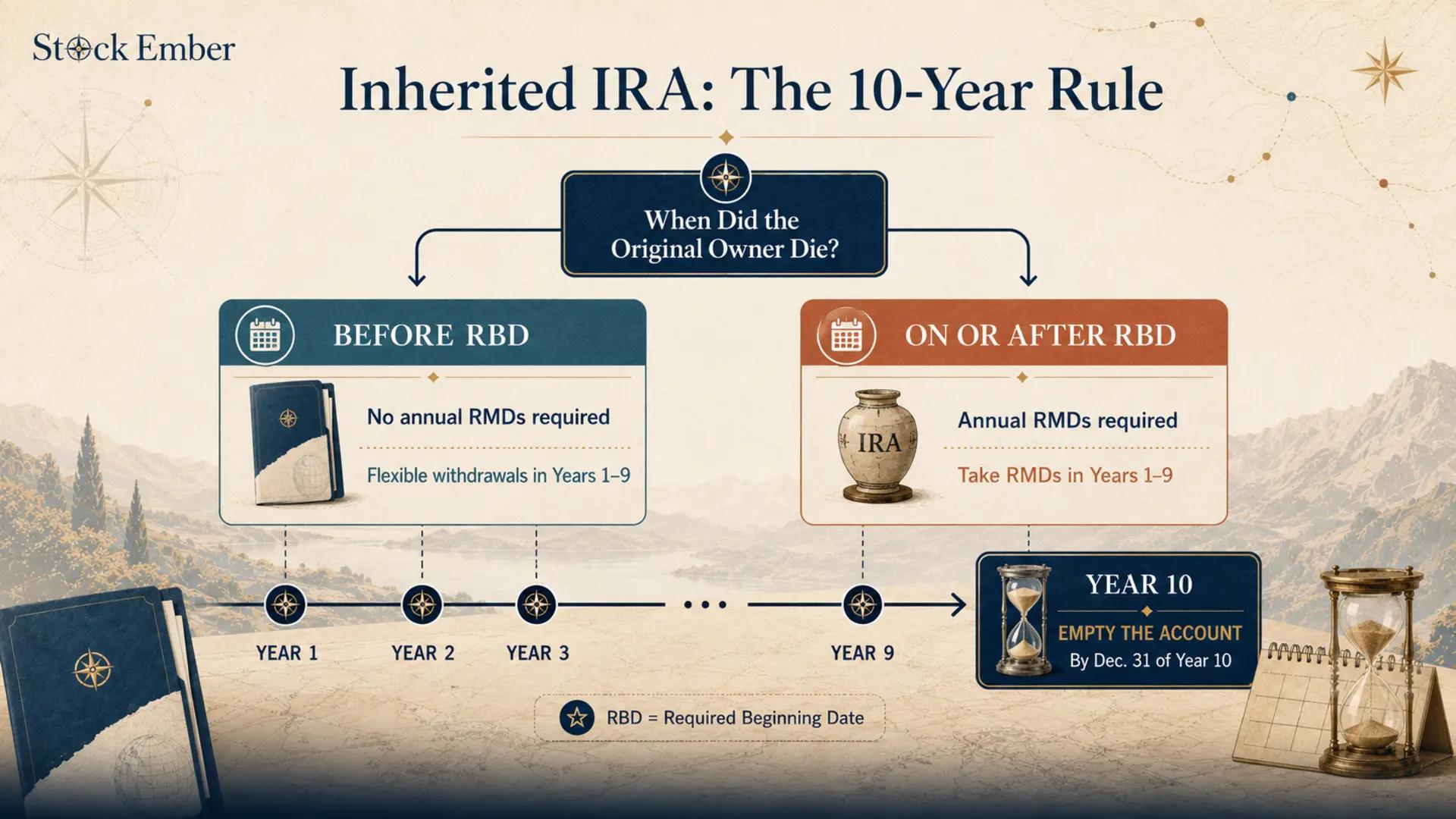
Under these inherited ira withdrawal rules, the entire balance of the account must be withdrawn by December 31 of the tenth year following the year of the original owner's death. However, final IRS guidance introduced an important distinction based on whether the original owner died before or after reaching their Required Beginning Date (RBD)—the age when mandatory withdrawals begin (age 73 for those reaching it between 2023 and 2032).
Original owner died BEFORE their Required Beginning Date: The beneficiary has full flexibility. No annual distributions are required in Years 1 through 9, as long as the account balance reaches zero by December 31 of Year 10.
Original owner died ON or AFTER their Required Beginning Date: The beneficiary must take annual Required Minimum Distributions (RMDs) during Years 1 through 9 based on their own single life expectancy. The remaining balance must then be emptied by the end of Year 10
Flowchart comparing inherited IRA distribution rules before and after owner's Required Beginning Date.
Beneficiary Categories: Eligible Designated vs. Non-Spouse Beneficiaries
IRS regulations divide beneficiaries into distinct categories, each subject to different timeline mandates.
Surviving Spouses
Surviving spouses retain the most flexible options, since the non-spouse exclusions under inherited IRA rules do not apply to them. A spouse can choose to:
Roll the inherited assets directly into their own personal IRA, deferring RMDs until they reach their own required distribution age.
Remain a beneficiary of the inherited IRA and take lifetime distributions based on their single life expectancy.
Take a lump-sum distribution (subject to ordinary income taxes for traditional IRAs).
Eligible Designated Beneficiaries (EDBs)
Certain non-spouse beneficiaries qualify for an exemption from the strict 10-year limit. These Eligible Designated Beneficiaries retain the ability to "stretch" distributions across their personal life expectancy:
Minor children of the original account owner (until they reach the age of majority—usually 21—at which point the 10-year clock begins).
Disabled or chronically ill individuals as defined by IRS tax codes.
Beneficiaries who are not more than 10 years younger than the deceased account holder.
Designated Non-Spouse Beneficiaries
Most adult children, grandchildren, relatives, and non-related individual heirs fall into this category. They are strictly bound by the 10-year account depletion rule described above.
Inherited Roth IRA Distribution Rules vs. Traditional Accounts
The underlying account type creates major differences in how distributions are taxed and managed.
Account Feature
Traditional Inherited IRA
Inherited Roth IRA
Tax Status of Withdrawals
Taxable as ordinary income
Tax-free (if qualified)
Depletion Window
10 years (for most non-spouses)
10 years (for most non-spouses)
Annual RMDs in Years 1–9
Mandatory if owner died on/after RBD
Not required (regardless of owner's age)
5-Year Holding Rule
Not applicable
Applicable to earnings if account is under 5 years old
Under inherited roth ira distribution rules, distributions are generally tax-free because the original owner contributed post-tax dollars. Furthermore, because Roth IRAs do not have RMD requirements during the original owner's lifetime, an inherited Roth IRA is always treated as passing before the owner's Required Beginning Date.
This means non-spouse beneficiaries inheriting a Roth IRA never have mandatory annual distributions in Years 1 through 9. You can allow the money to grow tax-free for the entire 10-year period before making a complete withdrawal in Year 10.
Tax-Smoothing Strategies & Avoiding the 25% RMD Penalty
These inherited IRA rules make proactive tax planning essential for every non-spouse beneficiary.
Withdrawing funds from a traditional inherited IRA increases your taxable income. Taking a sudden lump-sum withdrawal in a single year can push you into a higher marginal tax bracket, creating an unnecessary tax spike.
To manage the tax impact effectively:
Practice Tax-Bracket Smoothing: Instead of waiting until Year 10, calculate how much you can withdraw each year without pushing your household income into the next tax bracket.
Offset Income Spikes: Time your distributions during years when your income is lower (such as during sabbatical, career transitions, or early retirement), or offset taxable distributions using capital loss carryovers.
Avoid Penalty Traps: If you fail to take a required annual distribution when mandated, the IRS imposes an excess accumulation penalty of 25% on the amount that should have been withdrawn. If you correct the missed distribution within two years and submit IRS Form 5329, the penalty drops to 10%.
Conclusion
Managing an inherited individual retirement account requires careful timing to satisfy IRS rules while protecting your long-term wealth. Identifying whether you are an Eligible Designated Beneficiary or a standard non-spouse heir is the first step in setting your distribution schedule. By comparing traditional taxable distributions against tax-free Roth growth, you can establish a multi-year withdrawal strategy that limits bracket expansion and avoids steep IRS penalties.
When you are ready to evaluate platforms for managing or transferring inherited retirement assets, our broker reviews and rankings offer a practical starting point.
Investing and retirement tax rules carry inherent financial trade-offs; consider treating this guide as an educational foundation for your personal research rather than formal legal or tax advice.
FAQ
5 questions
What are the inherited IRA rules for non-spouse beneficiaries?
Most non-spouse beneficiaries who inherited an IRA after December 31, 2019, fall under the SECURE Act's 10-year rule. This requires the account to be fully depleted by December 31 of the tenth year following the owner's death. If the owner died on or after their Required Beginning Date, annual minimum withdrawals are also mandatory in Years 1 through 9.
Do you have to take RMDs every year on an inherited traditional IRA under the 10-year rule?
It depends on whether the original owner reached their Required Beginning Date before passing away. If they died before reaching their required starting age for distributions, you are not required to take annual withdrawals in Years 1 through 9, provided the entire account balance is withdrawn by Year 10. If they died on or after that date, annual RMDs are required in Years 1 through 9.
What is the 10-year rule for an inherited Roth IRA?
Under the 10-year rule, an inherited Roth IRA must be completely emptied by December 31 of the tenth year after the original owner's death. However, because original Roth IRA owners do not have mandatory lifetime distributions, an inherited Roth is always treated as passing before the owner's distribution date. Consequently, non-spouse heirs never owe annual minimum withdrawals in Years 1 through 9.
How are inherited IRA distributions taxed?
Withdrawals from a traditional inherited IRA are taxed as ordinary income in the year they are distributed. Conversely, qualified distributions from an inherited Roth IRA are entirely income-tax-free, provided the original account satisfied the IRS 5-year holding requirement.
What happens if you miss an inherited IRA required distribution deadline?
Failing to take a required minimum distribution results in an IRS excess accumulation penalty equal to 25% of the missed distribution amount. However, if the error is corrected in a timely window and reported on IRS Form 5329, the excise tax penalty is reduced from 25% to 10%.
Disclaimer
This guide was written with AI assistance and reviewed by the StockEmber editorial team for accuracy. StockEmber provides independent education, not personal financial advice. Some links may support our work at no additional cost to you.
The StockEmber Team is our in-house desk of independent research writers. We test brokerage platforms, read the fine print on fees and custody, and cover ETFs and long-horizon investing for people who plan to hold for decades — not days.