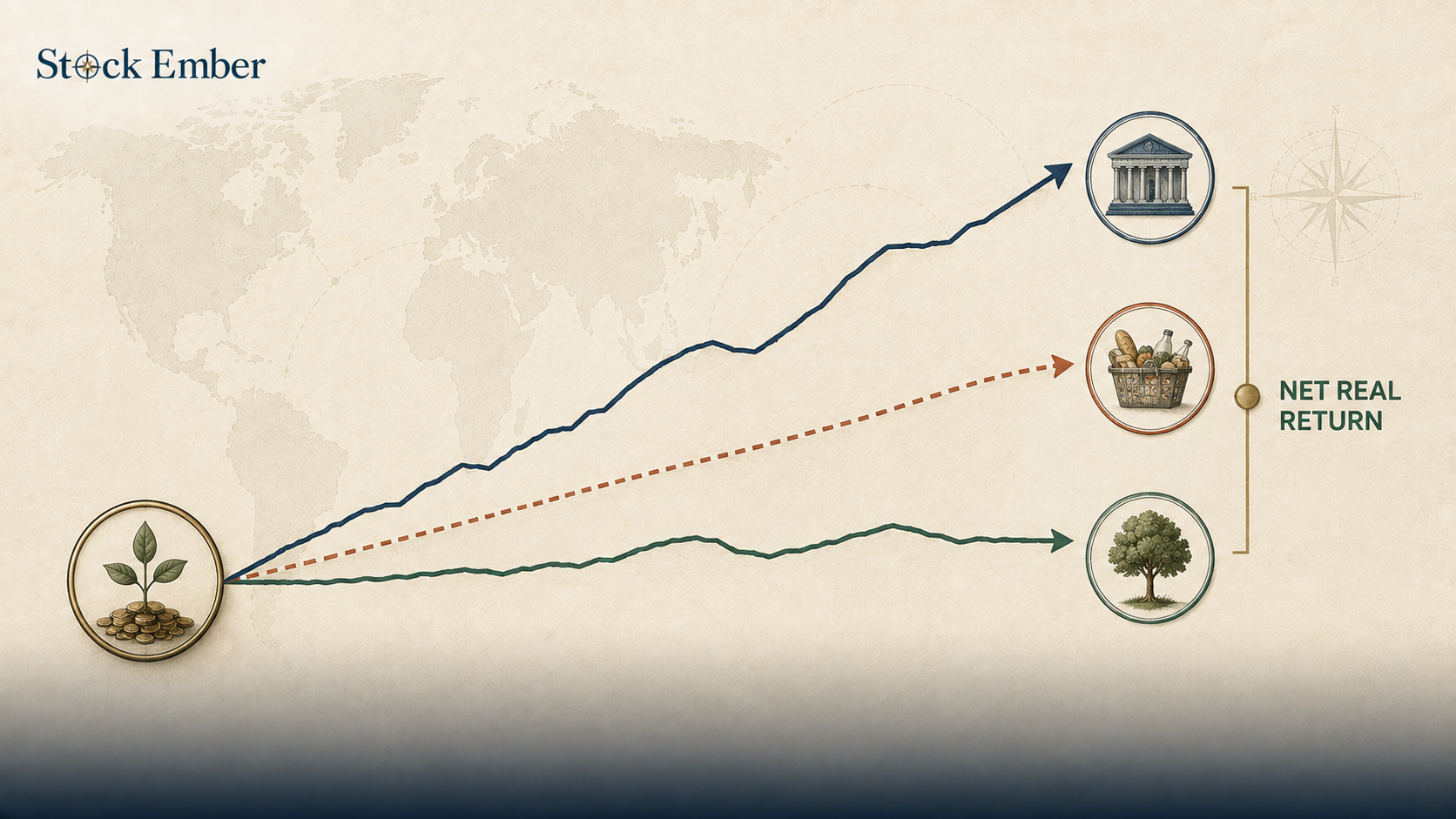
Inflation risk is the probability that rising prices for goods and services will reduce the purchasing power of your money and investment returns over time. It causes real investment returns to fall below nominal yields if interest earned does not keep pace with price increases.
Inflation risk is the probability that rising prices for goods and services will reduce the purchasing power of your money and investment returns over time.
Holding cash in a savings account may feel safe because the account balance never drops, but rising living costs quietly shrink what that cash can actually buy. For long-term investors, ignoring this subtle erosion can jeopardize multi-year financial goals. This guide explains how inflation risk works, how to calculate real returns, and how to preserve your buying power over a 10-year horizon.
Quick Takeaways
01Inflation risk measures how much rising prices reduce the real purchasing power of your money over time.
02Real returns account for inflation by subtracting the rate of price increases from nominal investment returns.
03Fixed-income investments and cash savings carry high inflation risk because their payouts remain static while prices rise.
04Broad-market index funds historically help long-term portfolios outpace price increases over 10-year horizons.
What Is Inflation Risk?
Inflation risk, often called purchasing power risk is the chance that the future value of your money will buy fewer goods and services due to rising prices across the economy.
Governments and central banks track overall price levels using measures like the US Bureau of Labor Statistics, Consumer Price Index (CPI). When CPI rises, the purchasing power of each dollar falls. For example, if a basket of groceries costs $100 today and $105 next year, inflation is running at 5%. If your cash earned zero interest during that year, your $100 still says "$100" on the bill, but it now buys 5% fewer groceries.
This distinction explains why nominal stability can be misleading. While market volatility (price swings in stocks or bonds) is visible every day, inflation risk works silently over long periods. Holding money in cash equivalents avoids short-term price swings, but it exposes your capital to steady purchasing power loss.
How Inflation Erodes Purchasing Power: Nominal vs. Real Returns
To evaluate any investment accurately, you must separate nominal returns from real returns.
A nominal return is the raw percentage gain on an investment before accounting for price increases. A real return is what remains after subtracting the inflation rate, showing the true change in your buying power.
Real Return = Nominal Return − Inflation Rate
Consider a hypothetical $10,000 investment held over one year:
Scenario
Nominal Return
Inflation Rate
Real Return
Ending Buying Power
High Inflation
4%
5%
−1%
$9,900 equivalent
Moderate Inflation
6%
3%
+3%
$10,300 equivalent
Low Inflation
5%
2%
+3%
$10,300 equivalent
If your savings account pays a 4% nominal yield while inflation runs at 5%, your real return is negative 1%. Although your account balance grows to $10,400, that larger sum buys less than your original $10,000 did a year earlier. Over a ten-year period, a recurring negative 1% real return shrinks your purchasing power by nearly 10%.
Diagram showing the difference between nominal returns and real returns after inflation.
Inflation Risk vs. Interest Rate Risk: Understanding the Link
Inflation risk and interest rate risk are closely related, but they describe two different threats to your portfolio.
Inflation risk is the loss of buying power caused by rising living costs. Interest rate risk is the potential drop in a bond's market price when central banks adjust interest rates to fight that inflation.
When price inflation accelerates, central banks typically raise benchmark interest rates to cool down the economy. When benchmark rates rise, newly issued bonds offer higher interest payouts. As a result, existing bonds with lower fixed payouts lose market value on the secondary market.
For fixed-income investors, this creates a double challenge:
During high inflation: The fixed cash payments from existing bonds buy fewer goods and services (inflation risk).
When rates are raised: The resale price of existing bonds falls on the open market (interest rate risk).
Understanding this connection helps investors prepare for periods when both bond prices and cash purchasing power face pressure simultaneously.
Managing Inflation Risk Over a 10-Year Horizon
Over a 10-year horizon, the key to protecting purchasing power is building a portfolio with growth potential that exceeds historical price increases.
While cash and fixed-income assets may offer greater short-term stability, equities have historically delivered positive real returns over long periods, although results vary across markets and time periods. Companies can often raise prices for their products as input costs increase, allowing corporate earnings and broad stock market values to adjust to inflationary environments over time.
Many investors choose broad-market index funds to capture this long-term corporate growth. Adopting a disciplined passive investing strategy allows you to hold a diversified basket of global stocks without needing to time market cycles or select individual companies.
For investors planning a FIRE movement retirement, accounting for inflation risk is critical. A retirement plan built on static cash assumptions can fall short if living expenses double over a 20- or 30-year withdrawal phase. Factoring in long-term inflation, while recognizing the Bank of England's 2% CPI inflation target, can help account for rising living costs throughout retirement.
In practice, many long-term investors find that maintaining a modest equity allocation even in retirement provides the growth engine needed to preserve purchasing power against rising living costs.
Common Pitfalls: Safe Havens That Fail to Protect Purchasing Power
The most frequent mistake investors make when trying to avoid risk is retreating entirely into nominal cash or short-term bank deposits.
While cash avoids short-term market declines, holding excess cash introduces cash drag, the drag on total portfolio growth caused by uninvested or low-yielding funds.
Consider the 10-year holding cost of holding $50,000 in a low-interest bank account:
Initial Deposit: $50,000
Average Interest Earned: 1.5% annually
Average Inflation Rate: 3.5% annually
Net Real Return: −2.0% per year
After 10 years, your bank balance grows nominally to roughly $58,000. However, because prices rose by 3.5% each year, it would take about $70,500 to buy what $50,000 bought a decade earlier. In real terms, your $50,000 cash balance lost over $12,000 in purchasing power.
Avoiding market volatility by staying entirely in cash eliminates price swings, but it replaces short-term uncertainty with a near-certain loss of future buying power.
Conclusion
Understanding inflation risk is essential for anyone building wealth over long horizons. While cash offers nominal stability for short-term needs, relying on low-yielding assets for multi-year goals allows rising prices to erode your buying power. By building a balanced portfolio that combines real growth assets like equities with disciplined risk management, you can keep your investments ahead of rising living costs. When you are ready to explore diversified fund structures to implement this strategy, our ETF reviews provide a clear breakdown of low-cost broad-market options. Investing involves risk including the potential loss of principal, so treat this guide as educational material rather than individual financial advice.
FAQ
5 questions
What is the difference between inflation risk and interest rate risk?
Inflation risk is the loss of purchasing power caused by rising living costs over time. Interest rate risk is the potential drop in a bond's market price when central banks adjust interest rates in response to inflationary pressures.
How do you calculate real rate of return?
You calculate real return by subtracting the annual inflation rate from your nominal investment return (Real Return = Nominal Return − Inflation Rate). For example, a 6% nominal gain during a 3% inflation period yields a 3% real return.
Why is holding cash risky during periods of high inflation?
ash carries severe inflation risk because nominal cash balances earn little or no interest while living costs rise. Over time, this creates cash drag, where your money buys fewer goods and services even if the account balance stays constant.
Which assets carry the highest inflation risk?
Fixed-income securities with static coupon payouts and traditional cash savings carry the highest inflation risk. Because their nominal cash distributions are locked, rising price levels steadily erode the real buying power of their income stream.
Can broad-market stock index funds hedge against inflation risk?
Yes, broad-market stock index funds historically help protect long-term purchasing power because companies can often adjust prices to reflect higher input costs, allowing corporate earnings and equity values to grow alongside inflation over multi-year horizons.
Disclaimer
This guide was written with AI assistance and reviewed by the StockEmber editorial team for accuracy. StockEmber provides independent education, not personal financial advice. Some links may support our work at no additional cost to you.
The StockEmber Team is our in-house desk of independent research writers. We test brokerage platforms, read the fine print on fees and custody, and cover ETFs and long-horizon investing for people who plan to hold for decades — not days.