Central banks raise benchmark interest rates during periods of high inflation to increase borrowing costs, slow consumer spending, and cool economic demand. Higher interest rates reduce price pressures over time, but they also lower bond prices and alter stock valuations across economic market cycles.
How does inflation affect interest rates? When inflation rises, central banks increase benchmark interest rates to raise borrowing costs, slow consumer and business spending, and stabilize price levels across the economy.
When everyday prices for food, energy, and housing accelerate, the purchasing power of cash declines. Central banks respond by making loans more expensive, which reduces market demand and helps bring price growth back toward long-term targets. Understanding this economic relationship helps long-horizon investors protect real purchasing power and manage risk across changing economic conditions.
This guide breaks down central bank policy tools, the difference between real and nominal returns, and how interest rate shifts affect long-term stock and bond portfolios.
Quick Takeaways
01Central banks raise benchmark interest rates during inflationary surges to cool economic demand and stabilize consumer prices.
02Higher interest rates increase borrowing costs for credit cards, mortgages, and corporate loans.
03Nominal interest rates show headline yields, while real interest rates adjust for inflation to measure actual purchasing power growth.
04Rising interest rates decrease existing bond prices and change equity valuations by increasing discount rates on future corporate earnings.
The Direct Link Between Inflation and Interest Rates
Inflation measures the rate at which the general level of prices for goods and services rises over time. When inflation accelerates rapidly, each unit of currency buys fewer goods, eroding consumer purchasing power and creating economic instability.
Central banks such as the Federal Reserve use short-term policy interest rates as their primary monetary tool to control price growth. When inflation moves significantly above target levels (often set around 2% annually), the central bank raises its benchmark interest rate. This action creates a chain reaction throughout the banking system:
Commercial Banks Raise Borrowing Rates: The cost for banks to borrow money increases, forcing them to raise interest rates on mortgages, personal loans, business credit, and credit cards.
Consumer and Business Spending Slows: Higher borrowing costs encourage households and companies to spend less and save more.
Price Growth Cools Down: As demand for goods, services, and real estate slows, sellers reduce price increases to attract buyers, bringing overall inflation back down.
Conversely, when inflation is unusually low or economic growth stalls, central banks lower interest rates to make borrowing cheaper and stimulate economic activity.
Real vs. Nominal Interest Rates: The Fisher Effect
To evaluate investment performance during inflationary periods, investors must distinguish between nominal interest rates and real interest rates.
Nominal Interest Rate: The stated headline interest rate paid on a loan or investment, without adjusting for price changes.
Real Interest Rate: The actual purchasing power return earned after subtracting the inflation rate from the nominal rate.
Economist Irving Fisher formalized this relationship through the Fisher Effect, which shows that nominal interest rates adjust to reflect changes in expected inflation.
Real Interest Rate = Nominal Interest Rate − Inflation Rate
Consider a ten-year portfolio example:
Suppose, hypothetically, you invest $10,000 in a fixed savings vehicle earning a 4% nominal annual return (this example is illustrative only and does not represent a guaranteed or expected return). Over ten years, your balance grows to $14,802.
If inflation averages 2% annually over that same decade, your real interest rate is 2% (4% nominal minus 2% inflation). Your real purchasing power increases to $12,190 in today's dollars.
However, if inflation surges to 5% annually while your nominal return stays at 4%, your real interest rate becomes negative 1% (4% nominal minus 5% inflation). Even though your headline bank balance grew, your actual purchasing power fell to $9,048 over ten years.
Lenders and investors demand higher nominal yields during high-inflation periods specifically to avoid losing purchasing power over long holding periods.
How Inflation & Rates Shift Across Market Cycles
The interaction between inflation and interest rates follows predictable patterns across different stages of the economic cycle.
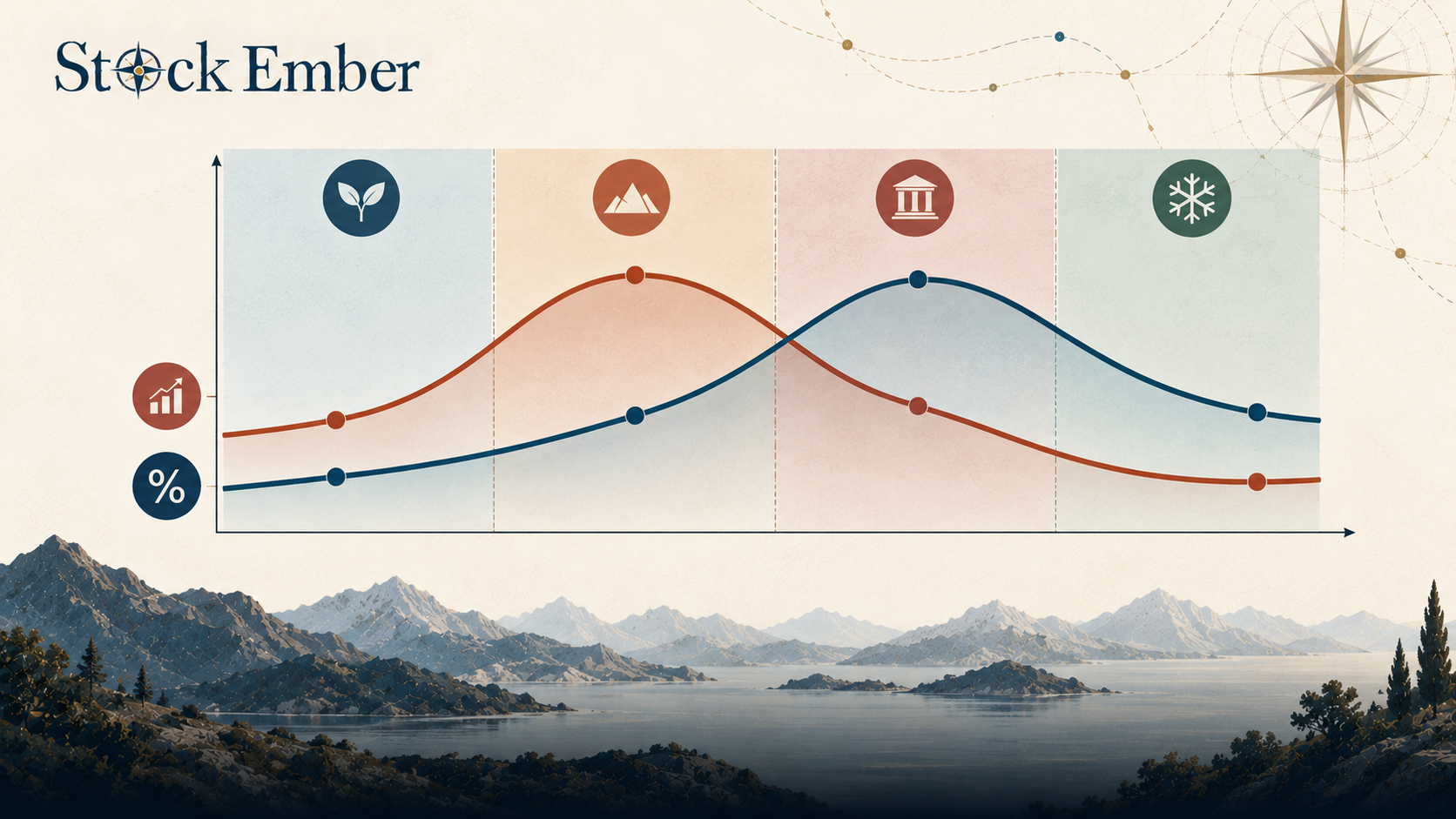
Inflation rarely stays constant. During early economic expansion, low interest rates encourage borrowing, business investment, and job growth. As the expansion reaches late-stage maturity, high demand for labor and raw materials creates price bottlenecks, driving inflation upward.
Central banks respond by tightening monetary policy and raising rates, marking a transition point within the broader market cycle. This rate-hiking phase influences consumer demand, corporate earnings expectations, and the stock market cycle.
Diagram showing how central bank interest rates follow inflation trends through market cycle phases.
Understanding where the economy sits in these broader cycles prevents buy-and-hold investors from making emotional asset allocation decisions based on short-term central bank headlines.
Impact on Long-Term Portfolios: Bonds and Equities
Shifts in interest rates directly influence the market valuation of both fixed-income debt and stock equities:
Fixed-Income Securities (Bonds)
When central banks raise interest rates, newly issued bonds offer higher yield payouts. Existing bonds paying lower coupon yields become less attractive to buyers, causing their secondary market prices to fall. Longer-duration bonds experience larger price swings for every percentage point shift in interest rates.
Stock Equities
Higher interest rates affect stock valuations through two channels:
Corporate Earnings: Increased borrowing costs raise corporate debt expenses, which can narrow corporate profit margins.
Valuation Discount Rates: Financial analysts discount future corporate earnings at higher interest rates when calculating present value. Growth stocks, whose value relies heavily on earnings far in the future, often face valuation pressure during rate-hiking cycles.
In practice, many long-term index investors find that maintaining a fixed asset allocation across equities and intermediate-term bond funds helps smooth performance through complete inflation cycles. Rebalancing on set calendar dates automatically buys undervalued assets without needing to predict central bank rate shifts.
Common Investor Pitfalls During Inflationary Spikes
When inflation surges and interest rates rise, investors frequently react out of fear, making long-term allocation errors:
Chasing Speculative High Yields: Investing in high-risk junk bonds or unproven assets to beat inflation exposes capital to elevated credit default risk.
Holding Too Much Idle Cash: Leaving large cash reserves in standard bank accounts during high-inflation periods guarantees a steady loss of real purchasing power.
Panic-Selling Core Equity Holdings: Selling broad index funds during interest rate hikes locks in temporary market declines and misses the eventual recovery.
Regulatory educational materials from the US Securities and Exchange Commission emphasize that maintaining long-term diversification is essential for protecting wealth against purchasing power erosion.
Conclusion
How does inflation affect interest rates? It comes down to one core mechanism: central banks adjust interest rates to manage inflation, cooling hot economies with higher rates and supporting weak economies with lower rates.
Stated nominal rates must always be viewed alongside inflation to determine real purchasing power growth over long investment horizons. While rising rates create short-term price fluctuations across stock and bond markets, disciplined long-horizon portfolios remain resilient through complete rate cycles.
When you are ready to explore low-cost index funds that provide broad diversification across changing rate environments, reviewing detailed ETF reviews offers a clear starting point. Because all investments involve risk of capital loss and past market performance never guarantees future results, use these concepts to guide your independent research.
FAQ
5 questions
Why do interest rates go up when inflation rises?
Central banks raise benchmark interest rates to slow price growth. When borrowing becomes more expensive, consumers and businesses spend less money on goods, services, and loans. This reduction in overall economic demand forces sellers to stabilize prices, helping bring inflation back down toward normal central bank target levels.
What is the difference between nominal and real interest rates?
The nominal interest rate is the stated headline rate paid on an investment or loan. The real interest rate adjusts that nominal yield for inflation to reflect true purchasing power. If an investment pays a 4% nominal yield while annual inflation is 5%, the real interest rate is negative 1%.
How do rising interest rates affect bond funds?
Rising interest rates cause existing bond fund prices to fall. When newly issued bonds offer higher interest payouts, existing bonds with lower yields become less valuable in secondary trading. Longer-duration bond funds experience larger price drops for every percentage point increase in market interest rates.
Does inflation help or hurt stock market valuations?
High inflation generally hurts stock valuations by increasing corporate operating costs and prompting central banks to raise interest rates. Higher interest rates increase the discount rates used to value future corporate earnings, which can compress price-to-earnings ratios, particularly for fast-growing companies.
How can long-term investors protect purchasing power against inflation?
Long-term buy-and-hold investors protect purchasing power by maintaining a diversified allocation to productive growth assets, such as stock index funds. While cash holdings lose real value during inflationary surges, equities historically generate compound returns that outpace inflation over ten-year holding periods.
Disclaimer
This guide was written with AI assistance and reviewed by the StockEmber editorial team for accuracy. StockEmber provides independent education, not personal financial advice. Some links may support our work at no additional cost to you.
The StockEmber Team is our in-house desk of independent research writers. We test brokerage platforms, read the fine print on fees and custody, and cover ETFs and long-horizon investing for people who plan to hold for decades — not days.