Herd mentality in investing is the cognitive bias where individuals follow the crowd's financial moves instead of conducting independent analysis. This evolutionary tendency causes market participants to buy during euphoric rallies and sell during market panics. Long-term investors neutralize crowd noise by using automated dollar-cost averaging and systematic rebalancing.
Herd mentality in investing occurs when individuals copy the buying or selling actions of the wider crowd rather than making decisions based on independent analysis. This behavioral tendency leads investors to join market rallies out of excitement or join market sell-offs out of panic.
Watching a stock market boom while standing on the sidelines makes almost every investor uneasy. However, rushing to buy because everyone else is buying often forces you to purchase overvalued assets right before a drop. This guide explains how crowd behavior operates, why it quietly damages your ten-year compounding math, and how rules-based strategies protect your portfolio.
Quick Takeaways
01Herd mentality drives investors to buy during euphoric market tops and sell during fearful market bottoms.
02Information cascades cause individuals to assume the crowd possesses insights they lack, overriding personal risk tolerance.
03Following market momentum leads to severe performance drag by converting paper volatility into permanent capital loss.
04Automated index investing and systematic rebalancing act as structural shields against crowd noise.
What Is Herd Mentality in Investing?
Herd mentality in investing is the impulse to follow collective market behavior instead of sticking to an independent strategy. Often referred to as the herd mentality, this cognitive shortcut is a cornerstone concept within behavioral finance.
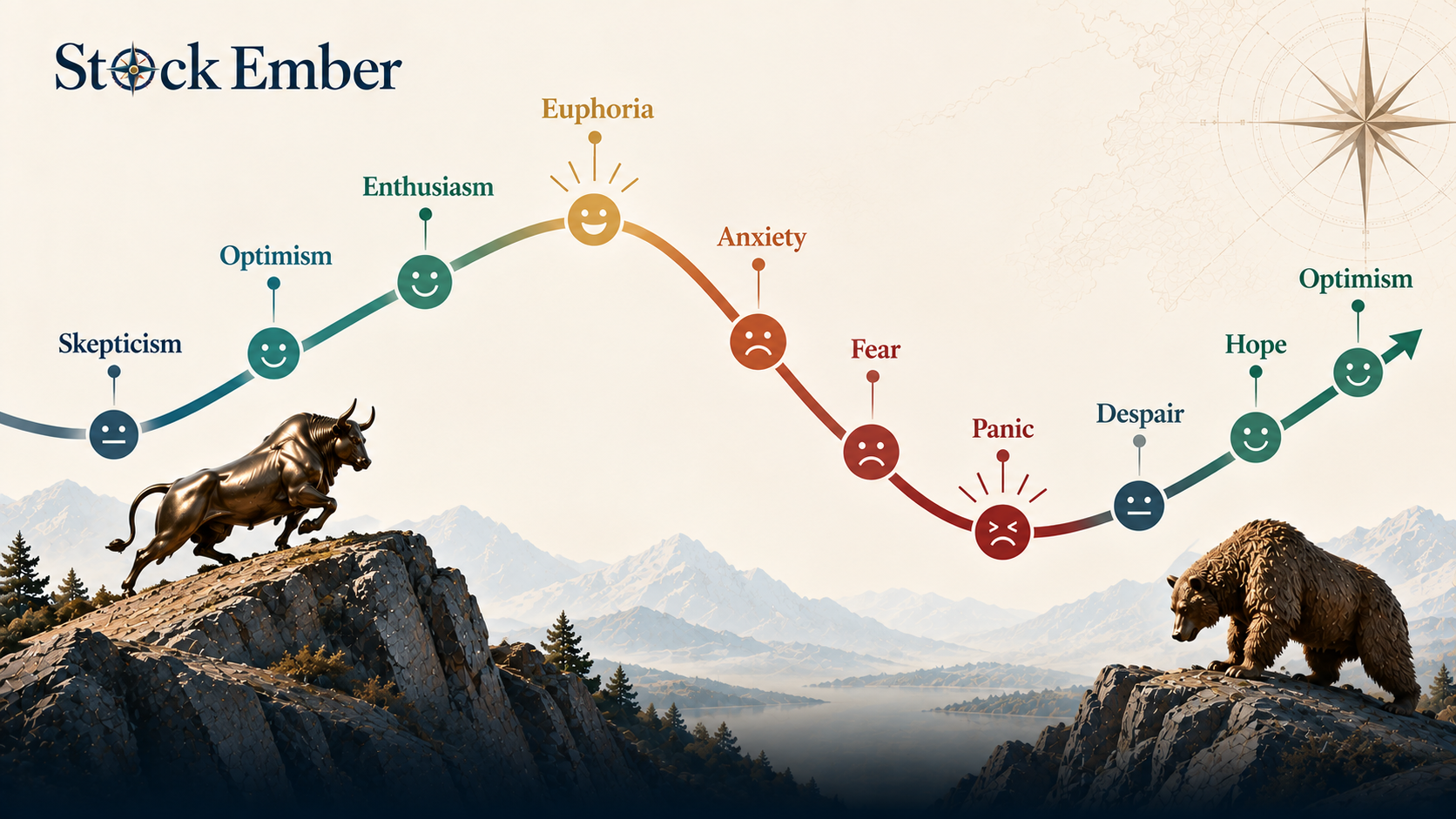
Historically, human survival depended on safety in numbers. Staying with the group protected early humans from physical danger. In modern capital markets, however, that same evolutionary instinct works against you. Financial markets reward patient asset allocation, yet human biology pulls investors toward social proof. When prices rise rapidly, public attention grows, creating the illusion that the crowd has discovered a sure pathway to wealth. Conversely, when prices drop sharply, collective fear triggers mass selling, prompting individual investors to flee for safety right when asset prices are lowest.
How Herd Mentality Works: Information Cascades and FOMO
Herd mentality spreads through two main psychological triggers: fear of missing out and information cascades. Studying the psychology of investing reveals how these two forces undermine sound financial judgment.
Fear of missing out, or FOMO, takes hold during long bull markets. As asset prices rise, financial news and online discussions focus heavily on rapid gains. Seeing peers earn quick profits creates psychological discomfort. Investors start to feel left behind, which pushes them to abandon their risk management plans and buy high.
An information cascade occurs when an individual ignores their own private analysis because they assume the crowd knows something they do not. If hundreds of market participants are buying a specific asset, an investor infers that the collective group holds superior knowledge. In reality, many people in the crowd are simply copying one another, creating an echo chamber that drives prices far above fair economic value.
Diagram showing the emotional investment cycle driven by herd mentality
Why Herd Mentality Harms a Long-Term Portfolio
Herd mentality harms a portfolio by repeatedly forcing investors to buy asset classes at inflated valuations and sell them during temporary market drawdowns.
When you follow the crowd, your timing is almost always inverted. Mass enthusiasm peaks at market tops, right when expected future returns are lowest. Buying during these moments exposes your capital to severe valuation risk. Conversely, mass panic peaks at market bottoms, precisely when long-term expected returns are highest. Fleeing the market during a sell-off locks in temporary paper drops as permanent losses.
Beyond bad timing, crowd behavior leads to poor asset diversification. Investors who follow popular trends end up heavily concentrated in whatever sector or market modern commentary favors. When market sentiment shifts, these concentrated holdings suffer steep declines, disrupting long-term portfolio growth.
The 10-Year Cost of Following the Crowd
The financial cost of following the crowd accumulates over time, creating a major performance gap compared to a rules-based index strategy over a ten-year horizon.
Consider a hypothetical investor who starts with $10,000. Over a ten-year period, a systematic broad-market index strategy might achieve an average annual return of 7% after inflation. By remaining fully invested through market ups and downs, the initial $10,000 grows to roughly $19,670.
Now consider a herd-following investor starting with the same $10,000. This investor repeatedly waits until market rallies reach euphoric stages before buying, then panics during 20% market corrections and moves to cash. Because they miss the initial stages of recoveries and suffer transaction costs, their effective net annual return drops to just 3%. After ten years, their portfolio reaches only about $13,439.
Starting Capital
Starting Capital
10-Year Return Rate
Ending Portfolio Value
10-Year Opportunity Cost
Systematic Buy-and-Hold
$10,000
7% annual average
$19,670
$0 (Baseline)
Herd-Following Investor
$10,000
3% net annual average
$13,439
-$6,231
Note: Hypothetical numbers for educational illustration. Past market movements do not guarantee future returns.
Over a decade, crowd behavior cost the second investor more than $6,200 or over 30% of their total potential wealth buildup. This gap stems not from fund fees, but from behavioral churn.
Common Herd Behavior Pitfalls (and How to Shield Your Portfolio)
Overcoming herd mentality requires recognizing common behavioral traps and building structural rules into your portfolio management.
Three primary pitfalls trap crowd-following investors:
Chasing Hype: Buying trending assets after steep price runs without evaluating underlying earnings or asset quality.
Panic-Selling Standard Drawdowns: Treating normal market volatility as a crisis requiring immediate liquidation.
Over-Monitoring Daily Noise: Checking portfolio balances daily, which heightens emotional reactions to short-term news cycles.
In practice, many long-term investors find that setting up mechanical portfolio rules removes emotional decision-making entirely. Automating monthly contributions through dollar-cost averaging ensures you buy regardless of market sentiment, purchasing fewer shares when prices are high and more shares when prices are low.
To shield your capital, implement periodic asset rebalancing. Setting a fixed schedule, such as rebalancing once or twice a year, forces you to trim overperforming assets and buy underperforming ones. This systematic discipline automatically counters crowd behavior without requiring market timing. According to guidance from the SEC, setting clear financial goals and maintaining asset allocation rules remain key defenses against market noise.
Conclusion
Herd mentality is a natural evolutionary human response, but following the crowd in financial markets destroys multi-year compounding. Buying during consensus euphoria and selling during mass panic locks in avoidable losses and disrupts long-term financial growth. By relying on automated contributions, rules-based rebalancing, and steady asset allocation, you isolate your portfolio from emotional market cycles.
When you are ready to build a resilient core portfolio with low-cost funds, exploring our ETF reviews offers a clear next step. Investing always involves risk of loss and past performance never guarantees future returns, so use disciplined framework rules as your personal guide.
FAQ
5 questions
What is herd mentality in investing?
Herd mentality in investing occurs when individuals copy the buying and selling decisions of the majority rather than evaluating market fundamentals independently. Driven by social proof and emotional momentum, crowd behavior often leads to buying overvalued assets during bull market tops and panic selling during market corrections.
What causes herd mentality in financial markets?
Herd mentality is driven primarily by fear of missing out (FOMO) and information cascades. During market rallies, seeing others profit creates emotional pressure to join. In addition, investors often assume the broader crowd possesses superior insight, leading them to ignore their own risk management and follow consensus actions.
How does herd mentality affect long-term portfolio returns?
Following the crowd creates a severe drag on multi-year compounding. Herd investors consistently buy high during consensus euphoria and sell low during mass panic. Over a 10-year horizon, this behavioral churn converts temporary paper volatility into permanent capital loss, significantly reducing total investment growth compared to disciplined index strategies.
What are classic examples of herd behavior in asset prices?
Financial history features numerous examples of herd behavior, including the late-1990s Dot-com bubble and the 2008 global financial crisis panic. In both cases, investors collectively rushed into overvalued assets during the boom, then executed mass liquidations at depressed prices during the collapse, ignoring intrinsic valuation.
How can long-term investors overcome herd mentality?
Investors overcome herd mentality by replacing emotional decision-making with automated, rules-based strategies. Setting up systematic dollar-cost averaging ensures disciplined contributions regardless of market sentiment. Additionally, periodic asset rebalancing forces investors to trim overperforming sectors and buy underperforming ones, structurally countering crowd behavior.
Disclaimer
This guide was written with AI assistance and reviewed by the StockEmber editorial team for accuracy. StockEmber provides independent education, not personal financial advice. Some links may support our work at no additional cost to you.
The StockEmber Team is our in-house desk of independent research writers. We test brokerage platforms, read the fine print on fees and custody, and cover ETFs and long-horizon investing for people who plan to hold for decades — not days.