Dividend Kings are publicly traded companies that have increased their regular annual dividend per share for at least 50 consecutive years. The title is an informal market category rather than an official stock index, and any company that freezes or cuts its yearly payout loses the status immediately.
Dividend Kings are publicly traded companies that have raised their regular annual dividend per share for at least 50 consecutive years.
Seeing a 5-decade streak of pay raises can make any stock look like an automatic income machine, yet past raises never promise future payouts or steady share prices.
This guide explains what these companies are, how they compare with Dividend Aristocrats, and what their 10-year compounding math and real-world risks mean for your long-term buy-and-hold portfolio.
Quick Takeaways
01A company must raise its regular per-share dividend every year for 50 straight years to qualify, and holding it flat ends the streak.
02These companies form an informal market group rather than an official index, and any freeze or cut removes a company immediately.
03Most 50-year dividend growers offer modest starting yields, relying on steady annual raises to build income over 10 years or more.
04Mature dividend payers still fall in market downturns and often grow slower than younger firms, making diversification essential.
What Are Dividend Kings?
Dividend Kings are publicly traded corporations that have increased their regular annual dividends for 50 or more years in a row. In practical terms, the Dividend Kings meaning comes down to multi-decade payout consistency rather than company size or starting yield.
Unlike the S&P 500 Dividend Aristocrats, which is an official index, the Dividend King title is an informal label tracked by market analysts. Because companies occasionally reach their 50th straight raise while others cut payouts during downturns, the count shifts over time and generally covers a few dozen U.S. companies.
Surviving 50 years of recessions requires durable cash flow, yet a 50-year record only shows past resilience, not future performance.
How Dividend King Status Works
A company keeps Dividend King status only by raising its regular per-share cash payout every calendar year for 5 straight decades without interruption. To see how Dividend Kings are explained in practice, look at how a board sets its annual payout: paying the same dividend as the year before breaks the streak just as surely as cutting it.
One-time special dividends do not count, and split-adjusted payouts must still rise every year.
This slow, multi-decade rhythm differs sharply from short-term tactics like a dividend capture strategy, which tries to buy a stock just before a payout date and sell soon after. Long-streak payers suit patient shareholders who hold through full market cycles.
Dividend Kings vs. Dividend Aristocrats
Kings require at least 50 consecutive years of annual dividend increases with no index or size rules, whereas S&P 500 Dividend Aristocrats require at least 25 consecutive years of increases alongside S&P 500 index membership (S&P Dow Jones Indices methodology).
Feature
Dividend Kings
Dividend Aristocrats
Minimum streak of increases
50 consecutive years
25 consecutive years
Index membership rule
None (informal label)
Must belong to the S&P 500
Size and trading rules
No formal minimums
Minimum size and trading volume
Because Kings have no index rule, a mid-sized firm leaving the S&P 500 stays a King if its payout keeps rising, while a 30-year S&P 500 Aristocrat still needs 2 more decades to qualify.
Why Dividend Kings Matter for Long-Term Investors
These companies appeal to long-term investors because modest annual raises compound quietly over 10 years, lifting cash income and total return (the combined gain from share-price changes and paid dividends). Many of them start with a low dividend yield, the annual dividend per share divided by the current share price, yet steady raises expand your yield on cost over time.
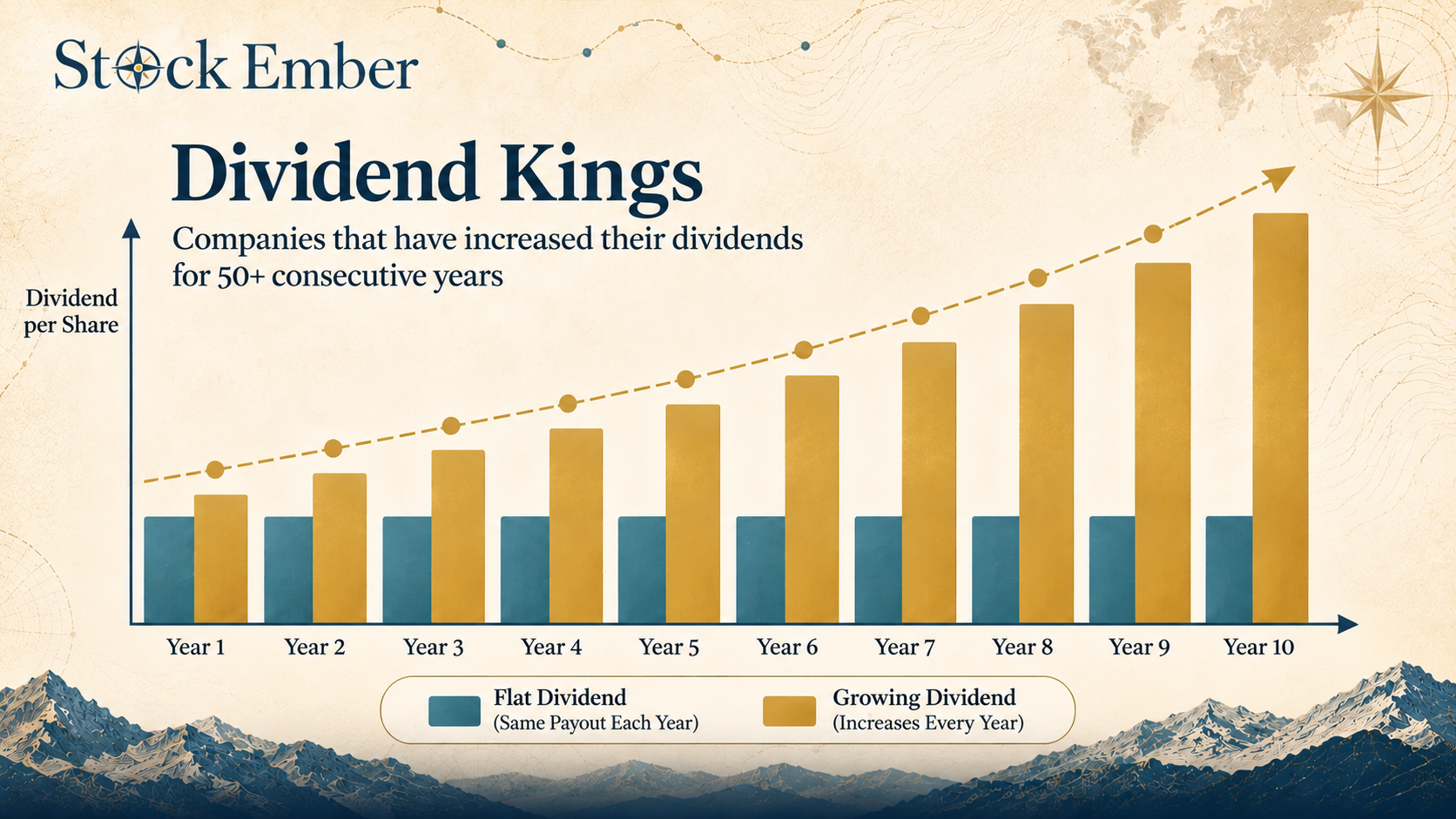
Chart comparing a flat annual dividend payment with a steadily growing dividend over a 10-year period
Consider a hypothetical example. Suppose you invest $10,000 in a stock with a 2.5% starting dividend yield, paying $250 in year one. If the board raises that payout by 6% each year and you take the cash rather than reinvesting it, your annual income rises to about $422 by year 10, a 4.2% yield on your original $10,000 cost. Over those 10 years, the stock pays you roughly $3,295 in total dividends.
Reinvesting payouts compounds the balance further, though actual results depend on share prices and future board decisions. Taxes on dividends and any fund fees, such as an ETF’s annual expense ratio, can also reduce the income you actually keep, so treat these figures as pre-tax, pre-fee illustrations.
In practice, many long-term investors find that focusing on steady dividend growth keeps them calmer during market sell-offs than watching daily share prices, because rising quarterly payments provide tangible feedback even though share prices may take years to recover, or may not recover at all.
The trade-off is that 50-year payers are mature firms returning cash instead of funding rapid expansion, often leading to slower share-price growth.
Common Mistakes When Evaluating Dividend Kings
A common mistake investors make with long-streak payers is treating a 50-year streak as a promise of safety rather than a historical record. Falling into survivorship bias, the habit of looking only at past winners while forgetting firms that stumbled, can hide warning signs in a business losing customers.
Watch out for 3 pitfalls before assuming any long-streak payer belongs in your portfolio:
Ignoring payout strain: A firm can stretch a streak by pushing up its payout ratio, the share of profits paid as dividends, or borrowing when free cash flow (the cash left after operating bills and capital costs) shrinks. A tiny 1% raise paired with a rising payout ratio often signals trouble.
Chasing starting yield: Most long-streak payers offer moderate yields because investors bid up reliable firms. If a Dividend King suddenly shows an unusually high yield, check whether its share price fell because earnings are under pressure.
Overlooking sector concentration: Many 50-year payers cluster in consumer staples, industrials, and utilities. Holding only individual 50-year payers can leave your portfolio underexposed to faster-growing sectors, which is why many buy-and-hold investors choose broad dividend or index exchange-traded funds (ETFs), funds that bundle dozens or hundreds of stocks into one holding, instead of picking single names.
Conclusion
These companies show the value of disciplined cash management, pairing 50-year records of annual raises with the steady compounding that buy-and-hold investors appreciate. Still, a long streak does not shield share prices during downturns, and mature payers can freeze or cut payouts when business conditions shift.
If you want diversified exposure to dividend stocks without betting on single companies, explore our ETF reviews as your next step. Stock investing always puts your capital at risk and past dividend streaks never promise future payouts, so treat this guide as educational background rather than investment advice.
FAQ
6 questions
How many Dividend Kings are there?
The exact number of Kings changes over time because it is an informal market group rather than a fixed stock index. Market analysts typically count a few dozen U.S. companies with at least 50 consecutive years of annual dividend increases, though the total shifts whenever a firm reaches its 50th raise or cuts its payout.
What happens if a Dividend King freezes or cuts its dividend?
If a Dividend King holds its regular annual dividend flat or reduces the payout, its streak ends immediately and analysts remove it from the list. Even a single calendar year without a split-adjusted per-share increase disqualifies the company, regardless of how many decades it raised payouts previously.
Do Dividend Kings have high dividend yields?
Most of them offer modest starting dividend yields rather than unusually high ones. Because investors often value their long payout histories, their share prices tend to trade at steady valuations, keeping initial yields moderate while relying on annual dividend raises to grow income over a decade or more.
Are Dividend Kings safe during a recession?
These companies have survived multiple past recessions without cutting payouts, yet they are not shielded from stock market losses. Their share prices can still drop sharply during economic downturns, and changing industry conditions can force even a 50-year dividend payer to freeze or reduce its cash payout.
How can you invest in Dividend Kings without picking individual stocks?
You can gain broad exposure to long-term dividend growers through dividend-focused or broad-market exchange-traded funds instead of buying single company shares. Funds hold dozens or hundreds of stocks at once, spreading out the risk that any single mature business slows down or cuts its dividend.
Do companies have to be in the S&P 500 to be Dividend Kings?
No, they do not need to belong to the S&P 500 or meet any minimum company size requirement. Unlike S&P 500 Dividend Aristocrats, which must be index members with 25 or more years of increases, any publicly traded company with 50 straight years of annual raises qualifies.
Disclaimer
This guide was written with AI assistance and reviewed by the StockEmber editorial team for accuracy. StockEmber provides independent education, not personal financial advice. Investing puts your capital at risk: the value of investments can go down as well as up, you may get back less than you invest, and past performance doesn’t guarantee future results. Some links may support our work at no additional cost to you.
The StockEmber Team is our in-house desk of independent research writers. We test brokerage platforms, read the fine print on fees and custody, and cover ETFs and long-horizon investing for people who plan to hold for decades — not days.