This approach to owning dividend-paying assets focuses on generating steady cash flow and long-term portfolio value. Many investors see cash payouts as an easy way to build wealth.
Many investors see cash payouts as an easy way to build wealth. However, chasing the highest yields without evaluating the underlying business often leads to serious capital losses. This guide explains how different payout approaches work, what metrics actually matter, and how to spot common traps.
What Is a Dividend Investing Strategy?
This approach involves buying assets that return a portion of their earnings to shareholders as cash. Instead of relying solely on the share price going up, you receive regular payments directly into your brokerage account.
However, corporate dividends are not free money. On the ex-dividend date—the cut-off day to qualify for the next payout—the share price drops by roughly the exact amount of the cash distribution. This is a mathematical transfer of value from the company's balance sheet to your account. The strategy works over the long run because healthy companies eventually generate new earnings to replace the cash they just paid out, allowing both the share price and the payouts to recover and grow over time.
How a Dividend Strategy Works: Growth vs. High Yield
When building a dividend stock investing strategy, you generally have to choose between a high initial payout or a lower payout that grows steadily over time.
A high-yield approach targets companies that pay a large percentage of their stock price as cash right now. These are often mature, slow-growing businesses, such as utilities or telecom providers. Because they do not have many new projects to spend money on, they return most of their profits to shareholders. The downside is that their share prices rarely grow much.
A dividend growth approach targets companies that pay a smaller amount today but steadily increase it each year. These are usually businesses with strong cash flows that reinvest in their own expansion while still rewarding shareholders.
Over a ten-year holding period, a lower-yielding stock that consistently raises its payout can actually provide more total cash than a high-yield stock that never grows, simply because the payouts compound over time.
How Dividend Reinvestment Compounds Long-Term Wealth
Dividend reinvestment turns your cash payouts into more shares, which then generate their own payouts in the future. According to the U.S. Securities and Exchange Commission (SEC), a dividend reinvestment plan allows you to automatically buy more shares of a stock or fund with your cash distributions.
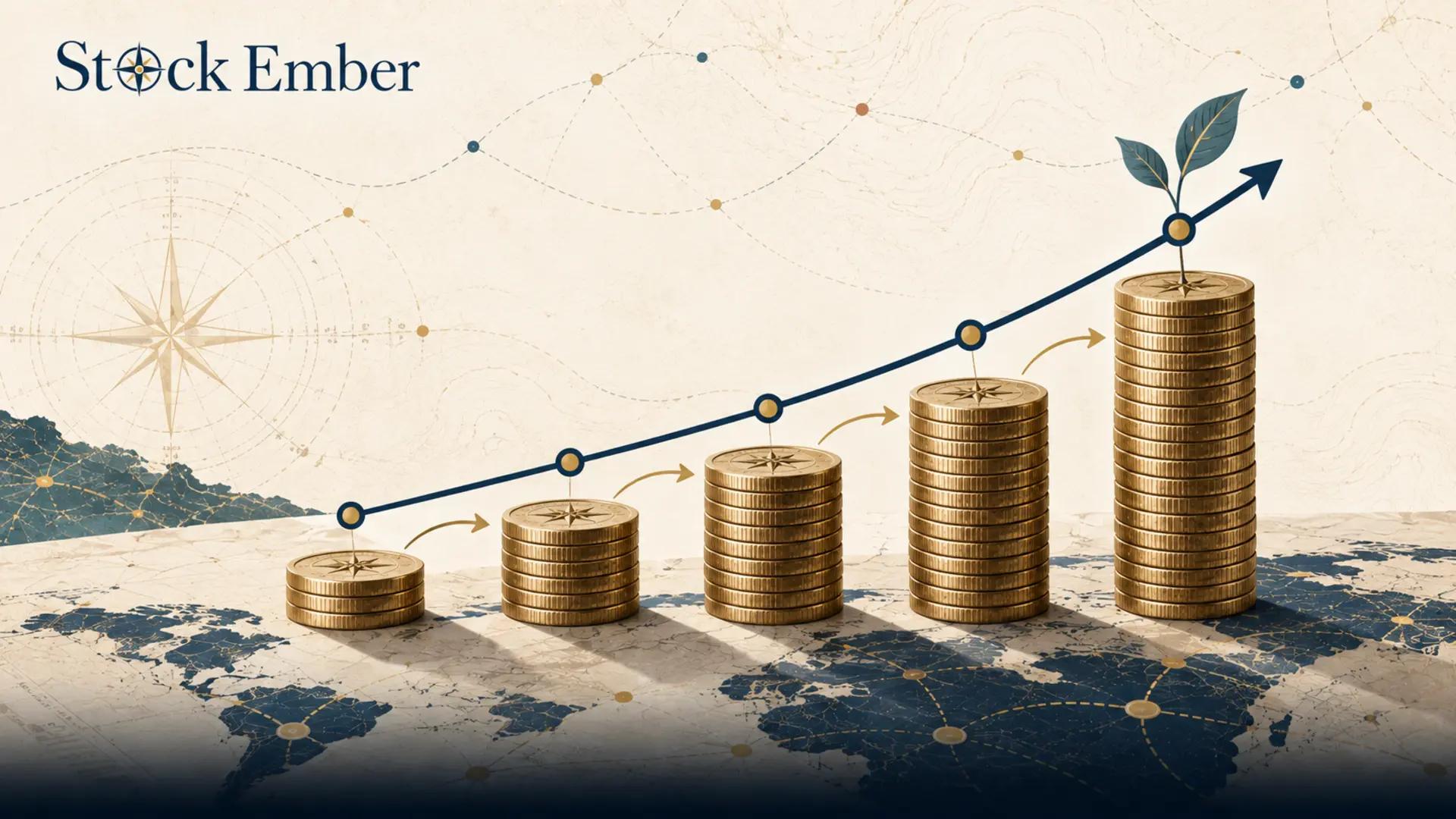
If you have $10,000 invested and receive a 3% payout, you get $300. If you take that cash out, your investment base stays at $10,000. But if you use that $300 to buy more shares, next year you will earn a 3% payout of $10,300.
Over ten or twenty years, this snowball effect can meaningfully outpace a portfolio that never reinvests its distributions. Failing to reinvest these distributions removes one of the strongest engines of wealth creation from your portfolio.
Over a multi-decade investing lifetime, the difference between taking the cash and reinvesting it often determines whether a portfolio simply maintains its value or grows exponentially.
Core Metrics to Evaluate Dividend Quality
To separate a sustainable payout from a risky one, investors look at the yield, the payout ratio, and how fast the distributions are growing.
Dividend Yield = Annual Dividend per Share / Share Price
The dividend yield tells you how much cash you get for every dollar invested today.
Payout Ratio = Annual Dividend per Share / Earnings per Share
The payout ratio shows the percentage of a company's total earnings paid out as cash. If a company earns $1 per share and pays out $0.50, its payout ratio is 50%. A ratio over 75% or 80% leaves the company with very little room for error if profits drop.
Finally, a consistent dividend growth rate is a strong sign that the underlying business is generating more cash each year.
Common Pitfalls: Yield Traps, Dividend Cuts, and Tax Drag
The biggest mistake in this approach is blindly chasing the highest percentage payouts without looking at the risks.
The most common danger is the yield trap. Because yield moves in the opposite direction of the share price, a collapsing stock price mathematically pushes the yield up. A stock offering a 10% yield is rarely a bargain; it usually means the market expects the company to cut its payout soon because the business is failing. If the company slashes its payout, the stock price usually crashes with it, hitting you with a double loss.
Tax drag is another hidden cost. If you hold international stocks, you may lose 15% to 30% of your payout to foreign withholding taxes before it ever reaches your account.
For example, a 3% yield might drop to 2.5% after taxes are automatically withheld by the foreign government. Over a ten-year holding period, losing a fraction of your cash distributions to taxes quietly erodes your final total return and reduces your compound growth.
Conclusion
A strong dividend investing strategy looks beyond the immediate cash payout and focuses on total return. Buying quality assets that can sustain and grow their distributions over decades is much safer than chasing double-digit yields that hide failing businesses.
When you are ready to explore funds that focus on these distributions, our ETF reviews are the place to start. All investments carry capital risk, and past payouts never guarantee future distributions, so treat this guide as educational research rather than financial advice.