A covered call ETF is an investment fund that buys an underlying portfolio of equities and sells call options on those shares to collect upfront cash premiums. The fund converts these collected premiums and stock dividends into regular monthly cash payouts for investors. In exchange for this immediate cash flow, investors give up their potential share price gains above a fixed strike price.
A covered call ETF is an exchange-traded fund that holds a basket of stocks and writes call options against them to collect cash premiums. The fund passes this cash to shareholders as regular monthly distributions.
Investors seeking income often encounter broad-market covered call funds advertising annualized distribution yields that can reach the high single digits or more. These headline figures look tempting when broad index funds often yield far less, but that extra cash comes with a real trade-off.
This guide covers how these funds generate income, why your capital upside is capped, and how net asset value (NAV) decay affects long-term total return.
Quick Takeaways
01Covered call ETFs generate high monthly cash by selling the upside potential of their stock holdings.
02Your upside is strictly capped during market rallies, while your downside is exposed to market drops with only a small cash cushion.
03Over a 10-year horizon, broad index funds may deliver higher total wealth because covered call funds sacrifice capital growth.
04These funds fit investors who need immediate income in flat markets, not savers looking to compound long-term wealth.
What Is a Covered Call ETF?
A covered call ETF is a fund that buys underlying equities and sells call options on those same holdings to earn steady cash. In financial markets, a call option is a contract that gives an outside buyer the right to purchase shares at a set price before a specific date.
When you unpack the covered call ETF meaning, the word "covered" means the fund already owns the underlying shares it promises to deliver. The fund does not speculate on borrowed shares. Instead, it holds the basket of stocks, such as the companies in the S&P 500 or Nasdaq-100, and sells call options against that exact portfolio.
For income-focused investors asking what is a covered call ETF in everyday practice, the strategy functions like renting out property. You own the building (the stocks) and collect regular rent (the option premiums). In exchange for that rent, you agree to sell the building at a fixed price if the market spikes. The fund collects that fee upfront, adds any standard dividends paid by the companies, and distributes the cash to fund holders, usually once a month.
How a Covered Call ETF Works
To see a covered call ETF explained step by step, consider how a fund manager runs the portfolio across a normal monthly cycle. The process follows 3 distinct steps:
Holding the equity base: The fund buys a basket of shares, either mirroring a standard benchmark or holding individual dividend-paying stocks.
Selling call contracts: The manager sells call options against the shares at a predetermined strike price (the agreed price at which the buyer can purchase the stock). In return, the fund collects an upfront cash fee known as the option premium.
Distributing the cash: The fund pays out the accumulated option premiums and dividend income to investors as cash yield.
As the U.S. SEC's investor bulletin on options explains, an option seller collects a cash payment but takes on a legal duty to sell shares if the contract is exercised. If the stock price stays below the strike price, the options expire worthless. The fund keeps both the underlying shares and the cash premium.
If the market surges above the strike price, the buyer exercises the option. Depending on the fund's design, it either delivers the shares at the strike price or, for index options that settle in cash, pays the difference, so the fund misses out on any gains above that line.
The Income vs. Growth Trade-Off
The core trade-off of a covered call strategy is simple: you trade future price appreciation for cash in hand today. This design behaves very differently from traditional ETFs that track plain market indexes.
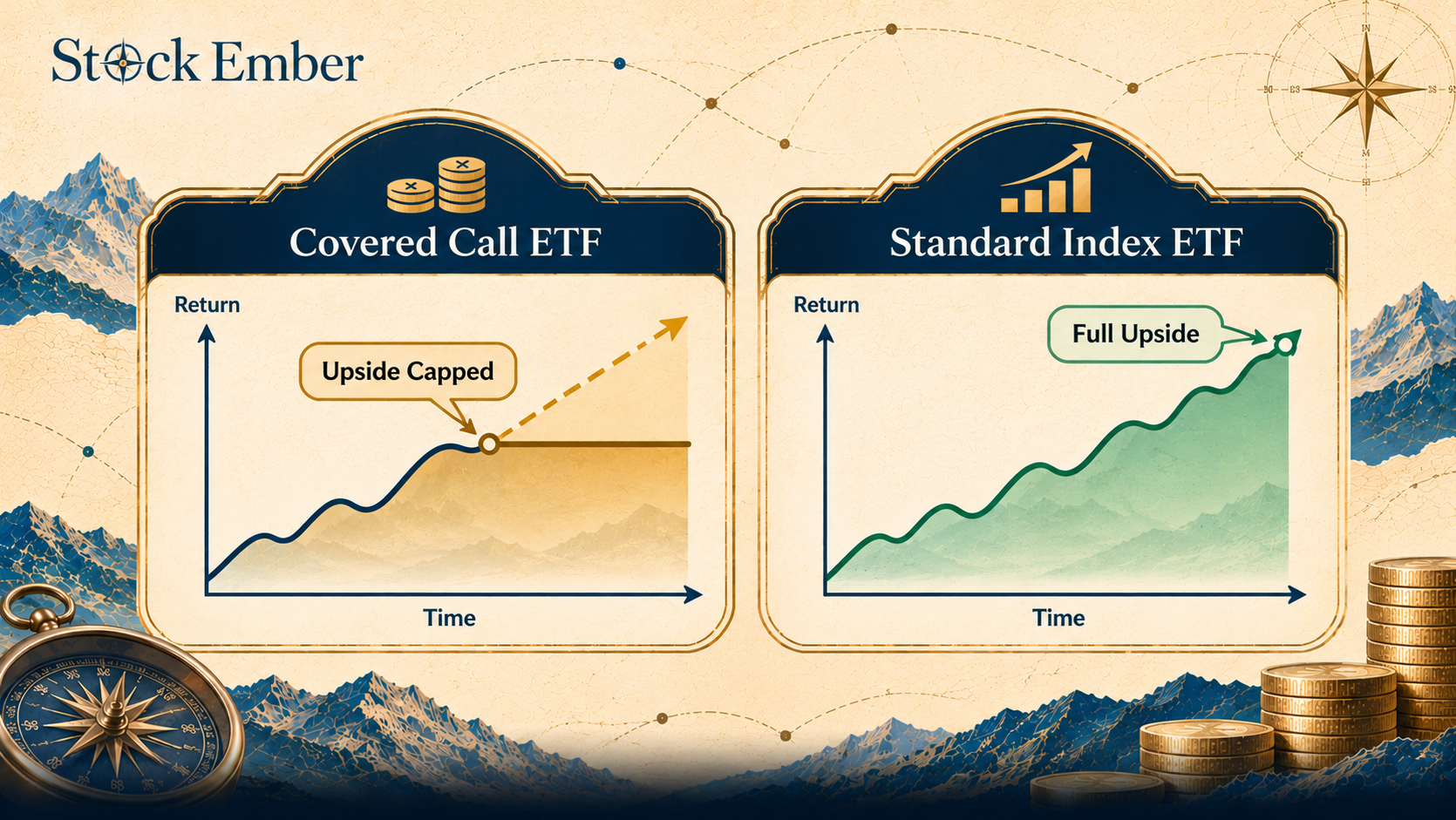
Chart contrasting capped covered call ETF upside with uncapped equity index growth
When the market enters a powerful bull run, a plain equity fund captures the entire rally. A covered call ETF, by contrast, caps its gains at the strike price. Once the index crosses that threshold, your profit stops growing even if the broader market climbs another 15%.
In practice, many long-term investors find that high distribution yields create a false sense of safety. Receiving an 8% cash payout feels rewarding, but if the fund's share price drops by 10% in the same year, your net wealth has actually shrunk.
The downside provides little protection. When the market tumbles, the fund holds all its shares down into the drop. The option premium you collected provides a small buffer, cushioning the loss by perhaps 1% or 2% for that month, but your principal drops almost as hard as the broader market. The payout profile is asymmetric: you take nearly all the downside risk, but give away most of the upside reward.
The 10-Year Total Return Reality (and NAV Decay)
To understand how this mechanic shapes your portfolio, look at total return over a 10-year horizon. Total return measures the cash you receive plus or minus the change in share price.
Imagine you invest $10,000 into a covered call ETF with a 9% annual distribution yield, while another investor puts $10,000 into a plain index fund yielding 1.5%. Assume a hypothetical 10-year period where equities return an average of 10% annually, a rate broadly comparable to some long-term estimates for U.S. stocks.
The outcomes diverge, although these figures are illustrative only; actual returns will vary, and either fund can lose value:
The plain index fund compounds both its dividends and full price appreciation. A $10,000 initial investment could grow to roughly $25,900 before taxes, with annual fund fees that are typically much lower than those of actively managed funds.
The covered call fund pays you roughly $900 each year in cash. However, because its upside was capped during every rally, its share price struggled to climb. If market pullbacks cut its share price and rallies failed to restore it, the underlying NAV slowly eroded, so after 10 years your starting principal might only be worth $9,200, leaving total wealth of roughly $18,200 including about $9,000 in cash collected.
This dynamic is known as NAV decay. When the market plunges, the fund takes the hit. When the market snaps back quickly, the fund has usually already written new calls with strike prices set near the lower market level, so the rebound is capped and the portfolio cannot recover at the same pace. Just as structural decay creates headwinds for daily-rebalanced leveraged ETFs, call-writing overlays create a persistent drag on returns over full market cycles.
Expense ratios also add to this drag. Covered call funds require active options management and trade execution, driving fees that are often several times higher than those of plain index funds, with some specialized funds charging more. Over 10 years, a 0.60% annual fee on a $10,000 balance removes hundreds of dollars from your portfolio that would otherwise compound.
Feature
Standard Index ETF
Covered Call ETF
Primary Goal
Long-term capital growth
Immediate cash distribution
Upside Potential
Full, uncapped market gains
Capped at option strike price
Downside Cushion
None
Small (limited to option premium)
Typical Expense Ratio (as of November 2026)
Low
Higher, due to active options management
10-Year Growth Profile
High compounding potential
Prone to NAV erosion in rallies
Expense ratios vary by fund, so check each fund's prospectus for its current figure.
Common Pitfalls to Watch
Before buying a covered call fund, watch out for 3 common traps:
Confusing distribution yield with interest: A fund distribution is not a fixed bank deposit. The payout changes every month depending on market volatility. When market volatility falls, option premiums shrink, and your monthly payout drops.
Expecting downside protection in a crash: An option premium of 1% does not protect you if the market drops 20%. In a severe correction, your portfolio falls almost in step with the underlying stocks.
Ignoring tax treatment: In many taxable accounts, distributions that come from option premiums may be taxed as ordinary income rather than at lower long-term capital gains rates, depending on your local tax rules (for U.S. investors, see IRS Publication 550) and how the fund is structured. This potential tax drag can reduce your net returns each year.
Conclusion
A covered call ETF can serve a specific purpose: providing high current cash distributions for investors who need income today and expect the market to stay flat. For long-term investors aiming to build wealth over decades, however, sacrificing capital appreciation in exchange for upfront cash creates a real headwind against compounding returns.
If you use a covered call ETF for income, consider holding it as one part of a diversified portfolio rather than your entire allocation, so a single strategy does not drive all of your results.
When you are ready to evaluate individual funds and compare fee structures, our ETF reviews provide detailed breakdowns of costs, strategies, and portfolio fits. All investing involves risk to your capital and past distributions do not ensure future returns, so evaluate your personal time horizon before choosing income over long-term growth.
FAQ
5 questions
Can you lose your principal in a covered call ETF?
Yes. A covered call ETF owns underlying shares that drop in value during a market downturn. While the option premium received provides a minor cash buffer, it does not prevent capital losses. If the broader market falls by 20%, the fund's share price will absorb nearly the entire decline, reducing your invested principal.
How are covered call ETF distributions taxed?
In taxable accounts, distributions from covered call ETFs are often treated as ordinary income rather than lower long-term capital gains or qualified dividends. Some funds classify a portion of distributions as return of capital, which defers taxes by lowering your cost basis. Investors should check their specific fund tax reporting documents or consult a tax advisor.
Why do covered call ETFs lag standard index funds over the long run?
Covered call ETFs lag because they give away capital growth during strong rallies. When stock prices climb above the option strike price, gains are capped. Over multi-year periods, the broader market's compounding price appreciation typically generates far more total wealth than the cash payouts extracted by a covered call overlay.
Are covered call ETFs suitable for retirement income?
They can suit retirees who prioritize immediate cash flow to fund living expenses and do not depend on long-term capital growth. However, retirees must remain aware of NAV decay risks. If market drawdowns shrink the principal, future distribution amounts may fall, reducing the fund's ability to maintain purchasing power over time.
What happens to a covered call ETF when market volatility drops?
When market volatility declines, the value of call options decreases across the market. Because the fund sells options to generate its payout, lower option premiums mean less cash collected each month. As a result, the fund's headline distribution yield will usually decline during prolonged periods of low market volatility.
Disclaimer
This guide was written with AI assistance and reviewed by the StockEmber editorial team for accuracy. StockEmber provides independent education, not personal financial advice. Investing puts your capital at risk: the value of investments can go down as well as up, you may get back less than you invest, and past performance doesn’t guarantee future results. Some links may support our work at no additional cost to you.
The StockEmber Team is our in-house desk of independent research writers. We test brokerage platforms, read the fine print on fees and custody, and cover ETFs and long-horizon investing for people who plan to hold for decades — not days.