Stocks provide direct fractional ownership in a single corporation, offering higher potential growth alongside company-specific risk. Exchange-traded funds hold a diversified basket of securities to track an entire index or sector, reducing risk while charging an ongoing expense ratio. Both trade on public exchanges throughout the day, but broad-market funds offer automatic diversification that individual equities lack.
The core debate in stocks vs ETFs centers on asset structure: a stock gives direct ownership in one business, while an exchange-traded fund pools money to buy a basket of securities. Both trade on public exchanges throughout the normal market day.
Deciding between individual companies and funds is one of the first choices in your investing journey. You might wonder whether picking individual shares will accelerate your growth, or if an index fund offers a simpler path to long-term wealth.
This guide walks through how each vehicle works, how risk profiles differ, the ten-year reality of fund fees, and how to combine them effectively.
Quick Takeaways
01Evaluating stocks vs ETFs requires balancing direct business ownership against pooled market diversification.
02Single stocks grant uncapped upside alongside heavy company-specific default risk.
03Broad-market index funds spread capital across hundreds of firms, eliminating single-business failure risk.
04Individual equities carry zero ongoing management fees, whereas funds charge an annual expense ratio that compounds over time.
05Combining a core allocation of broad index funds with a small satellite of individual stocks is often more practical than picking only one.
What Is the Difference Between Stocks and ETFs?
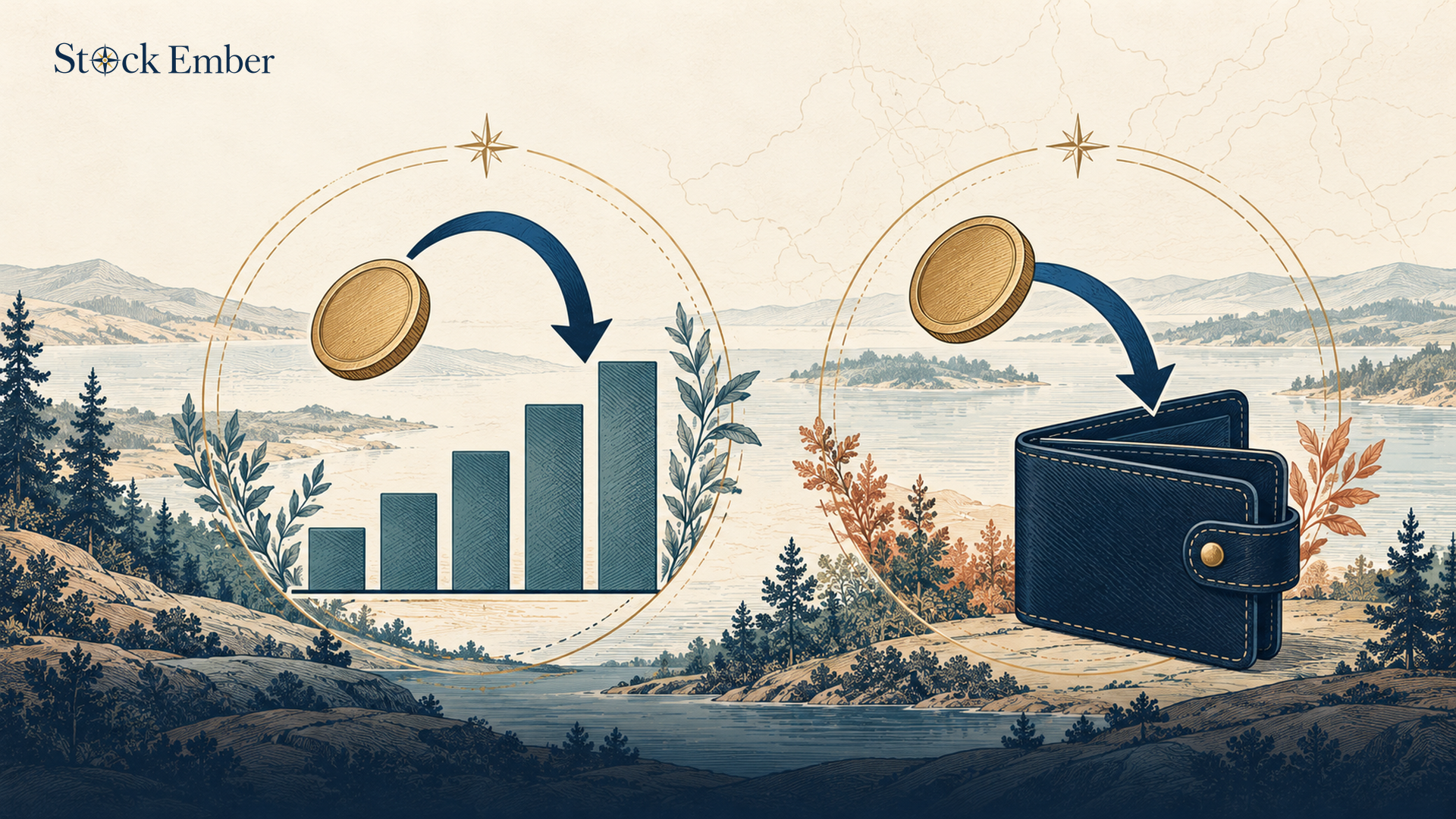
The fundamental difference between stocks and ETFs lies in what you legally own: a stock gives you fractional equity in one specific corporation, while an exchange-traded fund bundles dozens, hundreds, or thousands of underlying assets into a single tradeable security.
When evaluating stocks vs ETFs from an asset structure perspective, purchasing a share of stock ties your returns directly to that enterprise. If the company expands earnings, your shares can climb rapidly. If corporate leadership falters or competitors take market share, your investment absorbs the full loss.
An exchange-traded fund functions as an open-ended investment company. When comparing ETFs vs stocks, purchasing one fund share gives you immediate fractional exposure to every holding in that fund’s portfolio. Rather than tying your savings to the fate of a single business, you own a slice of an entire index, sector, or regional market.
How Trading, Ownership, and Dividends Work
Individual stocks and exchange-traded funds trade identically on public exchanges, letting you buy or sell shares throughout the trading day at live market prices.
Through a brokerage account, you can place market, limit, and stop orders on both instruments. Liquidity and order execution work the same way on your screen. However, dividend processing and corporate governance differ:
Shareholder voting rights: Direct stockholders typically hold proxy voting rights to vote on corporate proposals. Fund investors pass those voting powers to the fund manager, who votes the underlying shares for the fund.
Dividend handling: Individual companies pay cash dividends directly into your brokerage account. Funds handle payouts differently; you can select accumulating or distributing ETFs, depending on whether you prefer income paid out as cash or automatically rolled back into the fund.
Before you open a brokerage account, confirm that the broker is registered with the US Securities and Exchange Commission (SEC) and is a member of the Financial Industry Regulatory Authority (FINRA); you can check both on FINRA BrokerCheck. Also look for membership in the Securities Investor Protection Corporation (SIPC), which may restore up to $500,000 of cash and securities (including up to $250,000 of cash) if a member brokerage firm fails. SIPC protection does not cover losses from falling stock or ETF prices.
Note: Before opening a brokerage account, confirm that the broker is properly regulated and check whether your holdings are protected by an investor compensation scheme, such as SIPC in the United States or the FSCS in the United Kingdom.
Risk, Diversification, and the Safety Myth
Individual stocks carry concentration risk, meaning an unexpected earnings collapse or corporate scandal can permanently destroy a large portion of your capital.
Examining stocks vs ETFs also means weighing company-specific failure against broader market drawdowns. Holding single companies demands constant homework. Long-term research, such as the SPIVA scorecard research, shows that, in the most recently published scorecard, more than 85% of actively managed large-cap funds trailed their benchmark index over the trailing 15-year period.
For everyday retail investors, outperforming the market over a decade requires deep accounting literacy, emotional restraint, and extensive time. Many investors fall victim to overconfidence bias, remembering winning stock picks while forgetting the stagnant holdings dragging down their returns.
Broad-market index funds neutralize company-specific failure through diversification. If one company inside an index of 500 businesses fails, the remaining 499 firms keep operating, absorbing the loss with minimal disruption.
Even so, believing that all funds are safe is a costly misconception. Broad index funds offer deep diversification, but narrow thematic funds frequently hold only 20–30 volatile businesses. Sector funds can drop just as fast as single equities. Genuine safety comes from broad market diversification, not from the fund label on the package.
Comparing the Costs: The 10-Year Fee Drag
Individual stocks carry zero ongoing management fees, whereas all funds charge an annual operational expense ratio.
Another key factor in stocks vs ETFs is how fees erode returns over time. An expense ratio is deducted directly from fund assets to cover management, licensing, and administration. While broad-market index funds charge fractions of a percent, those deductions still compound over time.
Feature
Individual Stocks
Broad-Market ETFs
Diversification
Single company exposure
Hundreds or thousands of holdings
Ongoing Management Fee
0.00%
0.03%–0.20% typically
Research Burden
High (balance sheets, filings)
Low (passive indexing)
Company Default Risk
Direct exposure to one firm
Spread across an entire index
Cash Distributions
Paid directly in cash
Choice of distributing or accumulating
To understand how fund fees add up, look through Stockember’s ten-year cost lens. Suppose you invest $10,000 into an individual stock portfolio with no annual management fee. Assuming a 7% hypothetical gross annual return over ten years, your balance grows to roughly $19,670.
Note: These figures are hypothetical illustrations only — actual returns will vary, and your capital remains at risk.
Now suppose you put that same $10,000 into a fund charging a 0.50% annual expense ratio. After paying the fee each year, your net annual return drops to 6.50%.
Over ten years, your portfolio grows to roughly $18,770. That 0.50% fee quietly shaved around $900 from your wealth—capital that would have continued compounding. Keeping fund fees low is essential to protecting your long-term returns. Remember that these figures are a hypothetical example, not a forecast: actual returns and costs will vary, are never guaranteed, and your capital can lose value.
Common Mistakes When Choosing Stocks or ETFs
Investors trying to decide between stocks or ETFs frequently run into three avoidable traps:
Assuming every fund is diversified: Buying a specialized thematic fund gives you the heavy concentration risk of a single stock alongside the annual fee drag of a fund.
Underestimating the time commitment: Picking individual stocks requires analyzing balance sheets, competitive moats, and valuations. Without time to read quarterly reports, stock picking quickly turns into guesswork.
Viewing the decision as all-or-nothing: You do not have to pick exclusively between them. Many investors use a core-and-satellite model: allocating 85% of their money to broad index funds, while reserving 15% for a few individual companies they know well.
Conclusion
Deciding between stocks vs ETFs comes down to how much time you want to spend analyzing businesses and how much volatility you are comfortable handling. Broad-market funds provide a practical, low-stress engine for long-term wealth accumulation, while individual stocks offer hands-on control and higher upside for investors willing to do the research.
When you are ready to evaluate specific index funds for your portfolio, our ETF reviews are the place to start. Every investment involves the risk of capital loss and past performance never guarantees future results, so build your plan around your personal time horizon and risk tolerance.
FAQ
5 questions
Is it better to buy ETFs or individual stocks?
Neither option is universally better; the right choice depends on your time, knowledge, and temperament. Broad-market index funds suit investors seeking hands-off, diversified growth with minimal maintenance. Individual stocks suit investors willing to analyze balance sheets and manage single-company risk in exchange for higher upside potential. Many choose to hold both in a core-and-satellite portfolio.
Do ETFs pay dividends like individual stocks?
Yes, funds that hold dividend-paying equities collect those payouts and distribute them to fund shareholders. Depending on the fund structure, you can receive cash distributions directly into your brokerage cash account or select an accumulating fund that automatically reinvests the dividend income back into the fund’s underlying holdings to accelerate compounding.
Are ETFs safer than individual stocks?
Broad-market index funds are generally less volatile than individual stocks because they eliminate single-company failure risk through diversification. If one company in a 500-stock index collapses, the remaining holdings cushion the blow. However, specialized, thematic, or leveraged funds carry significant concentration risk and can be just as volatile as single equities.
Can you hold both stocks and ETFs in the same portfolio?
Yes, many long-term investors combine both using a core-and-satellite strategy. In this structure, the core consists of 80%–90% allocated to broad-market index funds for reliable market diversification. The remaining 10%–20% forms a satellite allocation of individual equities representing high-conviction companies you have thoroughly researched.
What are the hidden costs of ETFs compared to stocks?
Unlike single stocks, which carry no ongoing management fee once purchased, all funds charge an annual expense ratio deducted directly from fund assets. While broad index fund fees are typically low, they compound quietly over ten or twenty years, reducing total returns. Investors should also account for the bid-ask spread when trading fund shares.
Disclaimer
This guide was written with AI assistance and reviewed by the StockEmber editorial team for accuracy. StockEmber provides independent education, not personal financial advice. Investing puts your capital at risk: the value of investments can go down as well as up, you may get back less than you invest, and past performance doesn’t guarantee future results. Some links may support our work at no additional cost to you.
The StockEmber Team is our in-house desk of independent research writers. We test brokerage platforms, read the fine print on fees and custody, and cover ETFs and long-horizon investing for people who plan to hold for decades — not days.