Corporate bonds are debt securities issued by public companies to fund growth, offering higher yields to compensate for credit default risk. Government bonds are sovereign debt obligations backed by national governments, featuring lower credit default risk but carrying interest rate and inflation risks. While government bond interest often enjoys state tax exemptions, corporate bond interest is fully taxable.
Both corporate bonds and government bonds are fixed-income securities that pay periodic interest, but they differ fundamentally in who issues them and how much risk they carry. Corporate bonds are debt issued by public companies to fund expansion, while government bonds are issued by sovereign states to fund public spending.
Choosing between corporate and government bonds requires balancing the higher yield potential of corporate debt against the lower default risk of government obligations. This guide explains how credit ratings and yield spreads work, compares key features, and examines how both bond types fit into a long-term buy-and-hold portfolio.
Quick Takeaways
01Corporate bonds offer higher yields than government bonds to compensate investors for taking on corporate credit default risk.
02Government bonds carry lower credit default risk, but long-term issues remain fully exposed to interest rate and inflation risks.
03Credit rating agencies grade corporate issuers, and the interest rate premium over government debt is called the credit yield spread.
04Interest on government bonds often benefits from tax exemptions, whereas corporate bond interest is fully taxable at federal, state, and local levels.
What Are Corporate Bonds and Government Bonds?
A bond is essentially a loan made by an investor to a borrower. In exchange for upfront capital, the issuer agrees to pay regular interest payments, known as coupon payments, and return the principal amount when the bond reaches maturity. While the underlying mechanism is identical, the issuer determines the risk and return profile of the asset.
Government bonds (such as US Treasuries) are sovereign debt obligations backed by the full faith and credit of a national government. Because sovereign governments possess tax authority and the ability to issue currency, sovereign default is historically rare for major developed nations.
Corporate bonds are debt securities issued by corporations, ranging from blue-chip technology firms to industrial conglomerates. Companies issue debt instead of issuing stock to raise capital for research, capital expenditure, acquisitions, or debt refinancing without diluting existing shareholder ownership.
Corporate debt is broadly categorized into two distinct groups based on credit quality:
Investment-grade bonds: Issued by financially stable corporations with low probabilities of default.
High-yield (junk) bonds: Issued by companies with higher credit risks or weaker balance sheets, offering higher interest rates to compensate for the elevated risk.
When constructing a fixed-income allocation, understanding the broader landscape of types of bondshelps investors match specific debt instruments to their long-term income goals.
Risk and Return: Credit Ratings and Yield Spreads
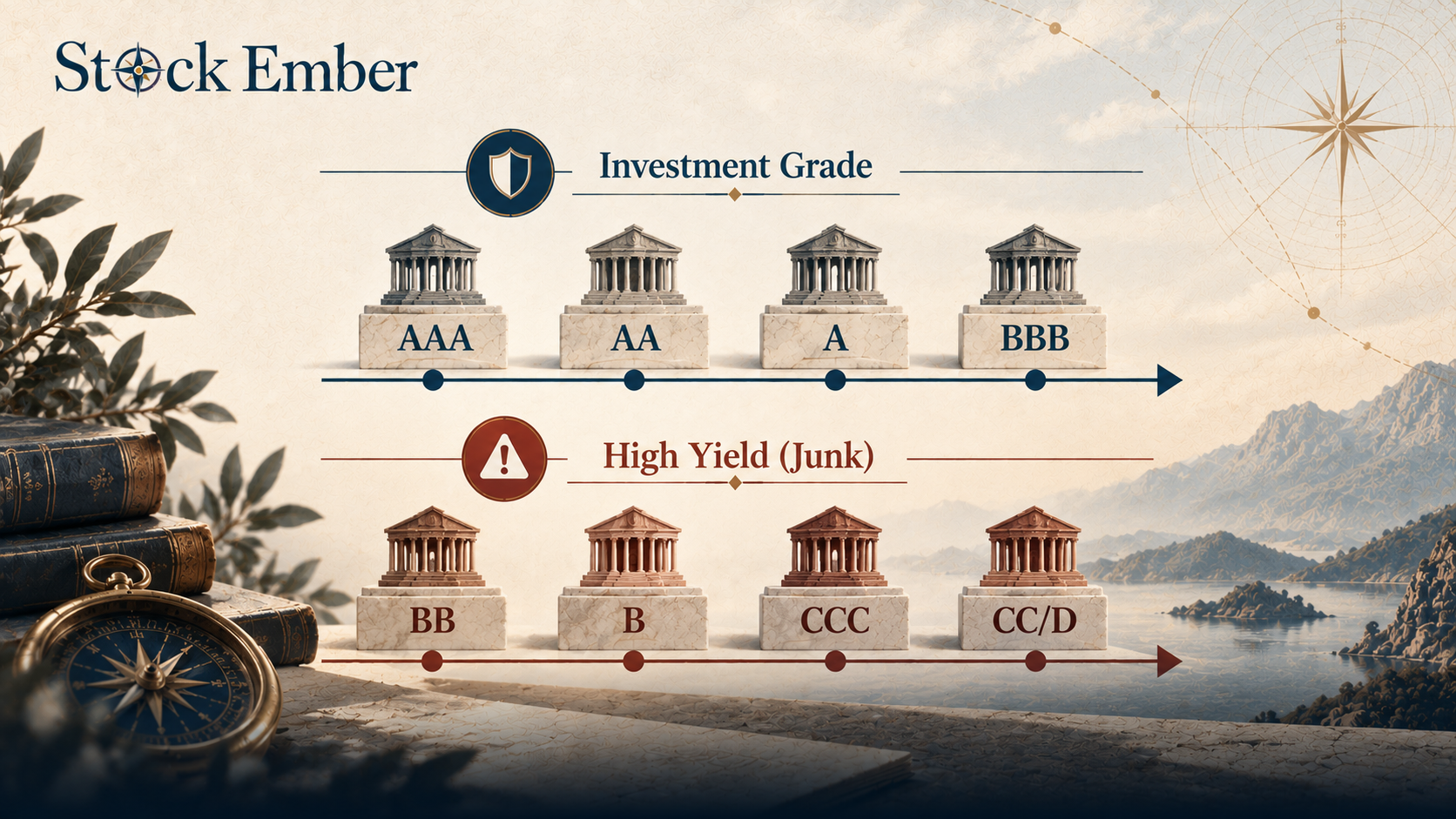
Because a corporation can experience financial distress or bankruptcy, corporate bonds carry credit default risk, the possibility that the issuer will fail to pay interest or principal. To help investors evaluate this hazard, independent credit rating agencies like Moody's, S&P, and Fitch evaluate corporate balance sheets and assign credit scores.
Credit rating spectrum showing investment-grade ratings from AAA to BBB and high-yield (junk) ratings from BB to CC/D.
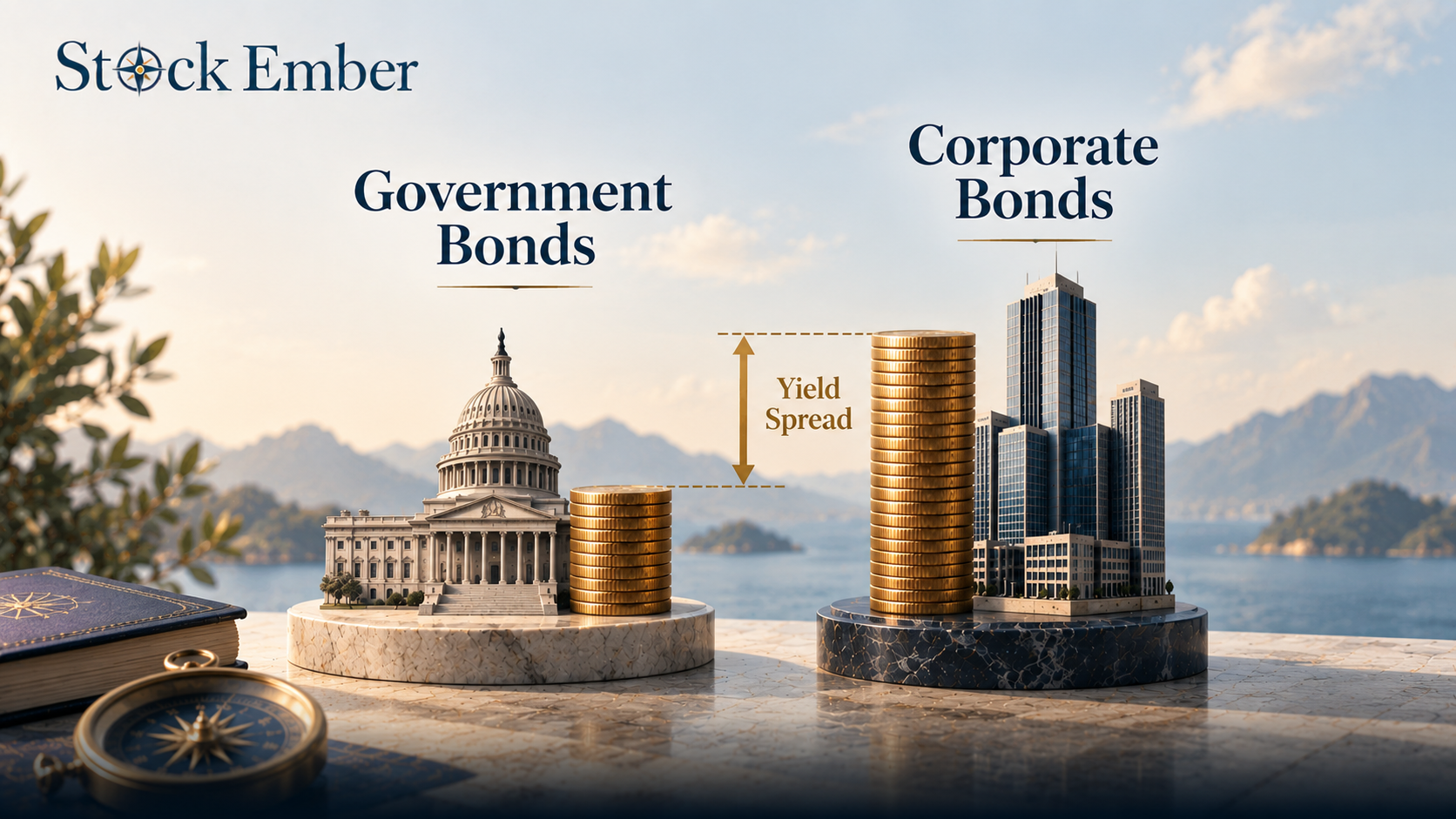
To persuade investors to purchase corporate debt instead of standard government issues, corporations must pay a financial premium. This extra payout is called the credit yield spread, the percentage difference in yield between a corporate bond and a benchmark government bond of matching maturity.
Credit Yield Spread = Corporate Bond Yield − Benchmark Government Bond Yield
For example, if a 10-year government Treasury yields 4.0% and a 10-year BBB corporate bond yields 5.5%, the credit yield spread is 1.5% (or 150 basis points).
When the economic outlook weakens, yield spreads generally widen because investors demand a larger risk buffer for holding corporate debt. During stable economic expansions, spreads tend to narrow as default risks decrease.
Graphic illustration of a credit yield spread comparing government and corporate bond yields
The Core Comparison: Corporate vs Government Bonds
Comparing corporate vs government bonds involves weighing higher annual payouts against higher credit risk, along with evaluating specific tax considerations.
Feature
Corporate Bonds
Government Bonds
Primary Issuer
Public and private corporations
Sovereign national governments (e.g., US Treasury)
Yield Potential
Higher (includes a credit risk premium)
Lower (reflects baseline sovereign rates)
Credit Default Risk
Moderate to high (varies by credit rating)
Extremely low (for major developed nations)
Interest Rate Risk
Present (prices drop when rates rise)
Present (prices drop when rates rise)
Tax Treatment
Fully taxable (federal, state, local)
Exempt from state and local taxes (for US Treasuries)
Market Liquidity
Moderate (varies by issuer size)
Extremely high (deep institutional trading)
Tax Treatment Impact
Taxation plays a significant role in determining net total returns. Coupon payments from corporate bonds are generally taxed as ordinary income at the federal, state, and local levels. Conversely, interest from US Treasuries is exempt from state and local income taxes. For investors residing in high-tax states, the higher headline yield of a corporate bond may be partially reduced after tax obligations are calculated.
Why Government Bonds Are Not "Risk-Free"
A common financial misconception is that government bonds carry zero total investment risk. While major sovereign bonds are virtually free of credit default risk, they remain fully exposed to two major market forces: interest rate risk and inflation risk.
Interest Rate Risk (Duration Risk)
Bond prices and market interest rates move in opposite directions. If central banks raise interest rates, newly issued bonds offer higher payouts. Existing bonds paying lower rates drop in market value so their yield matches the new market environment. The longer a bond's time to maturity, the more volatile its price becomes during interest rate fluctuations.
Inflation Risk (Purchasing Power Risk)
If a 10-year government bond pays a fixed coupon of 3% per year, but inflation averages 3.5% over that decade, the investor's real purchasing power declines despite receiving every promised interest payment on schedule.
Corporate Safety Mechanisms
To lessen credit default concerns for corporate issues, some corporate structures incorporate financial safeguards. A company may establish a corporate bond sinking fund, requiring the business to systematically set aside capital or retire portions of its outstanding debt prior to final maturity. This structural protection reduces default risk for long-term bondholders.
Common Fixed-Income Pitfalls for Long-Term Investors
Long-horizon investors shifting capital into fixed income frequently encounter three main strategic errors:
Chasing Yield Without Credit Context: Selecting corporate bonds strictly by headline yield often leads investors directly into high-yield, low-grade debt with substantial default risks during economic downturns.
Overlooking Fee Drag and Costs: Purchasing individual bonds via high-markup broker desks or holding bond mutual funds with high expense ratios erodes coupon yields over long investment horizons. A 0.50% annual fee drag on a 4.5% bond yield strips away over 11% of the annual cash flow.
Mismatching Duration: Holding long-term 20-year or 30-year bond instruments for medium-term goals introduces excessive market price volatility if interest rates shift unexpectedly.
Conclusion: Corporate Bonds vs Government Bonds
Balancing corporate bonds vs government bonds comes down to matching individual income requirements with total risk tolerance. Corporate bonds offer higher regular income through yield premiums, making them suitable for portfolio growth when credit risks are carefully managed through investment-grade diversification. Government bonds provide baseline capital preservation and liquidity, anchoring a multi-asset portfolio against equity market downturns.
When you're ready to evaluate how low-cost diversified funds hold these assets, our ETF reviews provide a clear starting point for comparing fixed-income index funds. Investing always involves risk and past returns do not guarantee future performance, so treat these comparisons as educational context rather than personal financial advice.
FAQ
5 questions
Which pays higher interest: corporate bonds or government bonds?
Corporate bonds generally offer higher interest rates than government bonds of matching maturity. This extra yield, known as the credit yield spread, compensates investors for taking on the credit default risk of a private company rather than a sovereign nation.
Are government bonds completely risk-free?
No investment is completely risk-free. While government bonds from major developed nations carry negligible credit default risk, they remain exposed to interest rate risk and inflation risk. If market interest rates rise, existing fixed-rate government bond prices decline, and high inflation can erode their real purchasing power over time.
How are corporate bonds vs government bonds taxed?
Interest earned from corporate bonds is fully taxable as ordinary income at federal, state, and local levels. Interest from US Treasury government bonds is subject to federal income tax but is exempt from state and local income taxes, which can increase their net yield for residents of high-tax states.
What is a credit yield spread in bond investing?
A credit yield spread is the difference in yield between a corporate bond and a benchmark government bond with the same maturity date. A wider spread indicates that the market perceives higher credit default risk in corporate issuers, while a narrower spread reflects greater market stability and confidence.
Can corporate bonds default?
Yes, corporate issuers can default on their financial obligations if the issuing business faces severe financial distress or bankruptcy. Independent credit rating agencies evaluate corporate balance sheets and assign ratings to help investors assess default risks before investing.
Disclaimer
This guide was written with AI assistance and reviewed by the StockEmber editorial team for accuracy. StockEmber provides independent education, not personal financial advice. Some links may support our work at no additional cost to you.
The StockEmber Team is our in-house desk of independent research writers. We test brokerage platforms, read the fine print on fees and custody, and cover ETFs and long-horizon investing for people who plan to hold for decades — not days.