A core satellite portfolio is an investment allocation strategy that combines a dominant foundation in broad, low-cost index funds with smaller tactical satellite holdings. The core provides steady market exposure and keeps overall management fees low, while satellite positions allow investors to pursue specific growth or sector opportunities.
A core satellite portfolio is an investment allocation framework that combines a stable, low-cost anchor position with smaller tactical holdings designed to seek specific growth or specialized market exposure.
Balancing long-term wealth accumulation with the desire for higher tactical returns often creates a dilemma. If you concentrate entirely on individual stocks or specialized sectors, you risk unnecessary volatility and high fees. Conversely, holding only broad market indexes might feel overly restrictive. This guide explains how a core satellite portfolio functions, how to balance allocation ratios, and why keeping fees low over ten years determines your ultimate success.
Quick Takeaways
01A core-satellite framework places 70% to 90% of assets into broad, low-cost index funds while allocating the remaining portion to targeted strategies.
02The core foundation provides steady broad-market exposure and controls total management costs, while satellite positions allow for targeted tactical tilts.
03Fee drag from active satellite positions can quietly reduce compounding over a ten-year holding period.
04Maintaining target allocation ratios requires regular rebalancing to keep satellite volatility from overwhelming the main core.
What Is a Core-Satellite Portfolio?
A core satellite portfolio is a hybrid investment structure where a primary broad-market holding acts as the foundation, while smaller secondary positions sit around it to capture specific returns.
In practice, this setup splits your total wealth into two distinct components. The core serves as the anchor, usually taking up 70% to 90% of your total capital. It provides stability, broad market exposure, and low ongoing maintenance. Surrounding this anchor are satellites, smaller allocations (typically 10% to 30%) reserved for individual stock selection, thematic funds, or sector-specific bets.
Investors often search for a core and satellite portfolio structure when they want to experiment with stock picking without risking their entire financial future. By dividing capital this way, you isolate active trading risks to a minor slice of your total assets while keeping the vast majority of your wealth growing steadily with the broader economy.
How the Core-Satellite Strategy Works
The core-satellite strategy works by dividing capital into a dominant passive allocation and a series of smaller active or thematic allocations.
Building this structure begins with selecting the anchor. Most investors build their core using broad-market index exchange-traded funds (ETFs) or mutual funds that track large asset classes, such as the total stock market or global bond indexes. Because these baseline assets require minimal management, they form the bedrock of passive investing, keeping management costs extremely low.
Once the core foundation is set, you build satellite positions around it. Satellites can take several forms, depending on your goals:
Sector Tilts: Adding extra allocation to technology, healthcare, or clean energy.
Active Management: Holding actively managed funds where portfolio managers try to beat market averages.
Individual Stocks: Allocating small amounts to single-company shares you have personally researched.
For example, an investor might place 80% of their funds into a broad global stock index ETF as the core. The remaining 20% might be split evenly between a cybersecurity ETF and five individual dividend stocks as satellites.
Why It Matters for Long-Term Investors
A core-satellite structure matters because it provides psychological discipline while keeping overall investment management fees low.
The main challenge for long-term investors is balancing behavioral discipline with market participation. Active trading is notoriously difficult; attempting to pick winning stocks with 100% of your capital frequently leads to underperformance due to high turnover and poor timing.
Many long-term investors find that giving themselves a small, controlled "sandbox" for satellite bets satisfies the urge to act on market news without damaging their core wealth buildup.
Furthermore, this strategy protects you from structural manager underperformance. If your active satellite positions fail to beat the market, your overall portfolio will still capture the vast majority of market returns because the bulk of your capital sits securely in low-cost core indexes.
The 10-Year Fee Impact: Calculating Total Cost of Ownership
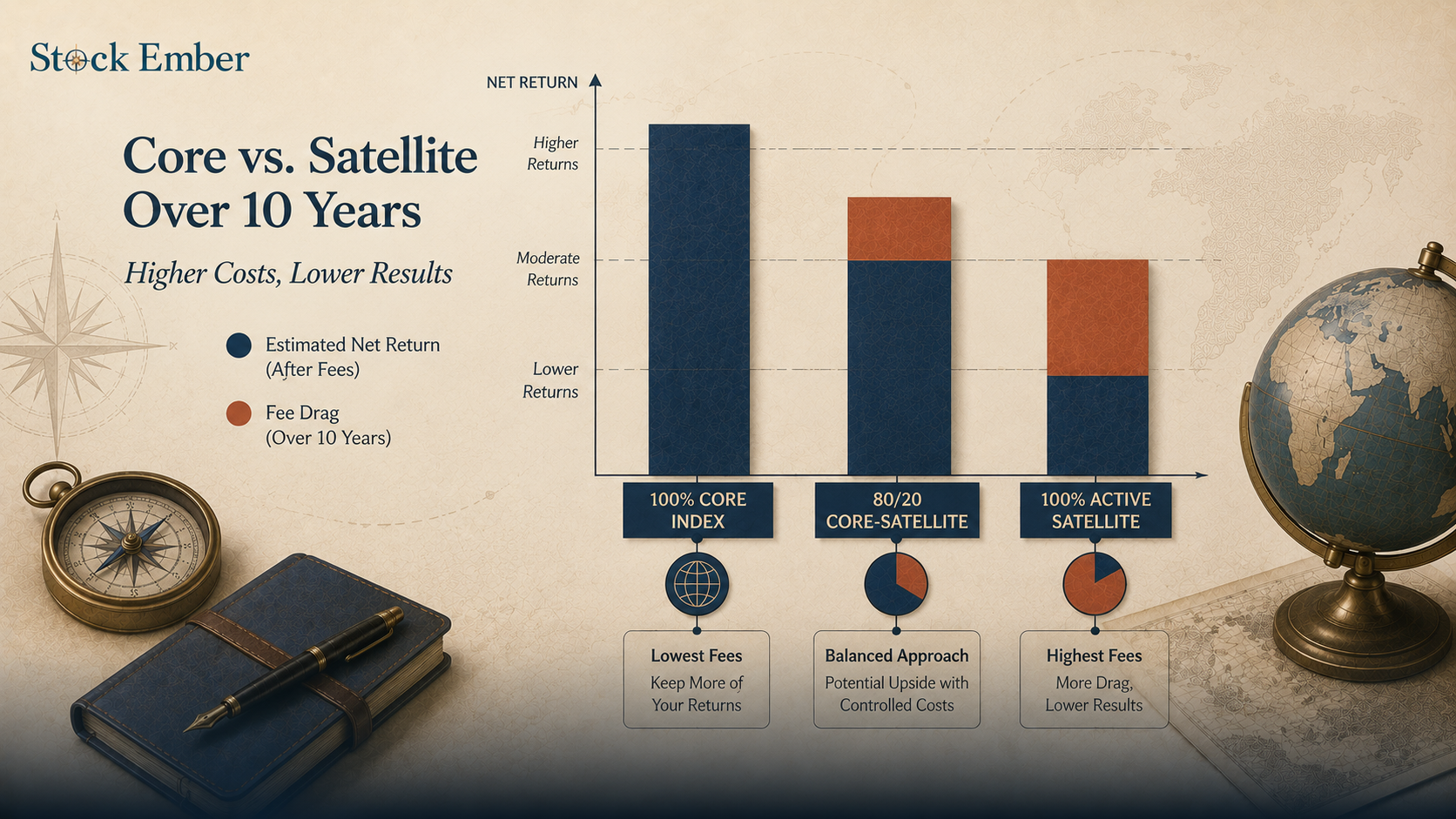
Total cost of ownership in a core-satellite allocation depends heavily on how higher fees in active satellite positions drag down overall portfolio compounding over a decade.
Fees are a silent drag on investment growth. While a low-cost core index ETF may charge a very low expense ratio, actively managed or specialized ETFs can charge higher fees. For this example, assume a 0.05% expense ratio for the core ETF and 0.75% for the active satellite allocation.
To understand how this impacts your wealth over ten years, consider an illustrative $100,000 investment growing at a hypothetical 7% annual gross return before fees:
Scenario A (100% Core): An allocation with an average expense ratio of 0.05% leaves you with roughly 6.95% net growth per year. Over 10 years, your $100,000 grows to approximately $195,800.
Scenario B (80/20 Core-Satellite): Keeping 80% in a 0.05% core fund and placing 20% in active satellite funds charging 0.75% creates a blended portfolio fee of 0.19% per year. Over 10 years, the portfolio grows to approximately $193,200.
Scenario C (100% Active Satellite): Placing all capital in active 0.75% fee funds yields approximately $183,300 over the same decade.
By keeping 80% of your capital in the core, you save nearly $10,000 in fee drag compared to an all-active portfolio, preserving compounding power where it matters most.
Chart showing 10-year portfolio fee drag across different core satellite allocations
Managing Pitfalls: Overlap, Volatility, and Drawdowns
Managing a core-satellite portfolio requires monitoring stock overlap, preventing satellite drift, and protecting against severe drawdowns near retirement.
While the strategy is structured to limit risk, several pitfalls can erode performance if left unmanaged:
Unintended Overlap: Specialized thematic satellite ETFs often hold the exact same mega-cap technology stocks that dominate your broad market core ETF. Holding both increases concentrated stock risk without providing true diversification.
Position Drift: If a satellite position experiences rapid gains, it may grow from 10% of your portfolio to 30%. Without systematic rebalancing back to your target ratio, your overall portfolio risk profile shifts toward volatile tactical bets.
Volatility and Retirement Timing: High-volatility satellite positions can suffer steep downturns. For investors approaching retirement, severe satellite losses introduce sequence of returns risk, where selling depreciated assets to fund living expenses permanently damages capital preservation.
Regular annual or semi-annual rebalancing ensures your satellite positions remain controlled tools for targeted growth rather than sources of uncontrolled portfolio risk.
Conclusion
A core satellite portfolio provides a practical balance between broad-market stability and flexible tactical opportunity for long-term investors.
By anchoring 70% to 90% of your assets in broad, low-cost index funds, you protect your wealth with proven market drivers while limiting management fee drag over ten-year horizons. Reserving a smaller satellite portion allows you to pursue specialized strategies or stock picks without risking your core financial goals. As you adjust your allocation over time, disciplined rebalancing and risk control remain key to long-term compounding success.
When you are ready to evaluate core and satellite asset options, our ETF reviews provide clear data to help build your allocation. Investing always involves risk of loss and past performance does not guarantee future results, so treat this guide as educational context for your own portfolio decisions.
FAQ
5 questions
What is a typical core-satellite allocation ratio?
Standard core-satellite allocations typically place 70% to 90% of a portfolio into low-cost core holdings, such as broad market index ETFs or mutual funds. The remaining 10% to 30% is allocated across satellite holdings, which can include active sector funds, thematic ETFs, or individual stocks intended to capture targeted market opportunities.
How does a core-satellite strategy lower total investment fees?
A core-satellite strategy lowers overall costs by anchoring the vast majority of capital in ultra-low-cost index funds that charge minimal management fees. Because higher-fee active or thematic satellite funds make up only a small fraction of the portfolio, the blended expense ratio stays low, preserving long-term compounding.
What types of investments belong in the core versus the satellite?
The core foundation usually consists of passive, broad-market index funds covering major asset classes like global stocks or total bond markets. Satellite positions feature more specialized or volatile assets, such as sector ETFs, emerging markets, active strategy funds, dividend stocks, or individual company shares.
How often should you rebalance a core satellite portfolio?
Most investors review and rebalance a core satellite portfolio once or twice a year, or when a position drifts beyond its target range by 5% or more. Periodic rebalancing prevents strong satellite gains from over-concentrating total risk and ensures active trades do not overwhelm the steady core.
Can a core satellite portfolio beat broad market index returns?
A core satellite portfolio aims to match broad market returns through its core foundation while seeking tactical outperformance from satellite bets. However, satellite outperformance is not guaranteed, and higher fees or manager underperformance in satellite holdings can cause the overall portfolio to lag benchmark indexes.
Disclaimer
This guide was written with AI assistance and reviewed by the StockEmber editorial team for accuracy. StockEmber provides independent education, not personal financial advice. Some links may support our work at no additional cost to you.
The StockEmber Team is our in-house desk of independent research writers. We test brokerage platforms, read the fine print on fees and custody, and cover ETFs and long-horizon investing for people who plan to hold for decades — not days.