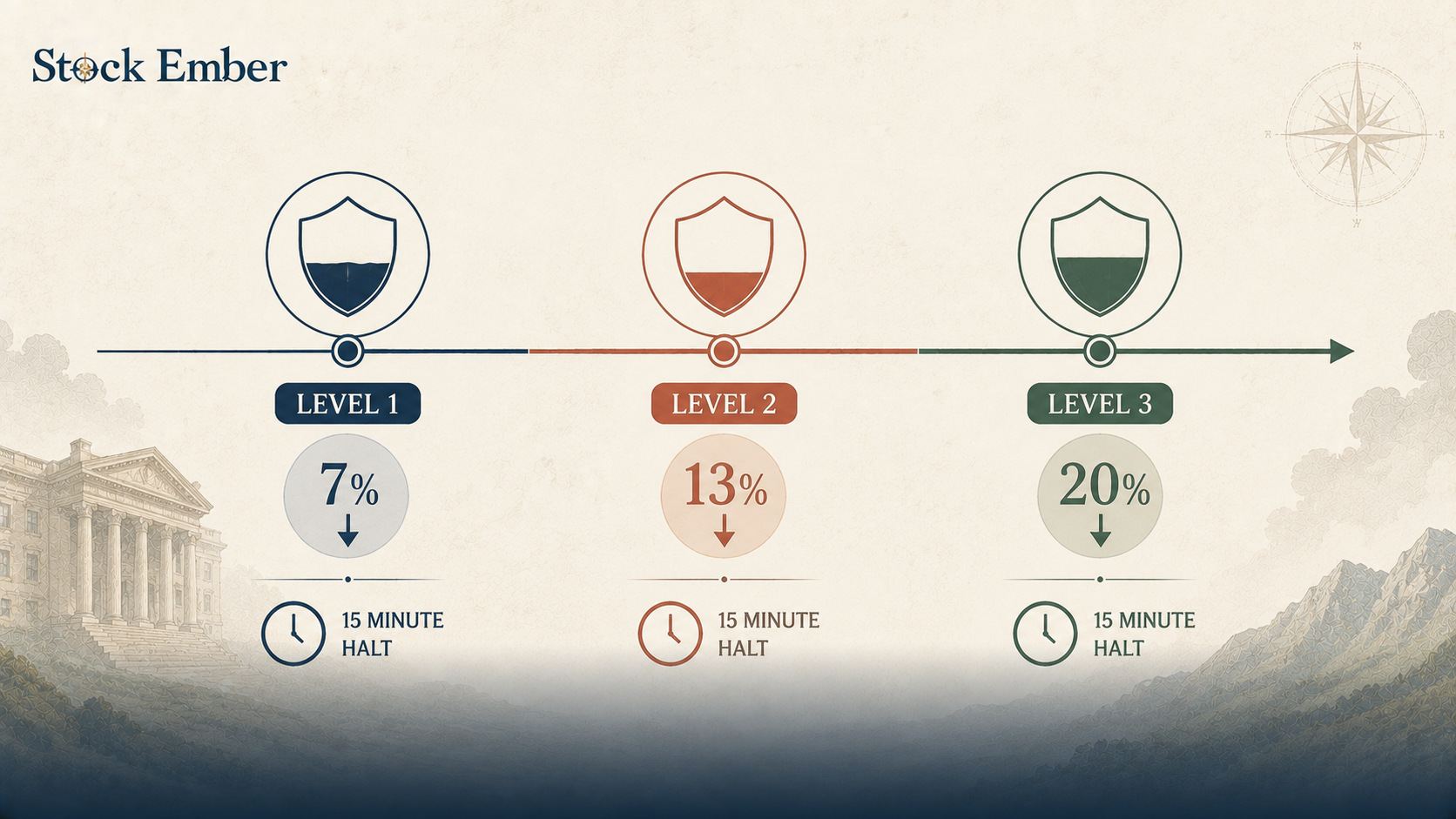
A stock market circuit breaker is an emergency regulatory halt that temporarily freezes trading across exchanges during sudden, severe index drops. It gives investors and market algorithms a 15-minute operational pause to digest news and process orders in an orderly environment. Circuit breakers prevent system crashes and panic spirals, but they do not guarantee stock prices will not drop further when trading resumes.
A stock market circuit breaker is an automated regulatory mechanism that temporarily pauses trading across an exchange when stock prices experience severe intraday declines.
When stock markets drop during periods of intense market stress, automatic trading halts step in to prevent system overloads and uncontrolled panic selling. For long-horizon investors, seeing headlines about trading pauses can feel alarming, but understanding these structural timeouts removes unnecessary anxiety. This guide breaks down how circuit breakers operate, the specific percentage triggers that pause exchange trading, and how buy-and-hold investors should approach market halts.
Quick Takeaways
01Circuit breakers temporarily halt stock trading during sudden market drops to maintain orderly conditions and prevent panic.
02Market-wide pauses trigger at three specific S&P 500 drop thresholds: Level 1 (7%), Level 2 (13%), and Level 3 (20%).
03A trading halt pauses execution mechanics but does not shield an investor from stock price drops when trading reopens.
04Long-term buy-and-hold investors do not need to make trades or change portfolios during temporary market halts.
What Is a Stock Market Circuit Breaker?
A stock market circuit breaker is a system-wide rule enforced by stock exchanges and securities regulators to maintain orderly trading conditions. Just as an electrical circuit breaker shuts off power to prevent an overload, a market circuit breaker stops trading activity when prices drop too far and too fast in a single trading session.
These automated rules apply across all major stock exchanges, using broad market indexes as their benchmark. In the United States, regulators monitor the S&P 500 index throughout the business day to determine when a market-wide pause should trigger.
When market volatility spikes, high-frequency algorithms and rapid human selling can create an extreme feedback loop. Enforcing a brief, mandatory pause gives human traders, fund managers, and market makers time to review incoming news and organize buy and sell orders cleanly.
Seeing trading pause for the first time during a sharp market drop can feel alarming, but experiencing a market halt firsthand highlights why rules-based timeouts exist: to keep exchange mechanics functioning cleanly under extreme pressure.
How Circuit Breakers Work: The 3 Regulatory Levels
Market-wide circuit breakers operate on a three-tiered threshold system based on the percentage drop in the S&P 500 index relative to the previous day’s closing value.
The regulatory rules split market-wide halts into three distinct severity levels:
Level 1 (7% Drop): If the S&P 500 index drops 7% before 3:25 PM Eastern Time, trading pauses across all stock exchanges for 15 minutes. A 7% drop occurring at or after 3:25 PM ET does not trigger a pause.
Level 2 (13% Drop): If the S&P 500 index drops 13% before 3:25 PM ET, trading halts again for 15 minutes. A Level 2 drop after 3:25 PM ET does not trigger a pause.
Level 3 (20% Drop): If the S&P 500 index drops 20% at any time during the trading day, trading halts for the remainder of the business day.
It is also useful to distinguish broad index circuit breakers from single-stock trading halts. Under Limit-Up/Limit-Down (LULD) rules, individual stocks experience brief 5-minute pauses if their prices move outside specific price bands. While single-stock halts happen frequently during earnings releases or company announcements, market-wide circuit breakers remain rare emergency interventions.
Why Circuit Breakers Exist (and What They Do Not Do)
Circuit breakers fulfill a key operational role: they interrupt irrational panic selling and give market participants time to absorb news, calculate asset valuations, and re-establish order books.
During high-speed market crashes, electronic trading systems process large volumes of sell orders within seconds. Without a temporary trading pause, temporary liquidity shortages can push share prices far lower than economic fundamentals justify. A 15-minute pause lets market makers step in with fresh liquidity and match buyer and seller interest.
However, investors should recognize what circuit breakers do not accomplish. A trading halt pauses market mechanics, but it does not protect an investor from fundamental capital loss.
A circuit breaker is not a floor on stock prices. When trading resumes after a 15-minute halt, prices are free to decline further if investors continue selling. The circuit breaker ensures that price discovery occurs in an orderly environment, not that share prices stay protected at artificial levels.
Market Halts vs. Long-Term Portfolio Strategy
When market circuit breakers trigger headlines, long-term investors are often tempted to log into their accounts or make immediate adjustments. However, market-wide halts are structural exchange events, not reasons to abandon a well-designed investment plan.
If your portfolio relies on passive investing, short-term trading pauses are simply temporary market noise. Broad index funds hold hundreds of underlying businesses, allowing capital to compound across full market cycles regardless of single-day exchange pauses.
Likewise, investors who allocate capital using factor investing strategies such as targeting value or quality factors, understand that factor performance develops over years. Day-to-day trading halts do not alter the underlying business health or earnings power of portfolio holdings.
Attempting to place orders during or immediately after a trading halt often exposes investors to poor order execution, wide bid-ask spreads, and emotional mistakes. Remaining patient during market volatility remains the most effective course of action.
Common Misconceptions During Market Halts
Understanding how stock exchanges operate during trading halts helps investors avoid expensive errors. Three common misconceptions include:
1. Market halts mean exchanges are closing permanently. A Level 1 or Level 2 halt is simply a temporary 15-minute operational pause. Even a Level 3 halt, which stops trading for the rest of the day, is an early close to prepare for orderly re-opening on the next business day.
2. Pending limit orders execute at pre-halt prices. When trading stops, pending orders wait in the order book. When trading reopens, orders execute at the new market clearing price, which may be lower or higher than prices recorded before the halt.
3. Investors should sell immediately when trading reopens. Selling immediately after a trading halt reopens often means selling at peak fear and low liquidity. Historical market drops demonstrate that emotional selling during volatile trading days frequently locks in temporary paper losses.
Conclusion
Stock market circuit breakers are essential regulatory tools designed to keep financial markets orderly, transparent, and functional during extreme selling pressure. They provide market participants with time to digest news and process orders, but they do not eliminate market volatility or shield portfolios from economic downturns. For long-horizon buy-and-hold investors, trading halts serve as a reminder to focus on long-term goals rather than short-term market noise.
When you are ready to evaluate diversified funds that fit your long-term plan, our ETF reviews provide a clear starting point for comparing low-cost index options. Investing always involves the risk of capital loss and past market behavior never guarantees future results, so treat market mechanics as educational knowledge for building your long-term strategy.
FAQ
5 questions
What triggers a stock market circuit breaker?
A market-wide circuit breaker triggers when the S&P 500 index drops by specific percentage thresholds relative to the previous day’s close. Level 1 triggers at a 7% drop, Level 2 at 13%, and Level 3 at 20%. Level 1 and Level 2 halts pause trading for 15 minutes if triggered before 3:25 PM ET, while Level 3 closes trading for the remainder of the business day.
How long does a circuit breaker halt trading?
Level 1 and Level 2 circuit breaker halts stop trading across all U.S. stock exchanges for 15 minutes, provided the drop happens before 3:25 PM Eastern Time. If the S&P 500 drops 20% (Level 3) at any time during the trading session, trading shuts down completely for the rest of the day.
Does a circuit breaker stop a stock market crash?
No, a circuit breaker does not stop a stock market crash or shield investments from capital loss. Circuit breakers pause exchange trading mechanics to prevent system overloads and stop automated panic selling. Once the 15-minute halt ends, market participants are free to continue buying or selling at updated prices.
What is the difference between market-wide circuit breakers and single-stock halts?
Market-wide circuit breakers pause trading across every exchange based on broad S&P 500 movements. In contrast, single-stock halts (governed by Limit-Up/Limit-Down rules) temporarily pause trading for an individual stock or ETF for 5 minutes if its price moves outside a specific price corridor due to sudden volatility.
What should long-term investors do during a stock market halt?
Long-term buy-and-hold investors should take no action during a market halt. Circuit breakers are short-term operational timeouts. Trying to place orders during extreme volatility often leads to poor order execution. Sticking to a disciplined, broad-market portfolio strategy remains the most effective approach.
Disclaimer
This guide was written with AI assistance and reviewed by the StockEmber editorial team for accuracy. StockEmber provides independent education, not personal financial advice. Some links may support our work at no additional cost to you.
The StockEmber Team is our in-house desk of independent research writers. We test brokerage platforms, read the fine print on fees and custody, and cover ETFs and long-horizon investing for people who plan to hold for decades — not days.