A child Stocks and Shares ISA is a tax-advantaged UK account that allows parents to invest up to £9,000 per year for a minor without paying capital gains or dividend tax. All funds belong legally to the child and remain locked until age 18, when the account converts into a standard adult ISA.
A child Stocks and Shares ISA, officially known as a Junior Individual Savings Account (JISA), is a tax-advantaged UK investment wrapper that lets parents and guardians invest money on behalf of a child under age 18.
Saving for a child over a 10 to 18-year period often comes down to a choice between cash interest and stock market growth. Because cash savings risk losing purchasing power to inflation over long periods, equity investments offer a structured path toward compound growth. This guide covers how a child Stocks and Shares ISA works, key age milestones, tax rules, and common mistakes to avoid.
Quick Takeaways
01A child Stocks and Shares ISA allows up to £9,000 per tax year to be invested completely free of capital gains tax and dividend tax.
02All deposited funds legally belong to the child from day one, though money remains locked until their 18th birthday.
03Account management control hands over to the child at age 16, while cash withdrawal rights activate automatically at age 18.
04Over long investment timelines of 10 to 18 years, stock market investments have historically outpaced inflation far better than cash savings, despite short-term price drops.
What Is a Child Stocks and Shares ISA?
This type of account is a tax-advantaged investment vehicle designed for UK residents under age 18 to build long-term wealth free from capital gains tax and dividend tax.
Under UK tax rules, parents or legal guardians can open an account and invest up to £9,000 per tax year on behalf of a child. Although only a parent or legal guardian with parental responsibility can open the account, anyone can contribute to it, including grandparents, family members, and friends.
The primary advantage of this account wrapper is total tax efficiency. Any capital growth or investment income generated within the account is completely protected from UK taxes. When the child eventually takes ownership of the funds, they do not owe income tax or capital gains tax on the total accumulated balance.
How a Child Stocks and Shares ISA Works: Age Milestones and Ownership
Account control for this type of account follows strict age milestones that divide legal ownership, management rights, and access to funds.
Legal Ownership Rights
Money deposited into the account legally belongs to the child from the exact moment it enters the account. Parents act as the registered contact to handle initial setup and asset choices, but they can never withdraw money for personal or household expenses.
Age 16: Account Management Rights
When the child turns 16, a major operational shift occurs. The child gains the legal right to take over management of the account. At this point, they can direct asset purchases, change fund selections, or switch providers. However, the legal lock-up remains in place; they cannot withdraw any cash from the account until they reach adulthood.
Age 18: Full Access and Conversion
On the child's 18th birthday, the Junior ISA automatically converts into an adult Stocks and Shares ISA. The young adult receives full legal authority over the account. They can choose to keep the money invested for their adult future or withdraw cash for personal goals, such as university fees or a home deposit.
Cash JISA vs. Stocks and Shares JISA: Managing Inflation and Volatility
If you're choosing between a Cash JISA and a Stocks and Shares JISA, the decision comes down to balancing guaranteed bank interest against the long-term growth you'll need to beat inflation.
Feature
Cash JISA
Stocks and Shares JISA
Capital risk
Protected — value doesn't fall
Capital at risk — value can rise or fall
Growth potential
Fixed or variable interest rate
Historically higher long-term growth via equities
Inflation protection
Limited — cash can lose purchasing power over time
Historically stronger over an 18-year holding period
Best suited for
Shorter timelines or risk-averse savers
Longer timelines (10–18 years) aiming to outpace inflation
Access before age 18
Locked, same as Stocks and Shares JISA
Locked, same as Cash JISA
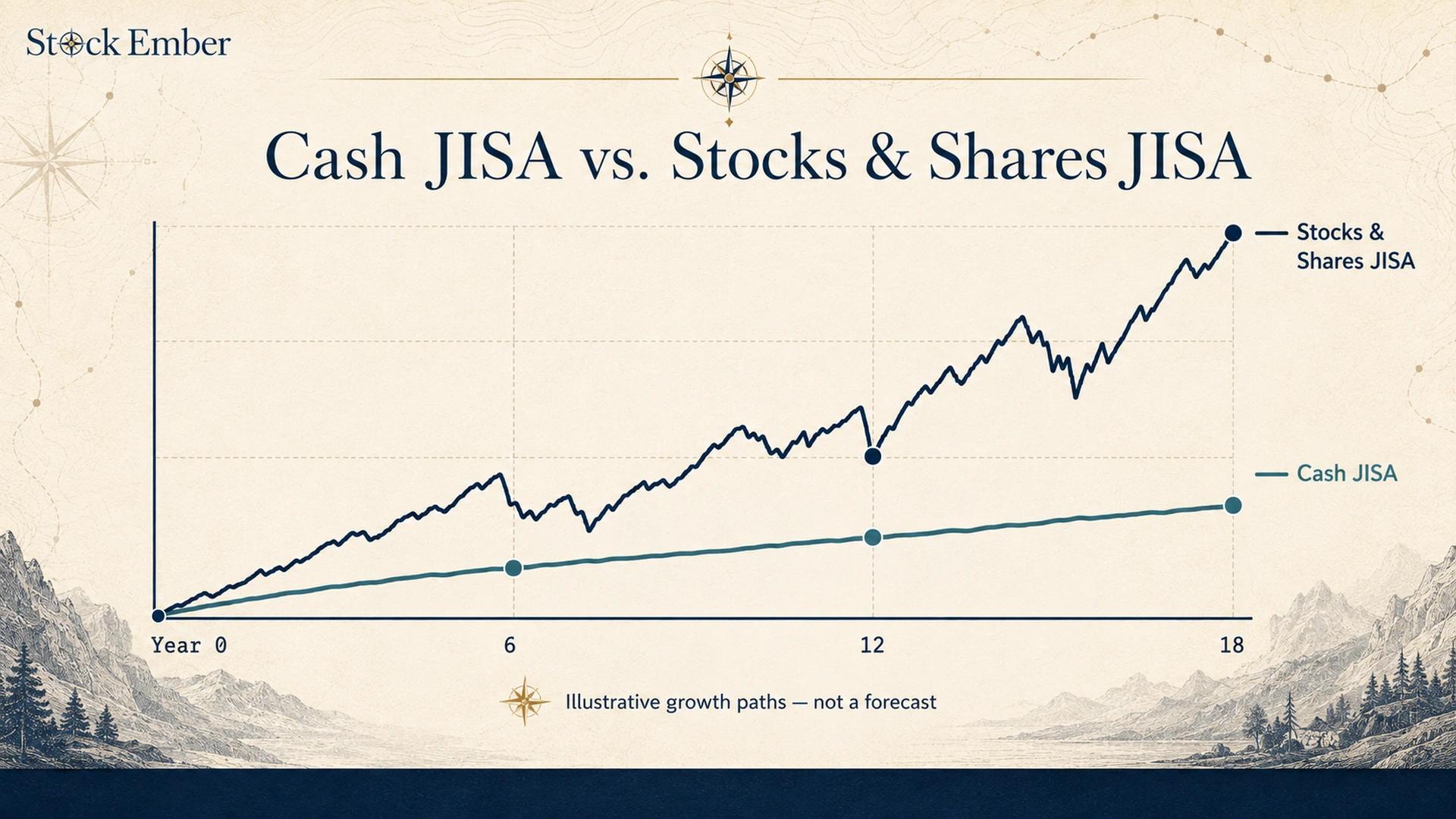
A Cash JISA offers a simple savings model where capital is protected from market drops and earns a fixed or variable interest rate. While this provides peace of mind, holding cash for 10 to 18 years introduces inflation risk. If inflation averages 3% per year while cash earns 2%, the real purchasing power of the child's savings steadily shrinks over time.
Comparison chart of cash savings versus stock market growth over 18 years
In contrast, a child Stocks and Shares ISA puts money to work in assets like index funds, individual shares, or exchange-traded funds (ETFs). Stock market values move up and down in the short term, meaning capital is at risk. However, over an 18-year holding period, historical market data shows that diversified equity portfolios regularly beat inflation, making equity accounts a practical tool for long-horizon wealth building.
Essential Rules, Limits, and Child Trust Fund (CTF) Transfers
UK account regulations allow a child to hold one Cash JISA and one Stocks and Shares JISA simultaneously, provided total deposits across both do not exceed £9,000 in a single tax year.
For instance, parents can split the annual allowance by putting £4,500 into a cash account and £4,500 into an equity investment account.
Child Trust Fund (CTF) Conversion Rules
Children born between September 2002 and January 2011 were automatically assigned a Child Trust Fund (CTF) by the UK government. According to official guidelines on GOV.UK, a child cannot hold a Child Trust Fund and a Junior ISA at the same time.
If a child currently has a CTF, parents must request a full transfer from their existing CTF provider into a Junior ISA. Once the transfer completes, the CTF closes, and the child can benefit from the wider choice of modern investment funds and lower management fees often available in Junior ISAs.
Conclusion
While the UK child Stocks and Shares ISA provides a flexible tax-free cash pot at age 18, international account systems like those in the United States rely on distinct wrappers designed for specific long-term goals.
In the United States, parents often review 529 plan rules to save tax-free specifically for higher education expenses. Unlike a 529 plan, which enforces penalties if funds are not used for qualified education costs, a UK child Stocks and Shares ISA imposes zero restrictions on how the young adult uses their money once they turn 18.
Similarly, US families with teenagers who earn income might set up a tax-advantaged account like a Roth IRA. While a Roth IRA focuses on building retirement wealth over decades, the UK Junior ISA is structured as a general wealth-building tool that transitions straight into an adult ISA at age 18.
FAQ
4 questions
What is a Junior Stocks and Shares ISA?
A Junior Stocks and Shares ISA (JISA) is a UK tax-free investment account designed to help parents save and invest money on behalf of a child under the age of 18.
Who can open and manage a Junior ISA?
A parent or legal guardian with parental responsibility must open the account and manage it as the registered contact until the child turns 16.
What is the annual contribution limit for a Junior ISA?
In the UK, you can contribute up to £9,000 per child each tax year into a Junior ISA. All investment growth and income inside the account remain tax-free.
When can the child withdraw money from the Junior ISA?
The money is locked until the child turns 18. At age 18, the account automatically converts into an adult ISA, and the child gains full control over the funds.
Disclaimer
This guide was written with AI assistance and reviewed by the StockEmber editorial team for accuracy. StockEmber provides independent education, not personal financial advice. Some links may support our work at no additional cost to you.
The StockEmber Team is our in-house desk of independent research writers. We test brokerage platforms, read the fine print on fees and custody, and cover ETFs and long-horizon investing for people who plan to hold for decades — not days.