Buy and hold is a long-term investment approach that involves purchasing assets and keeping them across multiple market cycles rather than trading frequently. The strategy relies on broad economic growth and uninterrupted compounding while avoiding the costs and timing mistakes of active trading. Investors maintain their positions through short-term market swings and rebalance periodically to preserve their target allocation.
This strategy involves purchasing assets to keep for many years or decades, regardless of short-term price swings in the financial markets.
When markets drop sharply, holding steady can feel difficult. Many investors feel pulled to sell during drops or chase hot trends. Yet market history shows that patience often beats frantic activity. This guide breaks down how long-term holding works, why low fees protect your money, and how to avoid the common errors that derail long-term plans.
Quick Takeaways
01This strategy focuses on long-term business growth rather than short-term price swings.
02Cutting trading activity lowers commissions, spreads, and taxes, leaving more cash to compound over time.
03Trying to time the market often means missing the strongest recovery days, which permanently reduces overall returns.
04True buy-and-hold investing requires broad diversification and periodic rebalancing, not blind neglect.
What Is Buy and Hold?
The buy and hold meaning comes down to a simple principle: you buy investments with the plan to own them across full market cycles.
When people ask what this means, they are looking at an approach built on patience. Instead of trading shares each week, you select broad assets and leave them alone to grow.
Properly understood, this strategy is not about guessing which single company will win next month. When applied to single stocks, holding forever carries severe business risk because individual companies can lose value permanently. In modern practice, the strategy often serves as the foundation for passive investing, where you own broad index funds or exchange-traded funds that track hundreds of companies at once. By owning entire markets, you accept normal short-term ups and downs while participating in long-term economic expansion.
How Buy and Hold Works in Practice
In practice, buy and hold works by establishing a target mix of investments and keeping that mix steady through bull and bear markets.
You begin by picking an asset allocation, such as an 80/20 mix of broad stock index funds and bond funds, that fits your personal goals and risk tolerance. From there, your main job is regular contributions and quiet maintenance.
Each time you receive a dividend (a cash payout from company earnings), you automatically reinvest it into more shares. When markets swing wildly, you ignore the daily headlines and avoid reactionary trades.
In practice, many long-term investors find that setting up automatic monthly transfers removes emotion from the process, making it far easier to stay invested during painful market drops.
Rather than checking account balances daily, a patient investor reviews their holdings once or twice a year to verify that their overall plan remains on course.
Why Buy and Hold Works: Compounding and Friction
This strategy works because it pairs uninterrupted compound growth with the elimination of trading friction.
When you hold investments over decades, uninterrupted time lets compound interestbuild long-term wealth by earning returns on your past returns and reinvested distributions.
Total Return = (End Value − Start Value + Dividends) / Start Value
This simple relationship shows why staying invested matters: every dividend and price gain adds directly to your capital base, and it measures your return over the whole holding period, not per year.
Every time you buy or sell, you pay friction. Trading friction includes broker commissions, bid-ask spreads (the gap between buying and selling prices), and taxes on short-term profits. Active trading also causes high turnover (how often assets are bought and sold in a portfolio), which creates a continuous drag on your money.
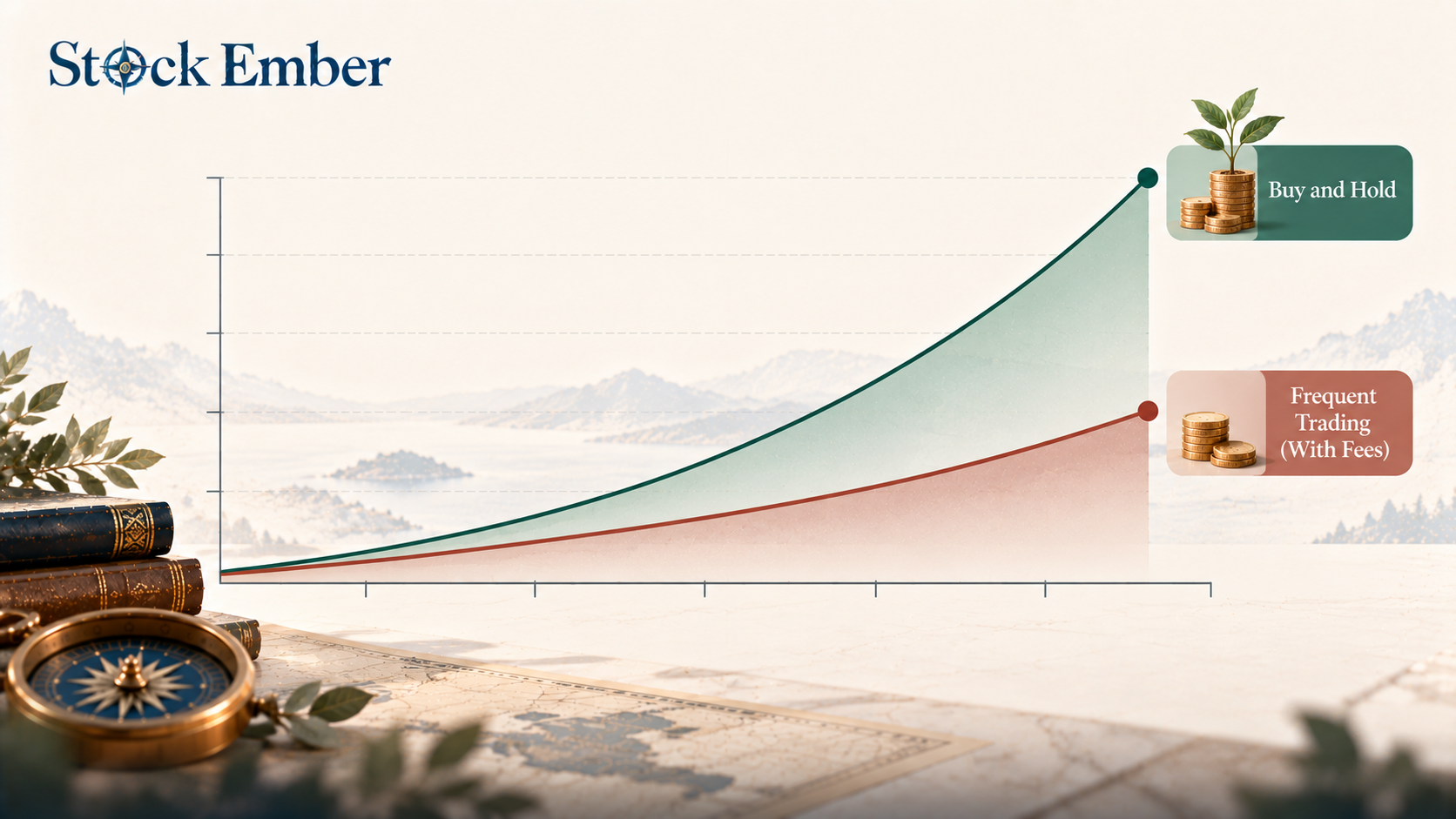
Consider the ten-year cost of this friction. Imagine you invest $100,000 in a portfolio growing at a hypothetical 7% a year. This is an illustration, not a forecast or a guarantee. If frequent trading adds an extra 1.5% in yearly costs from spreads, transaction fees, and tax drag, your portfolio grows at only 5.5%.
Over ten years, the low-turnover buy-and-hold portfolio grows to roughly $196,700, while the actively traded account reaches only around $170,800. That 1.5% drag quietly removes nearly $26,000 from your wealth, money that never gets the chance to compound. Even small-looking fees can add up over time, the SEC notes. You can test your own numbers with the SEC’s Compound Interest Calculator.
Chart illustrating the ten-year cost of trading friction compared to buy and hold compounding
Buy and Hold vs. Market Timing: The Cost of Missing the Best Days
The central difference between buy and hold and market timing is that this strategy focuses on time in the market, while market timing tries to predict market turns.
Market timers try to sell before drops and buy back right before recoveries. But market rallies often occur during the most volatile periods, directly after steep declines.
Missing just a handful of the market’s strongest trading days can sharply reduce your long-term returns. J.P. Morgan Asset Management’s 2025 Guide to Retirement found that missing the 10 best days of the past 20 years would have cut annualized returns by nearly half. An investor who panic sells during a drop can stay on the sidelines too long and miss the rebound that follows.
Strategy Feature
Buy and Hold
Market Timing
Trading Frequency
Very low (rare rebalancing)
High (frequent entries and exits)
Cost and Tax Drag
Minimal fees and lower tax rates
Higher commissions, spreads, and taxes
Main Challenge
Enduring market drops without selling
Predicting tops and bottoms correctly
Common Buy-and-Hold Mistakes to Avoid
The most common buy-and-hold mistakes stem from treating patience as total neglect or underestimating the emotional pain of market volatility.
First, never confuse this strategy with simply ignoring your portfolio. Holding for the long run still requires occasional rebalancing (bringing your mix of assets back to your original plan). If stocks surge for years, your portfolio may hold far more stock risk than you intended, leaving you exposed right before a downturn.
Second, avoid applying this strategy blindly to individual stocks. Companies face business disruptions, technological shifts, and bankruptcy. Holding a dying business for twenty years does not create wealth; it locks in permanent capital loss. The buy-and-hold philosophy works best with broad, diversified index funds where weak companies are naturally replaced by growing ones.
Third, beware of misjudging your risk tolerance. When a severe market drawdown (how far an investment drops from its peak) arrives, investors who took on too much risk often panic and sell at the bottom. A true buy-and-hold plan requires an emergency cash reserve so you never have to sell investments to cover living expenses.
Conclusion
A patient buy-and-hold approach strips away the noise of daily market swings, allowing compound returns and low friction to do the heavy lifting over decades. By pairing broad diversification with steady rebalancing, you avoid the costly trap of trying to outguess short-term market cycles.
When you are ready to evaluate core funds for your portfolio, our ETF reviews are the place to start. Investing always puts your capital at risk and past market recoveries do not promise future returns, so treat this guide as education for your research rather than personal financial advice.
FAQ
5 questions
When does it make sense to sell in a buy-and-hold strategy?
You typically sell only when your financial goals change, when you reach your target retirement date, or during scheduled rebalancing to restore your target asset mix. Selling may also make sense if you need to reallocate capital toward lower-risk assets like bonds as your time horizon shortens, rather than reacting to temporary market swings.
Does a buy-and-hold strategy work in volatile or sideways markets?
Yes, because long-term returns are driven by multi-year business earnings and reinvested dividends rather than short-term price momentum. During sideways or volatile periods, reinvested distributions purchase more fund shares at lower prices. This ongoing accumulation positions your portfolio for growth when broader economic expansion resumes.
Is buy and hold better suited for individual stocks or index funds?
The strategy works far better with broad index funds and ETFs. Individual companies face operational risks, disruptive competition, and insolvency, meaning a struggling single stock may never recover. Broad index funds hold hundreds of businesses at once, allowing market-wide growth to continue even when individual companies decline.
What is the difference between buy and hold and passive investing?
This approach is an overarching holding philosophy that prioritizes keeping assets for years, whereas passive investing is a specific implementation that uses index-tracking funds to mirror market returns. While you can technically own single equities for decades, combining long-term holding with passive index funds provides maximum diversification and minimal ongoing cost.
How should an investor handle severe market downturns?
Many financial professionals consider avoiding sales during downturns, and continuing regular contributions if your budget permits, to be among the more effective approaches. Maintaining an adequate cash emergency fund prevents forced liquidations at market bottoms. If your asset allocation has drifted significantly due to falling stock prices, scheduled rebalancing allows you to buy depressed assets methodically.
Disclaimer
This guide was written with AI assistance and reviewed by the StockEmber editorial team for accuracy. StockEmber provides independent education, not personal financial advice. Investing puts your capital at risk: the value of investments can go down as well as up, you may get back less than you invest, and past performance doesn’t guarantee future results. Some links may support our work at no additional cost to you.
The StockEmber Team is our in-house desk of independent research writers. We test brokerage platforms, read the fine print on fees and custody, and cover ETFs and long-horizon investing for people who plan to hold for decades — not days.