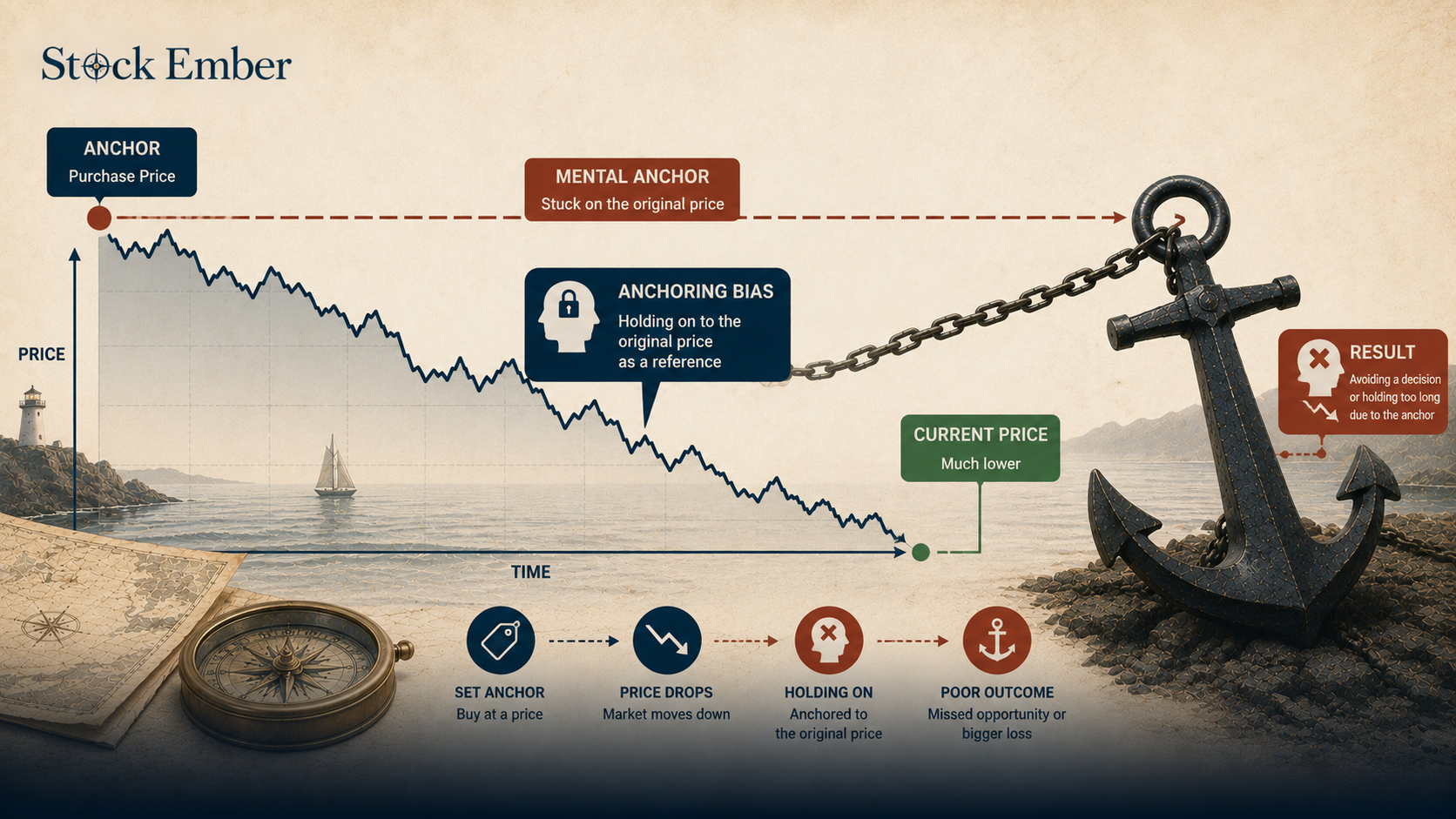
Anchoring bias is a cognitive shortcut where investors rely too heavily on an initial reference price such as a stock's purchase cost or a 52-week high, when evaluating future investment decisions. Fixating on irrelevant past figures prevents investors from adapting to new market realities, often leading to prolonged holding of underperforming assets.
Anchoring bias is a cognitive shortcut where an investor fixates on an initial piece of financial data, such as a stock purchase price or a historical peak, when making future investment decisions.
When you evaluate an asset based on what you paid rather than what it is worth today, your portfolio suffers. Holding a failing position just to break even or avoiding a quality asset because its price moved above an old anchor creates a quiet drag on long-term wealth. This guide breaks down the definition, reveals its real-world costs, and shows how to neutralize it through disciplined portfolio rules.
Quick Takeaways
01Anchoring bias occurs when you fixate on past prices, like purchase costs or past highs, instead of current fundamentals.
02Holding a declining asset until it breaks even creates an opportunity cost that compounds over a 10-year horizon.
03Combining price anchors with confirmation bias leads investors to ignore warning signs and hold impaired assets.
04Rule-based rebalancing and automated index strategies naturally bypass human psychological traps.
What Is Anchoring Bias in Investing?
Anchoring bias in investing refers to the tendency to rely too heavily on the first price or statistic you see when assessing an asset's market value. In behavioral finance, this initial number becomes a mental reference point that skews every choice that follows.
When people ask what this cognitive bias is, the simplest answer is refusing to update your mind when market facts change. Academic studies in psychology showed that human minds naturally start from an initial reference point and adjust too little. In stock markets, that reference point is usually the price tag on the day you bought a share.
The standard anchoring bias definition highlights that this reference point is often disconnected from future investment performance. A company's future stock price depends on cash flow, earnings growth, debt levels, and competitive strength. The dollar amount you paid six months ago has zero effect on where the business goes next. Yet, many long-term investors treat their entry price as a sacred target.
How Anchoring Bias Works in Practice
In practice, price anchors show up in everyday portfolio choices through three distinct traps:
The Break-Even Trap: You buy a stock at $100 per share. The underlying business loses competitive ground, and the price drops to $60. Instead of selling the weakened asset and moving money to a stronger business, you insist on holding until the price returns to $100.
The Fake Discount Trap: A stock drops from a 52-week high of $200 down to $100. You anchor on the $200 peak and assume the stock is cheap at $100, ignoring that company profits may have fallen by half.
The Missed Opportunity Trap: You watch an index fund rise from $100 to $120. You refuse to add fresh cash because you are anchored on the $100 entry level, waiting for a dip that never arrives while missing years of market growth.
Diagram illustrating the break-even trap in stock investing
In practice, many long-term investors find that purchase-price anchors are the hardest to break because admitting a loss feels like a personal failure rather than a normal cost of investing.
Why Anchoring Bias Harms Long-Term Portfolios
The true cost of price anchoring is not just the immediate loss on a poor investment, it is the 10-year opportunity cost of tied-up capital.
Consider a simple 10-year scenario. Imagine you hold $10,000 in a declining stock anchored at your $100 purchase price. The stock falls to $50, leaving you with $5,000 in market value. It takes ten years for the stock to recover to $100 so you can break even. On paper, you lost no principal.
However, if you had sold the impaired position at $50 and placed that $5,000 into a broad index fund assuming a 7% annual return, a hypothetical estimate only, since actual returns are never guaranteed and can be negative, that money would have grown to roughly $9,835 over a decade. By waiting 10 years just to get your original $10,000 back, you surrendered nearly $5,000 in compounding growth.
When you anchor on an entry point, you lock money into stagnant assets. Over several decades, these delayed exits drag down total portfolio returns far more than small individual losses.
Anchoring Bias vs. Confirmation Bias
Anchoring bias rarely works alone; it frequently pairs with confirmation bias to form a double psychological trap. While anchoring establishes a price target in your mind, confirmation bias drives you to seek out news that justifies keeping that anchor.
By definition, confirmation bias is the tendency to seek out, favor, or interpret new information in ways that confirm what you already believe.
For example, an investor anchors on a purchase price of $150 for a tech stock. As weak earnings reports arrive, the investor ignores negative analyst notes. Instead, they search online forums for optimistic commentary that supports the belief that the stock will return to $150. The anchor sets the emotional goal, and confirmation bias provides the selective facts to defend it.
How to Overcome Anchoring Bias in Portfolio Management
Overcoming price anchors requires moving from emotional target prices to rule-based habits. Key principles in behavioral finance show that relying on willpower alone fails when market swings trigger emotional decisions.
Long-term investors can use three structured habits to neutralize price anchors:
Evaluate Forward-Looking Fundamentals: Base asset decisions on future earnings potential, dividend security, and valuation, never on what you paid or where the price traded last year.
Automate Rebalancing: Set regular calendar dates (such as once a year) or asset allocation bands to rebalance automatically without judging daily market noise.
Use a Fresh-Money Checklist: Before holding a falling asset, ask: "If I held cash today, would I buy this asset at its current price?" If the answer is no, keeping it simply to break even is an anchored error.
Common Mistakes Investors Make with Price Anchors
Watch out for these frequent mistakes when managing your portfolio:
Setting Arbitrary Exit Rules: Refusing to sell an underperforming asset until it returns to your entry price. The market does not know or care what price you paid.
Confusing Price Drops with True Value: Assuming a stock that fell 50% is automatically a bargain without checking whether revenue or profits collapsed.
Refusing to Realize Tax Losses: Holding losing positions out of pride, missing tax-loss offset opportunities that could help your overall portfolio.
Conclusion
Anchoring bias is a quiet cognitive trap that causes investors to value past prices over current business realities. Fixating on entry points or past highs risks locking capital into weak assets and sacrificing years of compound growth. Establishing a clear, rule-based portfolio process removes emotional anchors and keeps your money working toward future goals. When you are ready to build a diversified, low-maintenance portfolio, reading our ETF reviews is a practical next step. Investing always involves risk of capital loss and past price performance never predicts future returns, so use these concepts as educational tools for personal portfolio discipline.
FAQ
5 questions
What is an example of anchoring bias in daily life vs. investing?
In daily life, anchoring bias occurs when a high initial price tag makes a sale price look like a bargain, even if the item is still overpriced. In stock investing, it happens when an investor refuses to sell a failing stock until its price recovers to what they originally paid, ignoring deteriorating company earnings.
Why do investors anchor on purchase price?
Investors anchor on purchase price primarily due to loss aversion and ego protection. Admitting a loss by selling below the purchase cost creates emotional regret, so investors treat their entry price as a psychological baseline that must be recovered before exiting the position.
How does anchoring bias affect asset allocation?
Anchoring bias distorts asset allocation by making investors hesitant to rebalance overperforming assets or buy funds trading near record highs. Fixating on lower historical entry points causes investors to miss ongoing market growth or maintain unbalanced, overly risky portfolios.
What is the difference between anchoring bias and sunk cost fallacy?
Anchoring bias is fixating on a specific reference number (like purchase price) to judge value. Sunk cost fallacy is continuing to pour time or money into a bad investment because of capital already spent. Sunk cost fallacy often stems from anchoring on the original investment amount.
Can automated index investing eliminate anchoring bias?
Yes, systematic index investing and rule-based rebalancing remove price anchors by taking human emotion out of the process. Automated index funds follow strict rules to buy and sell assets based on market caps or fixed allocation targets, completely ignoring historical purchase prices.
Disclaimer
This guide was written with AI assistance and reviewed by the StockEmber editorial team for accuracy. StockEmber provides independent education, not personal financial advice. Some links may support our work at no additional cost to you.
The StockEmber Team is our in-house desk of independent research writers. We test brokerage platforms, read the fine print on fees and custody, and cover ETFs and long-horizon investing for people who plan to hold for decades — not days.