A 401(k) rollover to an IRA moves retirement assets from a former employer's workplace plan into an individual retirement account. Executed as a direct transfer, the rollover maintains tax-deferred status without incurring immediate income tax or withdrawal penalties. This gives investors greater control over investment selection and administrative fees.
A 401(k) rollover to an IRA is the process of transferring retirement savings from a former employer's workplace plan into an Individual Retirement Account without triggering immediate income tax penalties.
Leaving a job often leaves investors unsure about how to manage an old retirement account left behind. Maintaining assets in a former employer's plan can limit investment choices and expose your portfolio to administrative costs. This guide explains how account transfers work, compares direct and indirect transfers, and outlines key tax rules to keep in mind.
Quick Takeaways
01Moving an old 401(k) into an IRA preserves tax-deferred growth while opening access to a broader selection of investments.
02A direct rollover transfers funds directly between account custodians, avoiding automatic tax withholding.
03An indirect rollover gives you 60 days to deposit the funds, but requires replacing a mandatory 20% tax withholding out of pocket.
04Transferring pre-tax 401(k) funds into a Roth account triggers an income tax bill in the year of the transfer.
What Is a 401(k) Rollover to an IRA?
A 401(k) rollover to an IRA moves retirement funds from a company-sponsored plan into an account you own and control independently.
When you leave an employer, your 401(k) account remains active, but you can no longer make new contributions or receive employer matching contributions. Executing a 401k rollover IRA transfer allows you to consolidate your retirement assets in one place.
Understanding a rollover from 401k to IRA accounts starts with recognizing how tax shielding works. As long as the assets move directly into another tax-advantaged wrapper, the IRS does not treat the transfer as a taxable withdrawal. Your balance continues compounding tax-deferred, keeping your long-term retirement savings intact.
The 4 Choices for an Old 401(k)
When you separate from an employer, you generally have four options for handling your workplace retirement savings:
Leave the assets in your former employer's 401(k) plan: Most plans permit this if your account balance exceeds $7,000. However, you cannot make further contributions.
Roll over to a new employer's 401(k) plan: If your new employer allows incoming transfers, you can consolidate your old balance into your active plan.
Execute a rollover 401k to IRA transfer: Moving assets into a personal IRA gives you full control over investment choices, fees, and account providers.
Cash out the balance: The plan custodian mails you a check for the balance. Cashing out triggers ordinary income tax on the full amount, plus a 10% early withdrawal penalty if you are under age 59½.
Option
Tax Effect
Main Benefit
Leave in Old Plan
Tax-Deferred
Keep institutional fund share classes
Move to New 401k
Tax-Deferred
Single workplace account login
Roll Over to IRA
Tax-Deferred
Broader investment choices
Cash Out
Taxable + 10% Penalty
Immediate cash access (High cost)
Direct vs. Indirect Rollover: Avoiding the 20% Tax Trap
Retirement account transfers occur through two distinct methods: direct transfers and indirect transfers. Choosing the wrong method can create an unexpected tax liability.
Direct Rollover (Trustee-to-Trustee)
In a direct rollover, your 401(k) provider transfers your funds directly to your new IRA custodian, either electronically or via a check made payable to the receiving institution. Because the money never touches your personal bank account, no income taxes are withheld, and the process completes without tax consequences.
Indirect Rollover
In an indirect rollover, the 401(k) custodian sends a payment directly to you. By law, the custodian must withhold 20% of the account balance for federal income taxes. You then have 60 days from the date you receive the funds to deposit the full distribution into an IRA.
To avoid taxes and penalties on the 20% that was withheld, according to rollover guidelines from the IRS, you must supply that 20% out of your own pocket when funding the new IRA. If you successfully deposit the full 100% within 60 days, the IRS returns the withheld 20% when you file your tax return. Missing the 60-day window causes the withheld portion—and any part of the balance not deposited—to be taxed as ordinary income, along with a 10% penalty if you are under age 59½.
Rollover 401(k) to Traditional IRA vs. Roth IRA
The tax classification of your existing 401(k) dictates which type of IRA you should open.
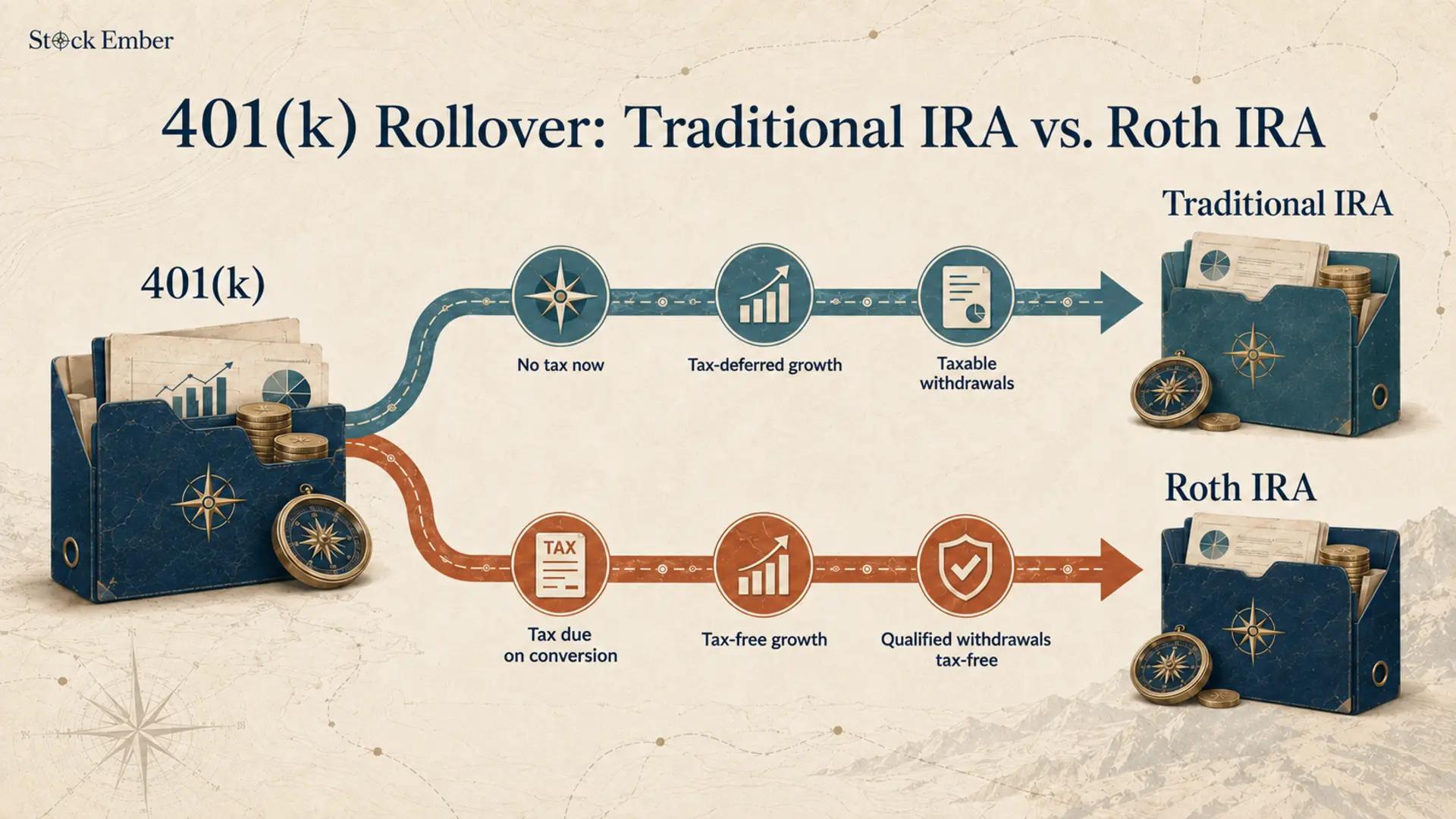
Diagram comparing tax rules for Traditional IRA and Roth IRA rollovers.
Traditional 401(k) to Traditional IRA
If your workplace contributions were made with pre-tax dollars, executing a rollover 401k to traditional IRA preserves your tax-deferred status. You pay zero upfront taxes on the transfer, and your investments grow tax-deferred until you take withdrawals in retirement.
Traditional 401(k) to Roth IRA
Moving pre-tax 401(k) funds into a Roth IRA is known as a Roth conversion. Because Roth accounts accept only after-tax dollars, the entire pre-tax amount you roll over is counted as ordinary income in the year the transfer takes place.
While future qualified withdrawals from the Roth IRA will be tax-free, converting a large 401(k) balance creates a substantial immediate tax liability.
Key Trade-offs: Fees, ERISA Rules, and the Rule of 55
While rolling over to an IRA offers access to thousands of individual stocks and index funds, staying in a workplace plan provides distinct structural benefits that deserve evaluation.
The 10-Year Fee Impact
Employer 401(k) plans often charge administrative recordkeeping fees. On a $100,000 balance, a 0.50% annual administrative fee costs $500 per year. Over ten years, those fees total $5,000 before factoring in the lost compound growth on those dollars. Moving funds to a low-cost IRA provider can reduce administrative overhead, though you should check whether your employer plan offers lower-cost institutional share classes that might not be available to retail IRA investors.
Legal Creditor Protection
Assets held in a 401(k) fall under federal ERISA rules, which offer broad protection against judgment creditors and bankruptcy. Individual Retirement Accounts receive federal bankruptcy protection up to statutory limits, but general creditor protection for IRAs depends on individual state laws.
The Rule of 55
If you leave your job during or after the calendar year in which you turn 55, the IRS Rule of 55 lets you take penalty-free withdrawals from that specific employer's 401(k). If you complete a 401k rollover IRA transfer into an IRA, those funds become subject to standard IRA rules, locking penalty-free access until age 59½.
Can You Do a Reverse Rollover? (Rollover IRA to 401(k))
A reverse rollover moves pre-tax assets from a Traditional IRA back into an active employer 401(k) plan. Executing a rollover IRA to 401k transfer can make sense if your current company plan offers low-cost institutional funds or strong creditor protections.
Investors also use reverse rollovers to clear pre-tax balances from their Traditional IRAs. Clearing pre-tax balances helps avoid the IRS pro-rata rule when performing Backdoor Roth IRA contributions, ensuring non-deductible contributions can be converted tax-free.
Note for International Investors: US vs. UK Wrappers
Tax-advantaged retirement wrappers are defined by national legislation. The 401(k) and IRA structures described here are strictly US accounts governed by the IRS.
In contrast, UK investors use workplace pensions and Personal Pensions, alongside tax-free accounts like a Lifetime ISA. While the names and specific tax allowances differ across borders, the core goal remains identical: minimizing fee drag while building long-term capital.
Common Rollover Pitfalls to Avoid
Leaving funds in uninvested cash: A rollover transfers your cash balance to the new IRA, but it does not automatically purchase investments. You must manually allocate the money into stocks, ETFs, or index funds.
Missing the 60-day window on indirect transfers: Late deposits turn an indirect transfer into an early distribution, triggering income taxes and potential early withdrawal penalties.
Underestimating conversion tax liabilities: Rolling pre-tax funds into a Roth account without setting aside cash for taxes can lead to an unexpected tax bill.
Conclusion
A 401k rollover to IRA is one of the most common moves investors make after leaving a job, and understanding the tax rules upfront can save you from a costly mistake.
Evaluating a 401k rollover requires weighing account fees, investment options, tax brackets, and your retirement timeline. Direct trustee-to-trustee transfers protect your savings from unwanted tax withholding, while keeping pre-tax balances in Traditional accounts prevents immediate income tax bills. Review your former plan's fee structure before initiating a transfer to ensure the move supports your long-term plan.
When you are ready to evaluate platforms for your rollover account, our Broker reviews & rankings guide can help you compare available investment choices and account costs.
Investing always puts your capital at risk and past performance never promises future results, so treat this guide as an educational foundation for your own research rather than personal financial advice.
FAQ
5 questions
Is it better to roll over a 401(k) to an IRA or keep it in the old plan?
Deciding whether to move an old 401(k) depends on fees, investment options, and early withdrawal plans. An IRA usually provides a wider array of low-cost funds and individual securities. However, staying in a workplace plan may offer institutional fund discounts, loan options, and protection against early withdrawal penalties under the Rule of 55 if you separate at age 55 or older.
What happens if I miss the 60-day indirect rollover deadline?
If you fail to deposit funds within the 60-day window during an indirect rollover, the IRS treats the full distribution as ordinary taxable income. Additionally, if you are under age 59½, you will face an extra 10% early withdrawal penalty tax. The 20% mandatory tax withholding initially kept by your plan provider is also lost unless recovered via tax filing.
Can I roll over a 401(k) from a current employer while still working there?
Generally, active employees cannot roll over 401(k) funds while still working for the company, unless the plan explicitly allows an "in-service distribution." In-service rollovers are typically restricted to employees who have reached age 59½ or meet specific financial hardship conditions defined by the employer's plan document.
Is a 401(k) rollover to an IRA considered a taxable event?
A direct trustee-to-trustee 401(k) rollover to a Traditional IRA is non-taxable, as assets remain tax-deferred. However, rolling pre-tax 401(k) assets into a Roth IRA constitutes a Roth conversion, which triggers ordinary income tax on the entire converted amount in the year the transfer takes place.
How many times per year can I roll over a 401(k) to an IRA?
Direct trustee-to-trustee rollovers from a 401(k) to an IRA have no annual limits; you can complete as many as you need. However, indirect 60-day IRA-to-IRA rollovers are restricted to one per rolling 12-month period across all IRAs you own. Workplace plan-to-IRA rollovers are generally exempt from this one-per-year limitation.
Disclaimer
This guide was written with AI assistance and reviewed by the StockEmber editorial team for accuracy. StockEmber provides independent education, not personal financial advice. Some links may support our work at no additional cost to you.
The StockEmber Team is our in-house desk of independent research writers. We test brokerage platforms, read the fine print on fees and custody, and cover ETFs and long-horizon investing for people who plan to hold for decades — not days.