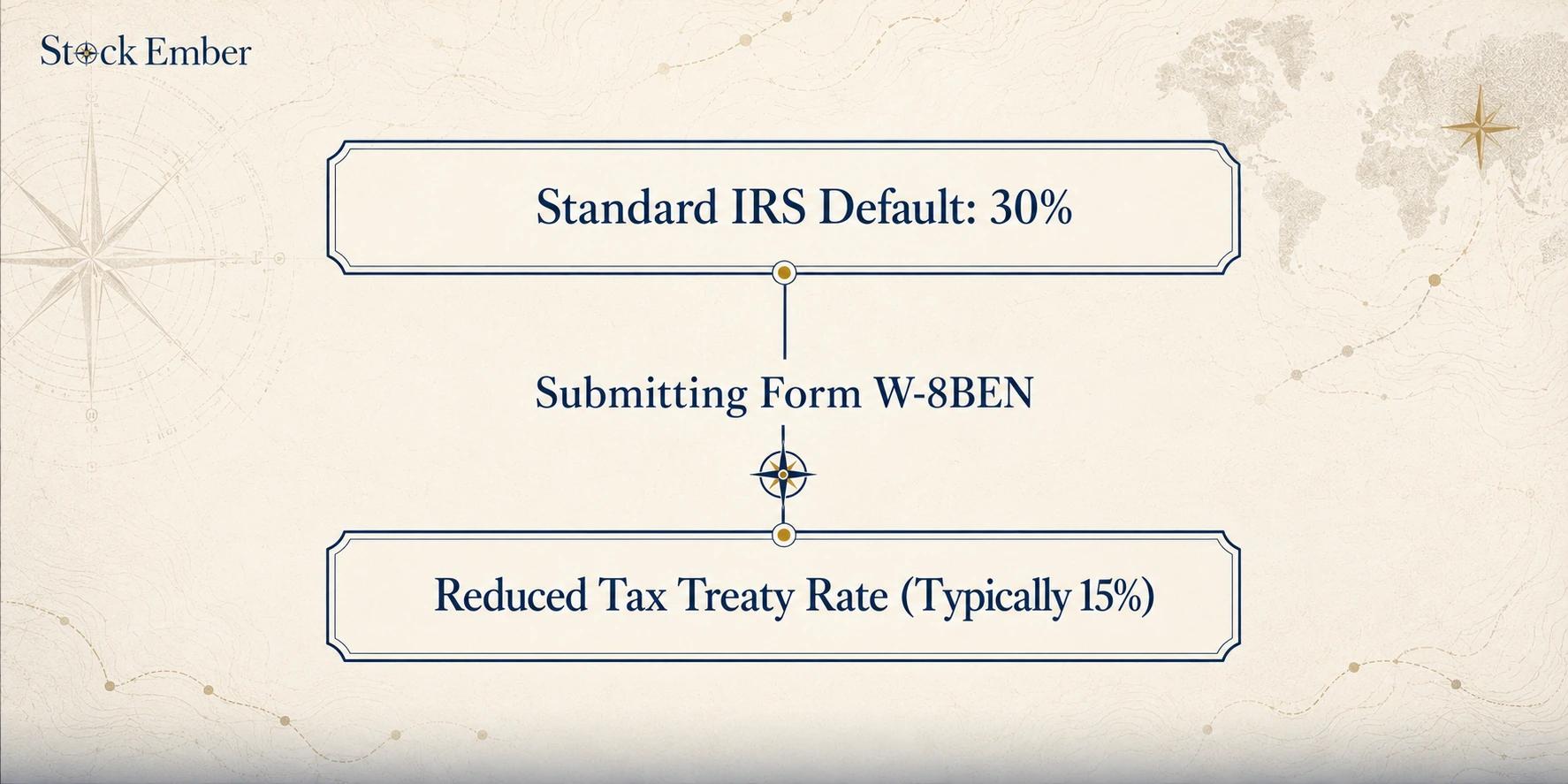
Form W-8BEN is an IRS tax document that non-US individuals submit to certify foreign tax residency and claim reduced dividend withholding under double tax treaties. Submitting it typically cuts default US withholding tax on stock dividends from 30% to 15%. The form remains valid for three full calendar years and is usually processed digitally by your brokerage.
Form W-8BEN is an official tax document that non-US individual investors submit to establish foreign status and claim reduced US tax withholding rates on US-sourced income.
When you invest in US stocks or funds from abroad, the IRS automatically withhold 30% of your dividend income by default. Completing this simple form notifies your broker to apply your country's bilateral tax treaty rate instead, This guide covers how the form works, treaty benefits, expiration rules, and key filing mistakes to avoid, so you can make an informed decision about your tax documentation. This guide covers how the form works, treaty benefits, expiration rules, and key filing mistakes to avoid.
Quick Takeaways
01Form W-8BEN certifies that you are a non-US resident for tax purposes, preventing default high-rate tax withholding on US investment income.
02Submitting the form typically reduces US dividend tax withholding from the standard 30% rate down to 15% (or lower) under applicable double tax treaties.
03The form remains valid for three full calendar years and must be renewed to maintain reduced tax withholding rates.
04Most international brokerages process Form W-8BEN digitally during account onboarding using your local Foreign Tax Identification Number (FTIN).
What Is IRS Form W-8BEN?
IRS Form W-8BEN, officially titled "Certificate of Foreign Status of Beneficial Owner for United States Tax Withholding and Reporting (Individuals)," is a document used by foreign individuals to confirm their non-US tax status.
If you reside outside the United States and hold US-domiciled equities or exchange-traded funds (ETFs) in a taxable account, US tax law considers you a non-resident alien. Without valid documentation on file, US payors are required by law to withhold 30% of any income paid to you—including stock dividends and fund distributions.
IRS Form W-8BEN
It is helpful to clarify three distinct tax situations:
Form W-8BEN (Individual): Filed by non-US individuals who own US assets directly through a brokerage account.
Form W-8BEN-E (Entity): Filed by non-US corporate entities, trusts, or funds rather than individual retail investors.
Form W-9: Used exclusively by US citizens and foreign residents living in the US for tax purposes.
Because tax rules differ fundamentally based on residency, non-US investors cannot utilize US tax-sheltered structures such as what is a roth ira. Instead, non-US investors rely on proper foreign tax certification through the irs form w-8ben to minimize tax friction on their US holdings.
How Form W-8BEN Works: Reducing US Withholding Tax
Form W-8BEN works by establishing your eligibility for reduced tax withholding under a bilateral Double Taxation Treaty (DTT) between the US and your country of tax residence.
The United States maintains tax treaties with dozens of countries worldwide. Under most standard treaties, the default 30% tax rate on dividend income is reduced to 15%.In select jurisdictions, the treaty rate on certain interest or dividend structures drops even lower.
The 10-Year Portfolio Impact
A 15% difference in tax withholding might sound modest on a single dividend payment, but over a ten-year horizon, that friction compounds into substantial portfolio leakage.
Consider an illustrative long-term portfolio holding $100,000 in US equities paying an average 3% annual dividend yield ($3,000 per year in dividend income):
Without a valid W-8BEN (30% Default Rate): $900 is withheld automatically every year, leaving you with $2,100 in net income.
With a valid W-8BEN (15% Treaty Rate): $450 is withheld every year, leaving you with $2,550 in net income.
Consider an illustrative scenario: a $100,000 portfolio earning a 3% annual dividend yield generates $3,000 in dividend income per year. At the default 30% withholding rate, $900 is withheld annually; at a 15% treaty rate, $450 is withheld. Over ten years, this difference amounts to $4,500 in cumulative gross withholding. Note: actual outcomes depend on your country's specific tax treaty terms, the accuracy of your FTIN, and applicable broker policies. These figures are for illustrative purposes only and do not constitute tax advice.
How to Complete Form W-8BEN Step-by-Step
Completing Form W-8BEN requires disclosing your personal legal identity, tax residence, and tax identification details.
Most online brokerages incorporate the form w-8ben directly into their digital onboarding workflow. If you are completing a physical form or manual upload, you can obtain an official w-8ben form download directly from the official IRS website.
The form is split into three primary sections:
Part I: Identification of Beneficial Owner
Line 1: Your full legal name (matching your passport or government identification).
Line 2: Country of citizenship.
Line 3: Permanent residence address (must be a physical street address in your home country, not a PO Box or broker address).
Line 5 / 6: Foreign Tax Identification Number (FTIN). Providing your local national tax identification number (such as a national ID or tax code issued by your home country) is mandatory to claim treaty benefits.
Part II: Claim of Tax Treaty Benefits
Line 9: You must explicitly state your country of residence to claim treaty benefits under US law.
Line 10: Used primarily if you are claiming special treaty rates or conditions that differ from standard dividend rates.
Part III: Certification
You must sign and date the document, certifying under penalty of perjury that you are not a US person and that the information provided is accurate.
Expiration, Renewal, and Common Investor Mistakes
Form W-8BEN remains valid starting from the date it is signed until December 31 of the third full calendar year following.
For example, a form signed on June 15, 2026, remains valid through December 31, 2029. Once that period expires, your brokerage will require an updated re-certification. If you fail to renew it, your account reverts to the default 30% withholding tax rate.
Common Pitfalls to Avoid
Omitting the FTIN: Leaving the Foreign Tax Identification Number blank is the most common reason brokers reject treaty claims. Without a valid local tax ID, withholding defaults to 30%.
Confusing Fund Domiciles: Form W-8BEN applies when you hold US-domiciled assets directly. If you hold non-US domiciled funds (such as Irish-domiciled UCITS ETFs), tax withholding occurs at the fund level in Ireland, meaning individual investors do not submit a W-8BEN for those holdings.
Confusing Withholding with Annual Tax Filings: Foreign investors often confuse foreign dividend withholding documentation with US resident capital gains reporting documents like a 1099 b form. Non-resident aliens who do not reside in the US generally do not owe US capital gains tax on stock sales and do not receive 1099-B forms.
Failing to Update Address Changes: Moving to a new country invalidates your previous treaty claim. You must submit a fresh form reflecting your new address and tax jurisdiction within 30 days of moving.
Conclusion
Form W-8BEN is an essential piece of administrative maintenance for any long-term investor living outside the United States. By certifying your non-US status and claiming treaty benefits, you prevent unnecessary 30% tax drag from eroding your compounding dividend returns over time. Ensure your documentation remains current with your brokerage to maintain your applicable treaty withholding rate.
When you're ready to select an international platform that automatically handles this tax documentation, our broker reviews offer a clear breakdown of features and fee structures.
FAQ
4 questions
How often do international investors need to renew Form W-8BEN?
Form W-8BEN remains valid from the date signed until December 31 of the third full calendar year. Unless your tax residency, legal name, or citizenship details change earlier, you must resubmit a renewed form every three years to maintain tax treaty benefits.
What happens if foreign investors do not submit Form W-8BEN to their broker?
Without a valid Form W-8BEN, US brokerages are legally required to withhold the default maximum rate of 30% on all US-sourced income, such as dividends. Furthermore, the broker may restrict trading or subject the account to mandatory backup withholding.
Does Form W-8BEN reduce US withholding tax on capital gains?
Non-US residents are generally exempt from US capital gains tax on the sale of US stocks, regardless of Form W-8BEN. The form primarily serves to confirm non-US tax status and reduce dividend tax withholding rates under applicable income tax treaties.
Can dual citizens or US passport holders submit Form W-8BEN?
No. Any individual holding US citizenship or a US Green Card is classified as a US person for tax purposes. US persons must submit Form W-9 instead of Form W-8BEN, regardless of where they reside globally.
Disclaimer
This guide was written with AI assistance and reviewed by the StockEmber editorial team for accuracy. StockEmber provides independent education, not personal financial advice. Some links may support our work at no additional cost to you.
The StockEmber Team is our in-house desk of independent research writers. We test brokerage platforms, read the fine print on fees and custody, and cover ETFs and long-horizon investing for people who plan to hold for decades — not days.