An Individual Savings Account (ISA) is a UK tax-advantaged wrapper that completely exempts cash interest, stock dividends, and capital gains from UK personal taxes. UK residents can deposit up to £20,000 per tax year across all adult ISA account types combined, with all investment returns compounding tax-free over time.
An Individual Savings Account (ISA) is a UK tax-advantaged wrapper that protects cash savings and investment returns from UK Income Tax and Capital Gains Tax.
If you are building long-term wealth while living in the UK, holding your investments inside an isa account prevents tax drag from reducing your compounding returns over time. Choosing the right account wrapper allows your portfolio to compound without friction from interest tax, dividend tax, or capital gains tax. This guide explains how ISAs work, annual allowance rules, and how to avoid costly platform fees.
Quick Takeaways
01An isa account is a tax-sheltered container for cash or investments, not an asset class itself.
02All capital gains, dividends, and interest generated inside an ISA are 100% exempt from UK income and capital gains taxes.
03The HMRC annual ISA allowance is £20,000 per tax year across all adult ISA account types combined.
04You can open and contribute to multiple ISAs of the same type within the same tax year, provided your total deposits remain under the £20,000 ceiling.
05Unused annual allowance expires on April 5 at the end of each tax year and cannot be carried forward.
What Is an ISA Account and How Does It Work?
An ISA account is a legal financial wrapper designed by HM Revenue & Customs (HMRC) that shields your money from UK personal taxes.
It is helpful to think of an ISA as a tax-exempt protective box. When you purchase assets—such as global index funds, corporate bonds, or dividend-paying stocks—inside that box, any growth or cash payouts belong entirely to you. You do not need to report ISA income or capital gains on a UK Self Assessment tax return, nor do you pay tax when withdrawing cash.
The Main Types of ISAs: Cash vs. Stocks & Shares
The two primary adult ISA accounts are Cash ISAs and Stocks & Shares ISAs, each serving distinct roles across different time horizons.
Selecting the right container depends on your need for short-term liquidity versus long-term capital growth:
Cash ISA: A tax-free savings account paying fixed or variable interest. While useful for short-term liquidity or emergency funds, holding cash over long periods exposes your capital to inflation drag, which steadily reduces purchasing power.
Stocks & Shares ISA: An investment wrapper that holds individual equities, broad-market index Exchange-Traded Funds (ETFs), and mutual funds. Designed for multi-year horizons, it enables long-term investors to capture market compounding without annual capital gains or dividend tax liabilities.
Specialist ISAs: Includes the Lifetime ISA (LISA), which allows up to £4,000 annually for first-time home buyers or retirement with a 25% government bonus, and the Junior ISA (JISA) for minors with a £9,000 annual cap.
HMRC Annual Allowance Rules and Limits
HMRC limits total annual deposits across all your adult ISAs to the ISA allowance limit of £20,000 per tax year.
The UK tax year runs from April 6 to April 5 of the following calendar year. The annual allowance operates on a strict "use it or lose it" rule: any portion of your £20,000 allowance remaining on 5 April resets to zero and cannot be rolled over into the next tax year.
Category
Details
HMRC Annual ISA Allowance
£20,000 annual contribution limit
Option A
Contribute £20,000 to a Stocks & Shares ISA
Option B
Contribute £10,000 to a Cash ISA + £10,000 to a Stocks & Shares ISA
Option C
Contribute £4,000 to a Lifetime ISA (LISA) + £16,000 to a Stocks & Shares ISA
Important Note
Total contributions across all ISA accounts must not exceed £20,000 per tax year.
Can You Have Multiple ISAs?
Under updated UK tax rules, you can open and contribute to multiple ISAs of the same type within a single tax year. For instance, you can hold two Stocks & Shares ISAs with different platform providers to access varied investment menus, provided your total combined deposits across all accounts stay within the £20,000 cap.
Cross-Border Context: ISA vs. SIPP vs. US Roth IRA
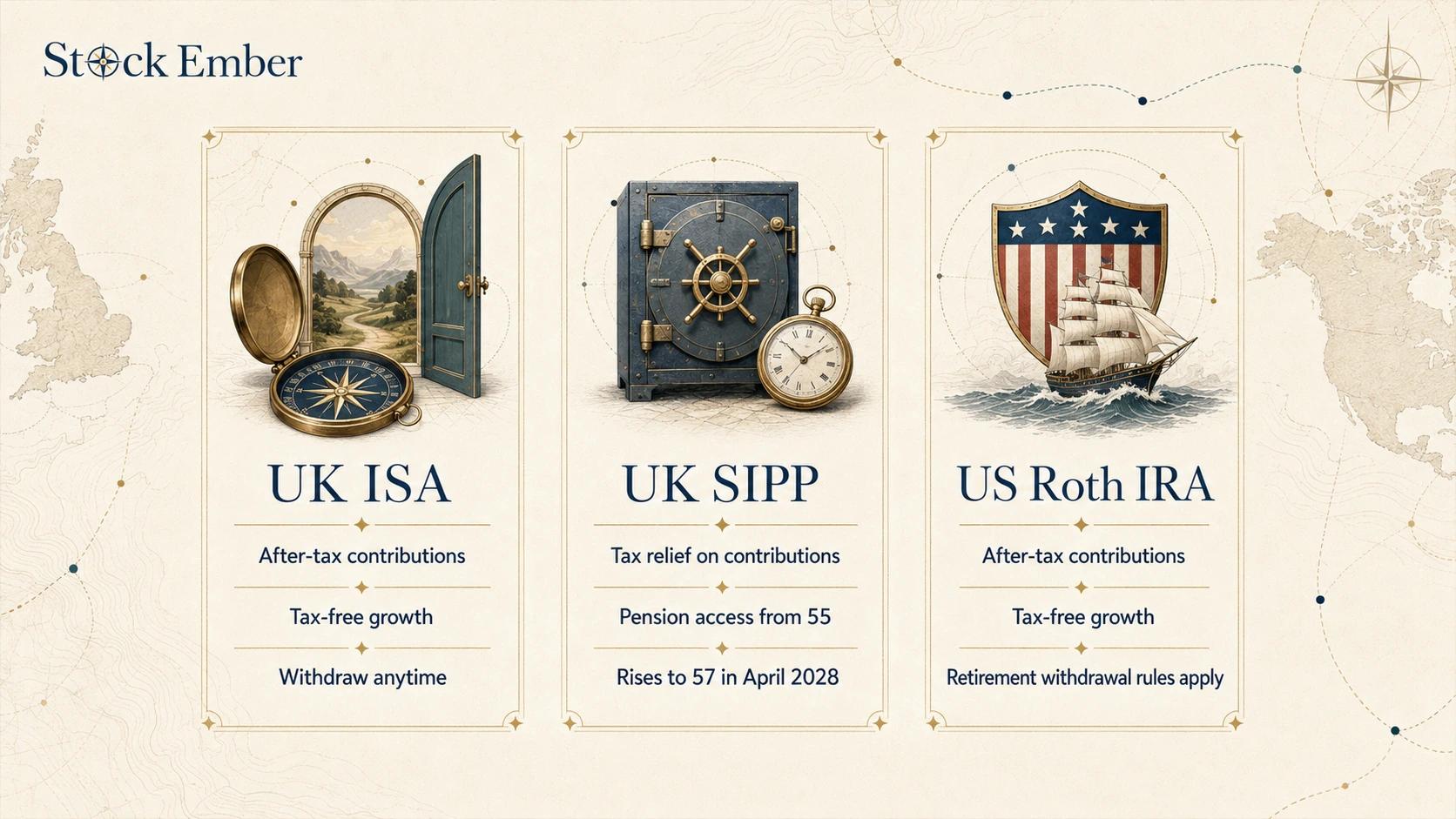
An ISA account provides tax-free flexibility without the age lockup rules required by personal pensions or retirement accounts.
Unlike a UK Self-Invested Personal Pension, which locks funds until age 55 (rising to 57 in April 2028), an ISA account lets you withdraw capital at any time without income tax or penalties. For a complete breakdown of UK pension tax relief and withdrawal age rules, read our foundational guide on what is a sipp.
For international context, an ISA functions similarly to a US Roth IRA, as both wrappers accept after-tax deposits and deliver completely tax-free investment growth. To see how after-tax retirement accounts operate under US tax laws, explore our core guide on what is a roth ira.
How a UK ISA account works as a tax-free wrapper for savings and investments
Common ISA Account Mistakes to Avoid
Avoiding administrative missteps helps maintain your tax-sheltered status and protects your long-term compounding.
Watch out for these common errors when managing your account wrapper:
Holding Long-Term Wealth in Cash ISAs: Keeping capital intended for multi-decade goals in cash savings accounts subjects your balance to persistent inflation erosion.
Withdrawing Cash Manually During Transfers: If you want to switch providers, never withdraw funds to your bank account manually. Doing so destroys your tax-sheltered status and consumes your annual allowance when re-deposited. Always initiate an official ISA transfer through your new provider.
Exceeding the Combined £20,000 Cap: Depositing more than £20,000 across your accounts in a single tax year creates an illegal over-subscription that HMRC will remove, potentially subjecting excess gains to tax.
Conclusion
An ISA account is one of the most effective tax wrappers available for UK investors, providing complete protection from capital gains and dividend taxes without restricting access to your money. By maximising your annual £20,000 allowance across low-cost Stocks & Shares ISAs, controlling platform administration fees, and using official transfer procedures, you can build a tax-sheltered portfolio tailored to your financial goals.
When you are ready to compare ISA platform providers, evaluate custody fees, and choose an account container, our independent broker reviews offer an unbiased breakdown of account charges, platform usability, and investment access.
FAQ
4 questions
Can non-UK residents hold or contribute to a UK Individual Savings Account?
Non-UK residents cannot open a new ISA or make fresh contributions once they move abroad (unless they are Crown employees serving overseas). However, existing ISA balances can remain invested tax-free within the account structure.
What happens to your ISA tax allowance if you do not use it before April 5?
The UK ISA annual allowance (£20,000) operates on a "use it or lose it" basis per tax year. Unused contribution room does not roll over into the following tax year; it expires permanently at midnight on April 5.
Can you transfer funds between a Cash ISA and a Stocks and Shares ISA?
Yes. You can transfer funds between Cash ISAs and Stocks and Shares ISAs without losing your tax-free wrapper status, provided you use the official provider-to-provider ISA transfer service rather than withdrawing funds manually.
Are capital gains and dividends inside an ISA subject to UK taxes?
No. All income, capital gains, and dividend payouts generated inside an ISA wrapper are entirely exempt from UK income tax and capital gains tax, and do not need to be declared on a self-assessment tax return.
Disclaimer
This guide was written with AI assistance and reviewed by the StockEmber editorial team for accuracy. StockEmber provides independent education, not personal financial advice. Some links may support our work at no additional cost to you.
The StockEmber Team is our in-house desk of independent research writers. We test brokerage platforms, read the fine print on fees and custody, and cover ETFs and long-horizon investing for people who plan to hold for decades — not days.