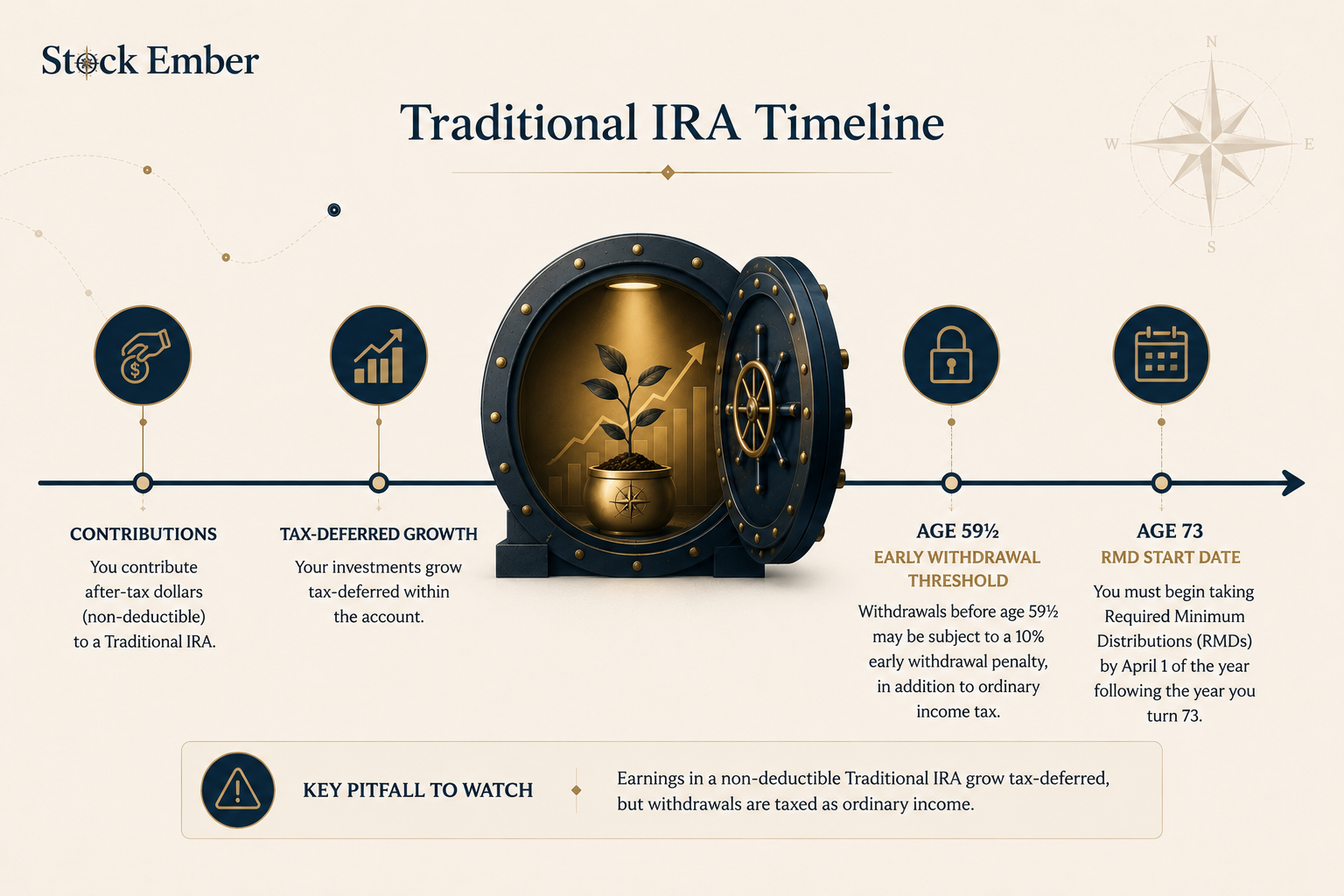
A Traditional IRA is an individual retirement account in the United States that allows investors to make contributions that may be tax-deductible from current income. Investment earnings compound tax-deferred until retirement, at which point withdrawals are taxed as ordinary income.
A Traditional IRA is an individual retirement account in the United States that lets you contribute pre-tax income, allowing your investments to grow tax-deferred until you make withdrawals in retirement.
If you are in a high tax bracket today, reducing your current tax bill while building long-term wealth is a primary financial objective. Deferring taxes on capital gains and dividends accelerates your portfolio's compounding speed over multi-decade horizons. This guide breaks down how Traditional IRAs work, Internal Revenue Service (IRS) deduction rules, and when pre-tax saving fits your overall investment strategy.
Quick Takeaways
01Contributions to a Traditional IRA may be tax-deductible in the year you make them, reducing your current taxable income.
02Investment earnings inside the account compound tax-deferred, meaning you pay zero capital gains or dividend taxes until you withdraw funds.
03Withdrawals in retirement are taxed as ordinary income, and early withdrawals before age 59½ generally incur a 10% IRS penalty plus regular income tax.
04Account owners must begin taking Required Minimum Distributions (RMDs) upon reaching age 73.
What Is a Traditional IRA and How Does It Work?
A Traditional IRA is a tax-advantaged individual account wrapper that defers tax liabilities on investment earnings until you take distributions in retirement.
When you fund a Traditional IRA, you can often deduct your contributions from your current taxable income, depending on your earnings and whether you participate in a workplace retirement plan. Because your contributions reduce your Adjusted Gross Income (AGI) for the current tax year, you pay less federal income tax immediately.
Once funds enter the account, every dividend paid, interest payment received, and capital gain realized stays inside the portfolio to compound. You owe no annual taxes on those earnings while they remain inside the wrapper. When you retire and withdraw cash from the account, the distributions are taxed as ordinary income.
The 10-Year Tax Deferral Impact
Deferring taxes inside a Traditional IRA allows your full investment return to compound over time without the annual tax drag found in standard taxable accounts.
To see how tax deferral preserves capital over long horizons, compare a $50,000 portfolio returning 7% annually inside a taxable brokerage account against the same portfolio held inside a Traditional IRA wrapper:
Taxable Account: Every year, dividend distributions and rebalancing capital gains incur an annual tax bill. Paying a 15% tax on returns each year creates a subtle drag, reducing your net compounding rate. Over a 10-year period, this tax drag can reduce your total balance by thousands of dollars compared to a tax-sheltered vehicle.
Traditional IRA Wrapper: All capital gains and dividends remain 100% intact, compounding at the full 7% rate for 10 straight years.
Even though you will eventually pay ordinary income tax when withdrawing funds from a Traditional IRA in retirement, starting with a larger compounded balance—and potentially withdrawing at a lower retirement tax bracket—often yields a higher net payout than investing through a taxable account.
IRS Rules: Deductibility, Contribution Caps, and RMDs
IRS rules for Traditional IRAs govern how much you can contribute annually, whether your contribution is tax-deductible, and when you must take required withdrawals.
Navigating a Traditional IRA effectively requires adhering to three core IRS constraints:
1. Annual Contribution Limits
For 2026, the annual contribution limit for a Traditional IRA is $7,500 for individuals under age 50, with an $1,100 catch-up contribution ($8,600 total) for investors aged 50 and older. According to the IRS (Notice 2025-67). You must have earned income equal to or exceeding your total contribution amount for the tax year.
2. Tax Deductibility Phase-Outs
Your ability to deduct Traditional IRA contributions on your tax return depends on your income and workplace retirement coverage:
If neither you nor your spouse has a workplace plan (like a 401(k)): You can deduct the full contribution amount regardless of your income level.
If you participate in a workplace plan: Your deduction phases out above specific Modified Adjusted Gross Income (MAGI) thresholds—for example, $81,000 to $91,000 for single filers in 2026, per IRS guidance.
3. Required Minimum Distributions (RMDs)
Unlike Roth IRAs, Traditional IRAs do not allow funds to stay in the account indefinitely. Under current federal tax law (the SECURE 2.0 Act, as administered by the IRS), original account owners must begin taking mandatory annual withdrawals, known as Required Minimum Distributions (RMDs), starting at age 73.
Traditional IRA vs. Roth IRA: Pre-Tax vs. After-Tax
The decision between a Traditional IRA and a Roth IRA rests on whether you want a tax deduction today or tax-free income in retirement.
Both individual retirement accounts offer protection from annual dividend and capital gains taxes, but they handle tax timing differently:
Feature
Traditional IRA
Roth IRA
Tax Timing
Pre-tax (upfront tax deduction potential)
After-tax (no upfront tax deduction)
Growth Phase
Tax-deferred compounding
100% Tax-free growth
Withdrawal Taxes
Taxed as ordinary income in retirement
100% Tax-free qualified distributions
RMD Requirements
Mandatory starting at age 73
No RMDs during owner's lifetime
A general framework for choosing between the two account types:
Choose a Traditional IRA if: You are currently in a high income tax bracket and want an immediate deduction to lower your tax bill today.
Choose a Roth IRA if: You are in a lower tax bracket today, expect your income or tax rates to rise in the future, or want penalty-free access to your original principal contributions.
To evaluate after-tax account mechanics in detail, see our complete guide on what is a Roth IRA.
High Income and Non-Deductible Contributions
High earners who exceed IRS income limits for tax deductions can still make non-deductible contributions to a Traditional IRA.
If your MAGI crosses IRS phase-out thresholds and you are covered by a workplace 401(k), you can no longer deduct your Traditional IRA contributions from your income taxes. However, the IRS still permits you to deposit after-tax dollars into a Traditional IRA.
Non-deductible Traditional IRA contribution used as the first step of a backdoor Roth IRA conversion
While earnings inside a non-deductible Traditional IRA grow tax-deferred, future earnings are still subject to ordinary income tax upon withdrawal. Because of this, high earners rarely hold non-deductible balances for the long term. Instead, they use a non-deductible Traditional IRA contribution as the immediate first step in executing a Backdoor Roth IRA conversion, moving those funds into a tax-free Roth wrapper.
Common Traditional IRA Pitfalls to Watch
Common mistakes with Traditional IRAs include taking premature distributions, ignoring tax rates on withdrawals, and missing mandatory withdrawal deadlines.
To maximize the benefits of a pre-tax retirement account, avoid these common operational traps:
Early Withdrawal Penalties: Taking distributions before age 59½ generally incurs a 10% IRS early withdrawal penalty in addition to standard ordinary income tax, as outlined by the IRS. While exceptions exist for qualified first-time home purchases or higher education expenses, early withdrawals break multi-decade compounding.
Ordinary Income Rates vs. Capital Gains: When you withdraw funds from a Traditional IRA in retirement, every dollar is taxed as ordinary income. For some high-income retirees, ordinary income tax rates can be significantly higher than the favorable long-term capital gains tax rates applied to standard taxable accounts.
Missing RMD Deadlines: Failing to take your required minimum distribution by the IRS deadline results in an excise penalty on the amount that should have been withdrawn.
Conclusion
A Traditional IRA provides an effective mechanism for lowering your current taxable income while allowing your investments to compound tax-deferred over decades. By balancing upfront tax deductions against ordinary income tax obligations in retirement, long-term investors can optimize their overall asset location and tax efficiency. Understanding how pre-tax savings interact with your current tax bracket will help clarify where this account wrapper belongs in your wealth building plan.
When you are ready to open an account or evaluate custodian options, our independent broker reviews offer a detailed comparison of platform fees, account features, and available investments.
FAQ
4 questions
Are Required Minimum Distributions mandatory for a Traditional IRA?
Yes. Under US tax law, account owners must begin taking mandatory annual withdrawals called Required Minimum Distributions (RMDs) from their Traditional IRAs once they reach age 73 (or 75 starting in 2033), which are taxed as ordinary income.
What is the tax penalty for taking funds out of a Traditional IRA before age 59½?
Withdrawing funds before age 59½ triggers a 10% IRS early withdrawal penalty on the taxable amount distributed, in addition to standard federal and state ordinary income taxes.
Can high earners deduct Traditional IRA contributions if they have a 401(k)?
If a high earner (or their spouse) participates in an employer 401(k) plan, the tax deductibility of Traditional IRA contributions phases out completely above specific IRS income thresholds. They can still make non-deductible contributions.
How does pre-tax growth in a Traditional IRA compound over long periods?
Because contributions are made with pre-tax dollars and dividends/interest are not taxed annually, full gross earnings remain invested to compound over decades. Income taxes are deferred until funds are withdrawn in retirement.
Disclaimer
This guide was written with AI assistance and reviewed by the StockEmber editorial team for accuracy. StockEmber provides independent education, not personal financial advice. Some links may support our work at no additional cost to you.
The StockEmber Team is our in-house desk of independent research writers. We test brokerage platforms, read the fine print on fees and custody, and cover ETFs and long-horizon investing for people who plan to hold for decades — not days.