A Self-Invested Personal Pension (SIPP) is a tax-advantaged UK personal pension scheme that grants investors direct control over their choice of individual stocks, bonds, and funds. Contributions automatically receive a 20% basic-rate HM Revenue & Customs (HMRC) tax relief gross-up, with investments compounding free from capital gains and income taxes until withdrawal.
Unlike a default workplace pension that locks you into a provider's pre-selected fund range, a SIPP hands you the controls — letting you build and rebalance a retirement portfolio from individual stocks, bonds, and broad-market ETFs, all inside a tax-sheltered wrapper.
If you want greater investment freedom than a default workplace pension provides, a SIPP offers a flexible structure for long-term wealth accumulation. By combining government tax relief with customised asset selection, this account wrapper helps you build a tax-sheltered retirement portfolio tailored to your financial timeline.
Quick Takeaways
01A SIPP is a private UK pension wrapper that gives you full control over your choice of underlying investments.
02Contributions automatically receive a 20% tax relief boost from HMRC, with higher and additional-rate taxpayers able to claim extra relief via Self Assessment.
03Funds are locked until the UK Normal Minimum Pension Age (age 55, rising to 57 in April 2028)
04When accessing funds, 25% can generally be withdrawn as a tax-free lump sum, while the remaining 75% is taxed as income upon distribution.
05You should maximize any available workplace pension employer matching contributions before funding a private SIPP.
What Is a SIPP and How Does It Work?
A SIPP is a personal pension wrapper that lets you choose, manage, and rebalance your own investment holdings rather than relying on a provider's default fund options.
In a standard workplace or personal pension, your scheme provider selects a pre-packaged portfolio of funds. In contrast, a SIPP operates like a tax-sheltered brokerage account dedicated to retirement, giving you access to global equities, investment trusts, corporate bonds, and exchange-traded funds (ETFs).
Because your assets sit inside a registered pension wrapper, all investment growth, capital gains, and dividend income compound free from income tax and capital gains tax.
The 10-Year Cost Lens on SIPP Administration
Holding a SIPP requires paying platform administration fees and underlying asset management charges. Over a 10-year horizon, these recurring friction points compound against your net portfolio returns.
For example, a platform charging a 0.45% annual administration fee on a £100,000 portfolio costs you £450 per year. Over ten years, that seemingly small fee quietly removes roughly £4,500 in principal—plus all the compound growth that money would have generated. Evaluating platform fee tiers is essential to protecting your long-term compounding efficiency.
HMRC Tax Relief Mechanics: Boosting Your Savings
HMRC tax relief automatically increases every contribution you make into a SIPP by adding back the income tax you paid on those earnings.
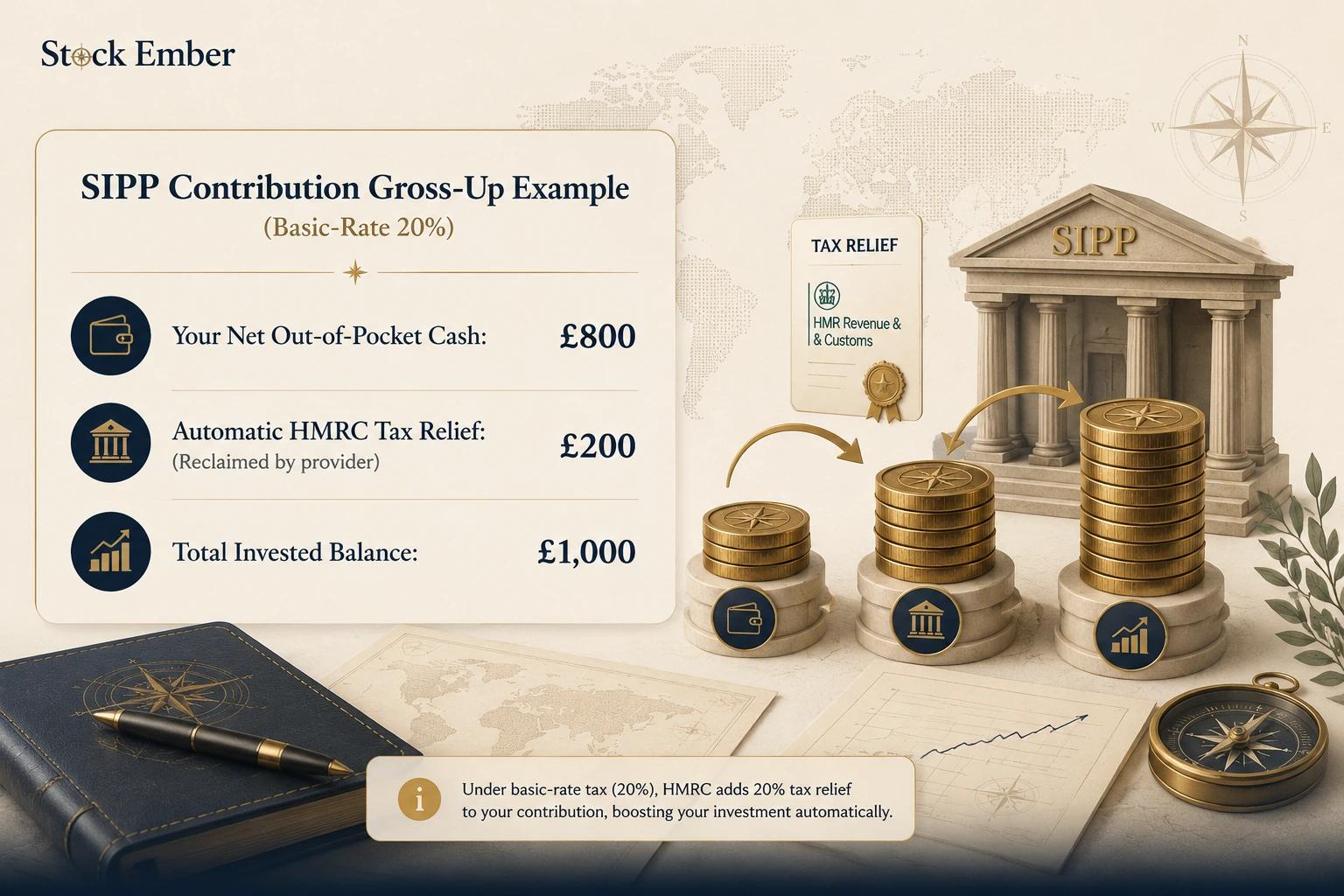
When you deposit money into a SIPP, HMRC treats your payment as being made net of basic-rate tax. Your SIPP provider reclaims 20% basic-rate tax relief directly from the government and adds it to your pension account:
SIPP Contribution gross-up example
Basic-Rate Tax Relief (20%): To add £100 to your pension, you deposit £80 of net income. Your provider claims £20 from HMRC, boosting your total contribution to £100.
Higher-Rate Tax Relief (40%): Higher-rate taxpayers can claim an additional 20% tax relief (£20 for every £80 contributed) through their annual HMRC Self Assessment tax return.
Additional-Rate Tax Relief (45%): Additional-rate taxpayers can claim an extra 25% tax relief via Self Assessment.
Accessing Your SIPP: Withdrawal Rules and Age Limits
SIPP assets are subject to strict legal lockup rules until you reach the Normal Minimum Pension Age set by UK law.
You cannot access funds held inside a SIPP whenever you wish. The government impose minimum age requirements to ensure pension capital is preserved strictly for retirement:
Access Age: The current legal access age is 55, but it increases to age 57 on 6 April 2028.
Tax-Free Lump Sum: Once you reach the minimum access age, you can generally withdraw up to 25% of your total pension balance as a tax-free lump sum, capped at the Lump Sum Allowance threshold of £268,275.
Taxable Income (75%): The remaining 75% of your SIPP balance is taxed as ordinary income at your marginal rate when drawn down via flexi-access drawdown (a flexible withdrawal arrangement that lets you take income as and when you need it) or used to purchase an annuity (a guaranteed income product from an insurer).
SIPP vs. Workplace Pensions vs. International Wrappers
A SIPP serves as an independent personal pension, whereas workplace pensions are arranged through your employer and often include employer matching funds.
Before funding a private SIPP, you should always contribute enough to your active workplace pension scheme to claim the full employer match. Employer contributions represent an immediate 100% return on your money that a private SIPP cannot match. Once you have secured your full employer match, adding a SIPP allows you to consolidate old workplace pensions from past jobs into a single, low-cost platform.
Cross-Border Tax Wrapper Context
For global investors evaluating international tax structures, a SIPP is the primary UK equivalent of a US Traditional Individual Retirement Account (IRA), as both use pre-tax gross-ups or deductions today while taxing withdrawals in retirement. To see how after-tax growth wrappers operate in other countries, read our overview on what is a roth ira.
Common SIPP Mistakes to Avoid
Avoiding administrative errors ensures your pension compounding remains on track and compliant with HMRC regulations.
Watch out for these frequent planning mistakes:
Bypassing the Employer Match: Contributing to a self-directed SIPP before maximizing your workplace pension's employer matching contributions forfeits free capital.
Ignoring Platform Fee Tiers: Selecting a SIPP provider with high percentage-based platform fees can create severe compound cost drag as your portfolio balance grows above £100,000.
Failing to Claim Higher-Rate Tax Relief: Relying solely on the automatic 20% basic-rate gross-up leaves substantial tax savings unclaimed if you pay 40% or 45% income tax.
Conclusion
A Self-Invested Personal Pension is a powerful tax wrapper that gives UK investors total autonomy over asset allocation, multi-decade compounding, and tax relief. By taking advantage of HMRC contribution gross-ups, controlling platform administration costs, and prioritizing employer matching funds first, you can construct a resilient retirement portfolio. Understanding how tax relief and withdrawal limits work helps you position pension wrappers effectively within your long-term plan.
When you are ready to evaluate platform features and select a custodian for your pension consolidation, our independent broker reviews offer an unbiased breakdown of account fees, investment access, and platform usability.
FAQ
4 questions
What happens to your SIPP pension when you reach age 55 (or 57 from 2028)?
Upon reaching the minimum pension age, you can access your SIPP. You can withdraw up to 25% of the total fund value as a tax-free lump sum, leaving the remaining 75% invested to draw down as taxable income as needed.
How does government tax relief boost contributions into a SIPP account?
When a UK resident contributes to a SIPP, the government automatically adds 20% basic-rate tax relief to the deposit. Higher and additional-rate taxpayers can claim an extra 20% to 25% tax relief via their annual tax returns.
Can non-UK taxpayers open and contribute to a SIPP?
Non-UK taxpayers can open a SIPP, but tax-relieved contributions are capped at £3,600 gross ($2,880 net) per year for the first five tax years of living abroad, provided they were UK tax residents when the account was opened.
How are SIPP funds treated for UK inheritance tax purposes upon death?
Assets held inside a SIPP fall outside your legal estate for UK inheritance tax purposes. If you pass away before age 75, beneficiaries can inherit the pension pot tax-free; if you die after 75, beneficiaries pay income tax on withdrawals.
Disclaimer
This guide was written with AI assistance and reviewed by the StockEmber editorial team for accuracy. StockEmber provides independent education, not personal financial advice. Some links may support our work at no additional cost to you.
The StockEmber Team is our in-house desk of independent research writers. We test brokerage platforms, read the fine print on fees and custody, and cover ETFs and long-horizon investing for people who plan to hold for decades — not days.