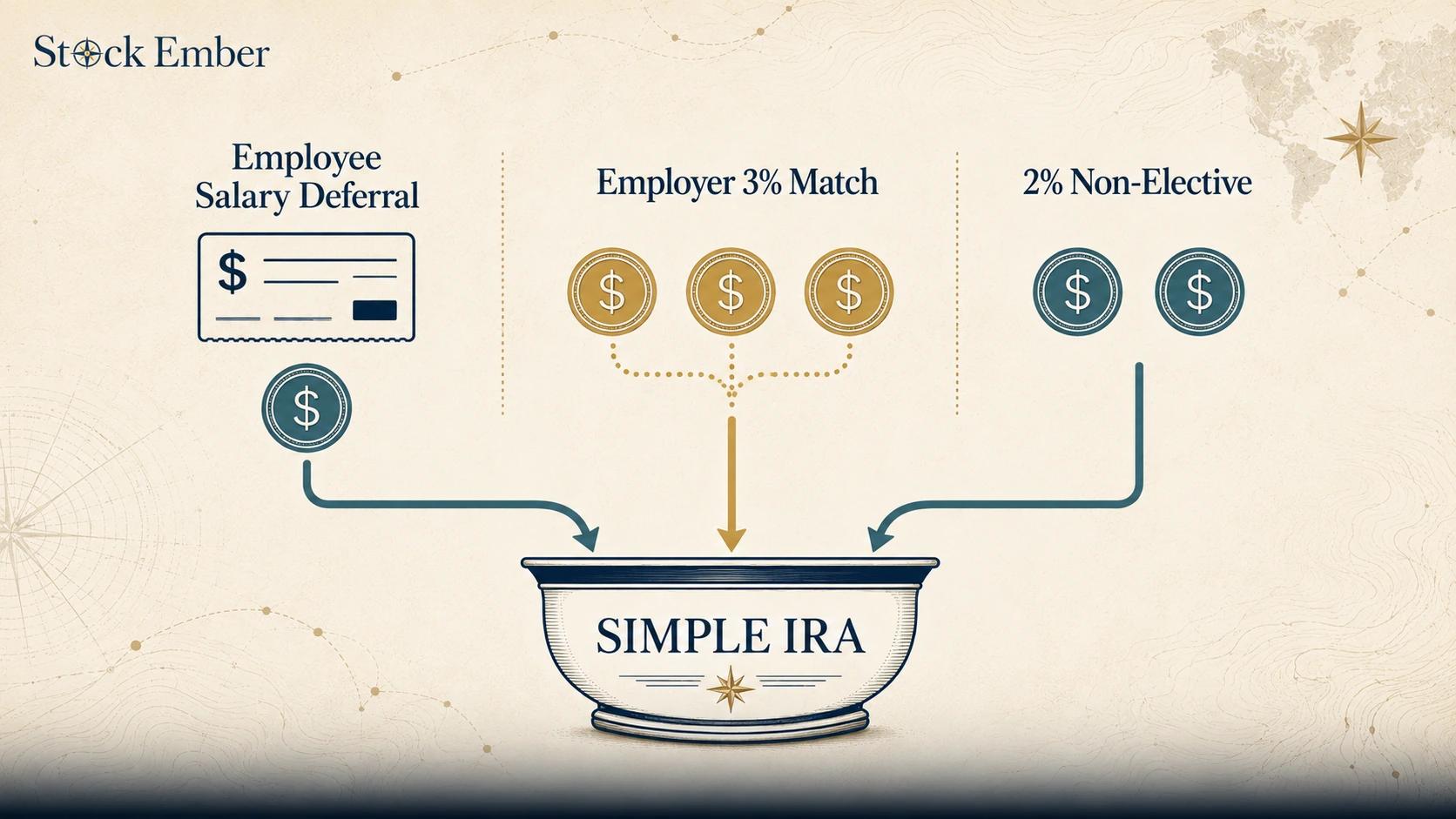
A SIMPLE IRA (Savings Incentive Match Plan for Employees) is a tax-deferred retirement plan for small businesses with 100 or fewer employees. Employers must contribute annually using either a 3% matching or 2% non-elective option, while employee salary deferrals grow tax-deferred until retirement.
A SIMPLE IRA (Savings Incentive Match Plan for Employees) is a tax-deferred retirement plan offered by small businesses with 100 or fewer employees.
It allows you to save for retirement through automatic salary deductions while requiring your employer to contribute on your behalf. If you work for a smaller company, understanding what is a simple ira helps you make the most of tax-advantaged workplace saving while building long-term portfolio growth over a multi-year horizon.
Quick Takeaways
01A simple ira plan gives small business workers a tax-deferred way to save through workplace salary deductions.
02Employers are legally required to contribute each year, using either a dollar-for-dollar match up to 3% or a flat 2% non-elective contribution.
03Early distributions or rollovers taken during your first two years of plan participation trigger a severe 25% tax penalty.
04Recent SECURE 2.0 (Setting Every Community Up for Retirement Enhancement) legislation authorized the SIMPLE Roth IRA, enabling after-tax contributions that compound tax-free in retirement.
What Is a SIMPLE IRA Plan and How Does It Work?
A simple ira plan is an employer-sponsored retirement account designed specifically for businesses with 100 or fewer eligible employees earning at least $5,000 in compensation.
When your employer sets up a SIMPLE IRA, an individual account is created in your name with a participating custodian. You choose how much of your pre-tax salary to defer into the account each pay period. Because these contributions come directly out of your paycheck before income taxes are calculated, participating immediately lowers your current taxable income.
[Paycheck Salary Deferral] ──► [Employer Match / Contribution] ──► [SIMPLE IRA Account (Tax-Deferred Growth)]
The money inside the account is then invested in broad-market funds, stocks, or bonds, where it compounds tax-deferred over time. You do not pay income taxes on investment growth or dividends as long as the funds remain inside the account. When you eventually withdraw the money in retirement, those distributions are taxed as ordinary income.
Unlike standard individual retirement accounts that you open on your own, a SIMPLE IRA relies on a structured partnership between employee contributions and mandatory employer funding.
SIMPLE IRA Rules: Contribution Limits and Employer Matching
The core simple ira rules set annual limits on how much salary you can defer into the account while requiring employers to provide a matching or non-elective contribution.
For employee contributions, For the 2024 tax year, you can defer up to $16,000 annually into a SIMPLE IRA, with an additional catch-up contribution of $3,500 permitted if you are aged 50 or older, according to IRS Notice 2023-75. Under SECURE 2.0 provisions, certain small employers with 25 or fewer workers may allow even higher salary deferral thresholds.
Contribution Limits and Employer Matching
Employers must choose one of two rigid contribution formulas every calendar year:
Dollar-for-Dollar Match (up to 3%): The employer matches your salary deferrals dollar-for-dollar up to 3% of your total compensation. If you contribute 3% of your salary, your employer adds another 3%. Under specific rule exceptions, employers can reduce this match to as low as 1% in two out of any five consecutive years.
Flat Non-Elective Contribution (2%): The employer contributes 2% of your eligible compensation to your account, regardless of whether you choose to defer any of your own salary.
In practice, many long-term investors overlook the power of the non-elective option. Even if an employee cannot afford to defer part of their paycheck during tight economic months, the 2% non-elective contribution ensures their account receives steady capital every year.
The SIMPLE Roth IRA Option
A simple roth ira is a post-tax workplace retirement account option created under the SECURE 2.0 Act that allows small business employees to make after-tax contributions that grow completely tax-free.
Historically, all SIMPLE IRAs operated exclusively on a traditional, pre-tax basis. Today, if your employer's plan document permits it, you can elect to designate your contributions as Roth contributions.
When you choose a Roth structure, you pay income taxes on your contributions upfront in the year you earn them. In exchange, all future investment returns and qualified retirement distributions come out completely tax-free. While personal Roth accounts have separate rules—which you can explore in detail through our guide on what is a roth ira —a Roth SIMPLE IRA brings that same long-term tax protection into a small-business workplace benefit.
Why SIMPLE IRAs Matter for Long-Term Investors
SIMPLE IRAs matter for long-term investors because mandatory employer contributions significantly increase your total savings rate and accelerate portfolio compounding over time.
Consider the math over a 10-year holding period. Imagine an investor earning $60,000 per year who contributes 3% of their salary ($1,800 annually) into a SIMPLE IRA, receiving a full dollar-for-dollar 3% employer match ($1,800 annually).
Contributor
Annual Amount
10-Year Total Contributed
Employee Deferral (3%)
$1,800
$18,000
Employer Match (3%)
$1,800
$18,000
Total Annual Capital
$3,600
$36,000
Without accounting for market growth, the employer match effectively doubles the baseline capital entering the account each year. For illustrative purposes only, assuming a hypothetical 7% average annual return—which is not guaranteed and will vary based on market conditions and fund selection—that combined $3,600 annual contribution could grow to approximately $50,000 over a decade. Actual returns will vary based on market conditions and investment selection. The employer contribution alone supplies $18,000 of principal that you never had to earn or save out of pocket.
Compared to a traditional 401(k) plan, a SIMPLE IRA has lower administrative overhead for small business owners, making workplace retirement plans accessible at firms that otherwise couldn't afford to offer one.
Critical Pitfalls: The 2-Year Rule and Early Withdrawal Penalties
The most critical restriction of a SIMPLE IRA is the 2-year rule, which imposes a steep 25% early withdrawal tax penalty on distributions or rollovers made within the first two years of joining the plan.
This 2-year clock starts on the exact day your employer makes the very first contribution into your account—not when you sign your employment contract.
[First Contribution Date] ──► [0 to 24 Months: 25% Penalty Window] ──► [After 2 Years: Standard 10% Penalty]
If you take an early distribution or attempt to transfer funds out of your SIMPLE IRA into a standard Traditional IRA or Roth IRA during this initial 24-month window, the IRS levies a 25% penalty tax on top of standard ordinary income tax. Once you pass the 2-year mark, early withdrawal penalties drop back down to the standard 10% rate applicable to conventional IRAs.
Additionally, keep these structural limitations in mind:
No Plan Loans: Unlike many 401(k) plans, IRS rules strictly prohibit participant loans from a SIMPLE IRA under any circumstances.
Rollover Lock-Out: During the first two years, you can only roll over funds into another SIMPLE IRA account. Moving money to a standard IRA or 401(k) before two years elapse triggers the 25% penalty tax and converts the distribution into taxable income, reported on a standard Form 1099-R as a taxable distribution.
Conclusion
A SIMPLE IRA offers small business employees an effective way to automate retirement savings while capturing employer matching contributions as a core component of your long-term retirement strategy. By maintaining salary deferrals and keeping your capital invested past the critical 2-year mark, you shield your savings from severe penalty taxes while compounding wealth over the long haul.
When you're ready to evaluate platforms, fee structures, and account access for your broader investment strategy, our broker reviews are the ideal place to explore your options.
FAQ
4 questions
Can an employee contribute to both a SIMPLE IRA and a Roth IRA in the same year?
Yes. An employee can contribute to a workplace SIMPLE IRA and a personal Roth IRA in the same tax year, assuming they meet the income limits for the Roth IRA. The annual contribution limits for each account type are managed independently.
What is the early withdrawal penalty during the first two years of a SIMPLE IRA?
If you take a distribution from a SIMPLE IRA within two years of the date you first participated in the plan, the standard IRS early withdrawal penalty increases from 10% to 25%, in addition to regular income taxes.
Are employer matching contributions mandatory in a SIMPLE IRA plan?
Yes. Employers offering a SIMPLE IRA are legally required to make contributions annually. They must either match employee contributions dollar-for-dollar up to 3% of compensation or make a non-elective 2% contribution for all eligible employees regardless of employee contribution.
Can you roll over a SIMPLE IRA into a Traditional IRA immediately?
You must wait two years from the day your employer first deposited funds into your SIMPLE IRA before rolling the balance over into a Traditional IRA or 401(k). Attempting a rollover prior to the 2-year mark triggers a 25% tax penalty.
Disclaimer
This guide was written with AI assistance and reviewed by the StockEmber editorial team for accuracy. StockEmber provides independent education, not personal financial advice. Some links may support our work at no additional cost to you.
The StockEmber Team is our in-house desk of independent research writers. We test brokerage platforms, read the fine print on fees and custody, and cover ETFs and long-horizon investing for people who plan to hold for decades — not days.