

A dividend is a formal distribution of a portion of a corporation's earnings to its shareholders, approved and authorized by the company's board of directors. So, what is a dividend in the context of corporate finance? It represents the structural mechanism by which a mature business returns tangible capital back to its owners rather than retaining all profits on its balance sheet. For the long-horizon, passive investor, these cash distributions are not speculative windfalls or detached cash bonuses. Instead, they represent a direct, fundamental component of your portfolio's total return over time.
Understanding corporate cash allocations allows you to move past the noise of daily stock tickers and evaluate the true underlying health of your holdings. This category hub serves as a central map, guiding you through the technical definitions, compounding engines, and mathematical frameworks that govern equity (stock) distributions. By treating distributions with a systematic, clear lens, you can build a stable, multi-decade plan designed around reliable corporate execution.
Quick Takeaways
- A dividend is a formal distribution of a portion of a corporation's earnings to its shareholders, approved by the board of directors.
- Dividends are not "free money" or detached bonuses; they represent a direct transfer of cash from the company's book value - the net worth recorded on its balance sheet - to your account.
- On the ex-dividend date, a stock's reference price is adjusted downward by the dividend amount to reflect this balance sheet change, although the actual traded price may move by more or less once normal market forces take over.
- Maximizing long-term dividend returns requires managing the structural frictions of tax leakage and transaction costs over a 10-year horizon.
Inside the Distribution Ecosystem: Core Sub-Areas of Dividend Investing
1. Foundational Metrics and Mathematics
Evaluating corporate distributions requires moving past absolute dollar amounts to understand underlying value metrics. You must master how capital payouts scale against fluctuating stock prices and balance sheets.
What is a Dividend Yield?
This metric measures corporate distributions as a trailing annual percentage of a stock's current market price. For example, if a company pays a total of $2 per share in dividends over a year and its stock currently trades at $50, its dividend yield is 4% ($2 ÷ $50), regardless of how large the company is. Understanding it helps you uncover why an exceptionally high yield can sometimes signal a dangerous corporate trap if the underlying business is in distress.
Dividend Per Share: This figure tracks the absolute, raw cash value assigned to every single stock unit you hold on a corporate register. It gives you a clear view of direct capital returns, completely separated from market price volatility.
2. The Mechanics of Compounding
The true power of long-horizon investing comes from letting your assets generate their own momentum across deep market cycles. Reinvesting capital systematically converts minor distributions into major engines of wealth.
What is Compound Interest?
This is the fundamental engine that allows your accumulated returns to generate their own returns over time. For a buy-and-hold investor, compounding transforms patient consistency into exponential structural growth.
Simple vs. Compound Interest: This highlights the profound difference between linear growth, where returns are pulled out, and exponential compounding growth, where returns are put back to work. It forms the mathematical foundation for all long-horizon execution.
What is a Dividend Reinvestment Plan (DRIP)?
This system automatically routes your cash distributions right back into buying fractions of the underlying shares, entirely bypassing manual execution. By cutting out human friction and temptation, it keeps your compounding plan running smoothly.
3. Operational Timeline and Execution
Corporate cash distributions follow rigid accounting rules and strict corporate calendar cutoffs. Missing these dates by even a few seconds alters who receives the capital
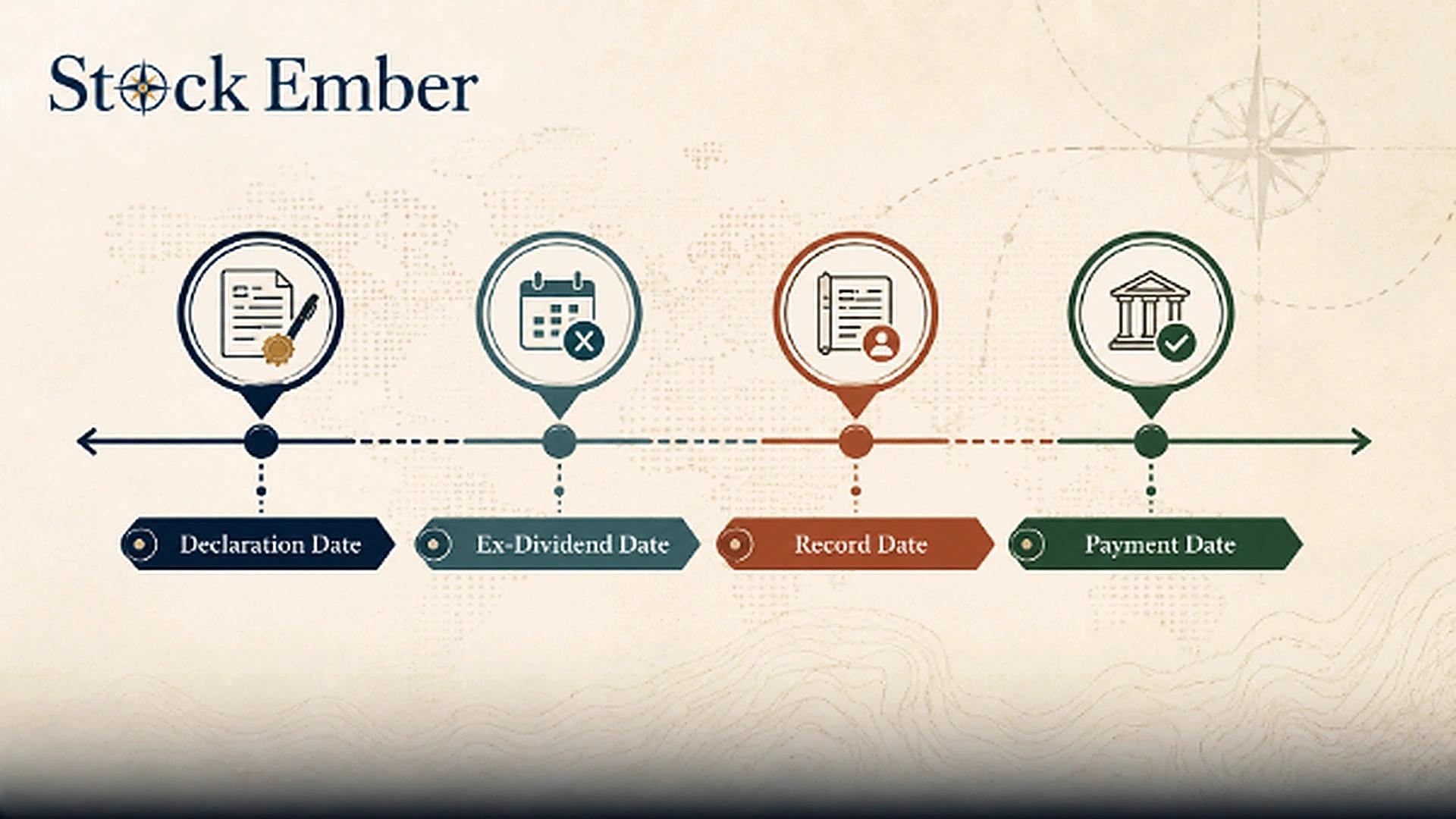
How Do Dividends Work?
This maps out the corporate balance sheet journey, showing how corporate net profits travel from cash accounts through the corporate register and down into your personal brokerage ledger.
What is Ex-Dividend Date?
This is the absolute deadline on the financial calendar that determines which investor owns an upcoming cash distribution. Buying or selling a stock around this date shifts the rights to the dividend, making it essential to understand the timing.
4. Selection Frameworks and Security Analysis
Not all businesses distributing capital possess the fundamental strength to sustain those payouts over the long haul. Separating sound corporate execution from structural decay requires robust analytical frameworks.
What Are Dividend Stocks?
These are mature, deeply established companies that generate predictable, ongoing cash flow and prioritize steady distributions over aggressive business reinvestment. They attract investors looking for sustainable financial health over speculative tech gains.
Dividend Payout Ratio: This structural health metric measures exactly how much of a company's net earnings are paid out to investors versus how much is kept on the balance sheet. It helps you judge if a distribution plan is safe or unsustainably overextended.
Dividend Growth Model: This mathematical framework values an equity (a share of stock) based on the assumption that its distributions will increase at a stable rate over time. It gives you a systematic way to project long-term intrinsic value - the estimated true worth of a stock independent of its current market price.
What Are Dividend Aristocrats?
This elite index, maintained by S&P Dow Jones Indices, tracks large-cap S&P 500 companies - those with a very large total market value - that have increased their annual cash payouts for at least 25 consecutive years. They provide a historical look at exceptional structural consistency.
5. Tax Rules and Fiscal Friction
Taxes and structural fees represent a silent friction - known as fiscal drag - that can quietly erode your investment returns over time. Navigating international tax laws is key to defending your global compounding returns.
How Are Dividends Taxed?
This guide breaks down international fiscal drag, showing how different jurisdictions tax investment income and how that leakage can affect your multi-decade returns.
What is a Qualified Dividend?
This explores the specific tax codes that allow certain corporate distributions to be taxed at lower capital gains rates rather than standard income rates. It offers a clear path to optimizing your portfolio's tax efficiency.
How These Topics Connect
Building an enduring, total-return portfolio means seeing how all these distinct components fit together. A common mistake is looking at these topics in isolation such as hunting for a high dividend yield while ignoring the dividend payout ratio that funds it. In practice, a sky-high yield combined with an unsustainably high payout ratio often signals a potential corporate dividend trap, a situation where the risk of a future dividend cut rises significantly.
To harness the real power of this cluster, your journey should connect corporate actions to your personal account structure. Once you understand how dividends work, you can use the ex-dividend date to ensure your purchase timeline aligns with corporate ledger deadlines.
From there, some investors pair an automated dividend reinvestment plan (DRIP) with a tax-advantaged account, a special account type that reduces or defers taxes, depending on the rules of their jurisdiction and their personal circumstances. This systematic approach turns corporate payouts into a self-funding compounding engine, keeping your eyes on long-term total returns rather than short-term price movements.
In practice, many long-term investors find that the psychological comfort of seeing cash credited to their account helps them stay disciplined during market downturns. However, the operational reality is that tax leakage from un-sheltered distributions can quietly reduce your total wealth over time, making account structure a critical part of any long-horizon plan.
Where to Start
If you are new to corporate distributions, avoid the temptation to jump straight into stock picking or forecasting models. Instead, build your foundation step by step to protect your capital from behavioral biases and common pitfalls:
- Internalize the Payout Mechanics: Start by uncovering how dividends work to break the illusion that dividends are "free bonus money" paid out like bank interest.
- Master the Time Horizon: Read up on what is compound interest and compare simple vs compound returns to see how your holding window changes everything.
- Analyze Fundamental Health: Learn to evaluate sustainability metrics like the dividend payout ratio before looking at any past growth records.
- Automate and Protect: Explore how an automated dividend reinvestment plan (DRIP) operates within global tax systems to protect your returns from unnecessary costs.
By focusing on fundamentals and long-term cost controls instead of chasing short-term yields, you give your portfolio a stronger foundation to compound over the next 10 years and beyond, although outcomes always depend on market conditions.
Conclusion
Understanding what is a dividend at a structural level shows that corporate payouts offer a transparent, time-tested way for long-horizon investors to capture real business cash flows without needing to trade or speculate. However, building sustainable wealth requires looking past surface-level yields and understanding the underlying balance sheets, calendar deadlines, and tax environments that dictate your net returns. When you manage your portfolio with an eye on total returns and a commitment to keeping costs low, these distributions become a powerful engine for long-term growth. When you are ready to evaluate where to hold these compounding assets, our Exchange-Traded Fund (ETF) reviews provide an independent look at cost-efficient vehicles built for long-horizon investors.