A Stocks and Shares ISA is a UK tax-sheltered investment account that shields capital gains, dividends, and interest from personal taxation. Eligible UK residents aged 18 and older can contribute up to £20,000 for the 2026/27 tax year across ISA wrappers, in line with the current ISA allowance set by HM Revenue & Customs (HMRC). Holding broad market index funds or stocks within an ISA allows long-term investments to compound without tax drag.
A Stocks and Shares ISA is a UK-based tax-sheltered investment account that allows individuals to hold stocks, funds, and bonds completely free from capital gains tax and dividend tax.
If you are building wealth over a 10-year horizon, taxes on capital growth and investment yield can quietly drag down your net compound returns. Holding your assets inside a stocks and shares isa uk ensures that every pound of real return stays in your portfolio rather than going to HM Revenue & Customs. This guide breaks down how the tax wrapper works, what assets you can hold, and how it protects long-term gains.
Quick Takeaways
01A Stocks and Shares ISA shelters all investment growth, capital gains, and dividend returns from UK income and capital gains taxes.
02UK residents age 18 and older receive a fixed annual allowance that cannot be rolled over if unused by April 5th.
03You can hold a wide array of assets inside the wrapper, including broad-market ETFs, individual shares, index funds, and corporate or government bonds.
04The wrapper protects against tax drag, but the underlying assets remain exposed to normal stock market fluctuations and capital risk.
What Is a Stocks and Shares ISA?
Asking what is a stocks and shares isa comes down to understanding a simple legal structure known as an investment tax wrapper.
An isa stocks and shares account is not an investment itself; rather, it is a protective tax shield placed around your brokerage portfolio. Any capital gains earned when selling appreciated shares, as well as any cash dividends paid out by companies or funds inside the account, are 100% exempt from personal taxation.
To qualify, you must be at least 18 years old and a tax resident in the UK. Under current regulations, eligible investors receive an annual subscription limit. This allowance applies across all ISA account types you contribute to in a single tax year (such as Cash ISAs, Stocks & Shares ISAs, or Innovative Finance ISAs).
If you do not use your allocation before the tax year ends on April 5th, the remaining limit is permanently forfeited. There are no roll-over allowances to carry unused contribution space into future years.
How an Investment ISA Works and What You Can Hold
An investment ISA operates through a standard brokerage setup where you deposit cash, select eligible securities, and maintain complete ownership of your portfolio within a sheltered environment.
Once cash is deposited into your account, you can select from a wide range of underlying financial instruments:
Broad-market equity index funds and exchange-traded funds (ETFs)
Individual common shares listed on recognized UK and international exchanges
Corporate bonds and government bonds (gilts)
Investment trusts and open-ended investment companies (OEICs)
Investors generally choose between two approaches: self-directed trading accounts, where you select individual funds or shares yourself, or managed discretionary portfolios. However, discretionary management services often charge 0.50% to 1.00% in additional management overhead. Over a decade or longer, these extra fees accumulate into a noticeable drag on net wealth.
The 10-Year Tax Shield: How Tax Drag Impacts Long-Term Growth
The true power of an investment tax wrapper is felt over a multi-year time horizon, as taxes paid out of an unprotected account permanently remove capital that would otherwise continue compounding.
Outside of an ISA wrapper, realized investment gains exceeding the annual allowance trigger Capital Gains Tax, while dividend distributions over the tax-free dividend threshold are subject to Dividend Income Tax.
To visualize how this tax drag impacts wealth over a 10-year period, consider an illustrative scenario:
Scenario
ISA (Tax-Sheltered)
Taxable Brokerage Account
Initial investment
£10,000
£10,000
Assumed annual return
7.0% (illustrative only)
7.0% before tax
Tax treatment
Fully sheltered from capital gains and dividend taxes
Subject to a 15% effective annual tax drag on total returns
Effective net growth rate
7.0%
5.95%
Investmentperiod
10 years
10 years
Estimated value after 10 years
Approximately £19,670
Approximately £17,820
Difference vs. ISA
-
About £1,850 less
Important note: The 7% annual return is a hypothetical assumption used for illustration only. Actual investment returns are not guaranteed, and the value of investments can fall as well as rise.
By shielding your assets, you retain nearly £1,850 in additional capital purely by avoiding tax friction.
This tax-sheltering concept is similar to international tax-deferred structures. For example, investors exploring US tax systems often review what is a roth ira to understand how post-tax growth wrappers operate in other financial jurisdictions.
Cash ISA vs. Stocks and Shares ISA Performance
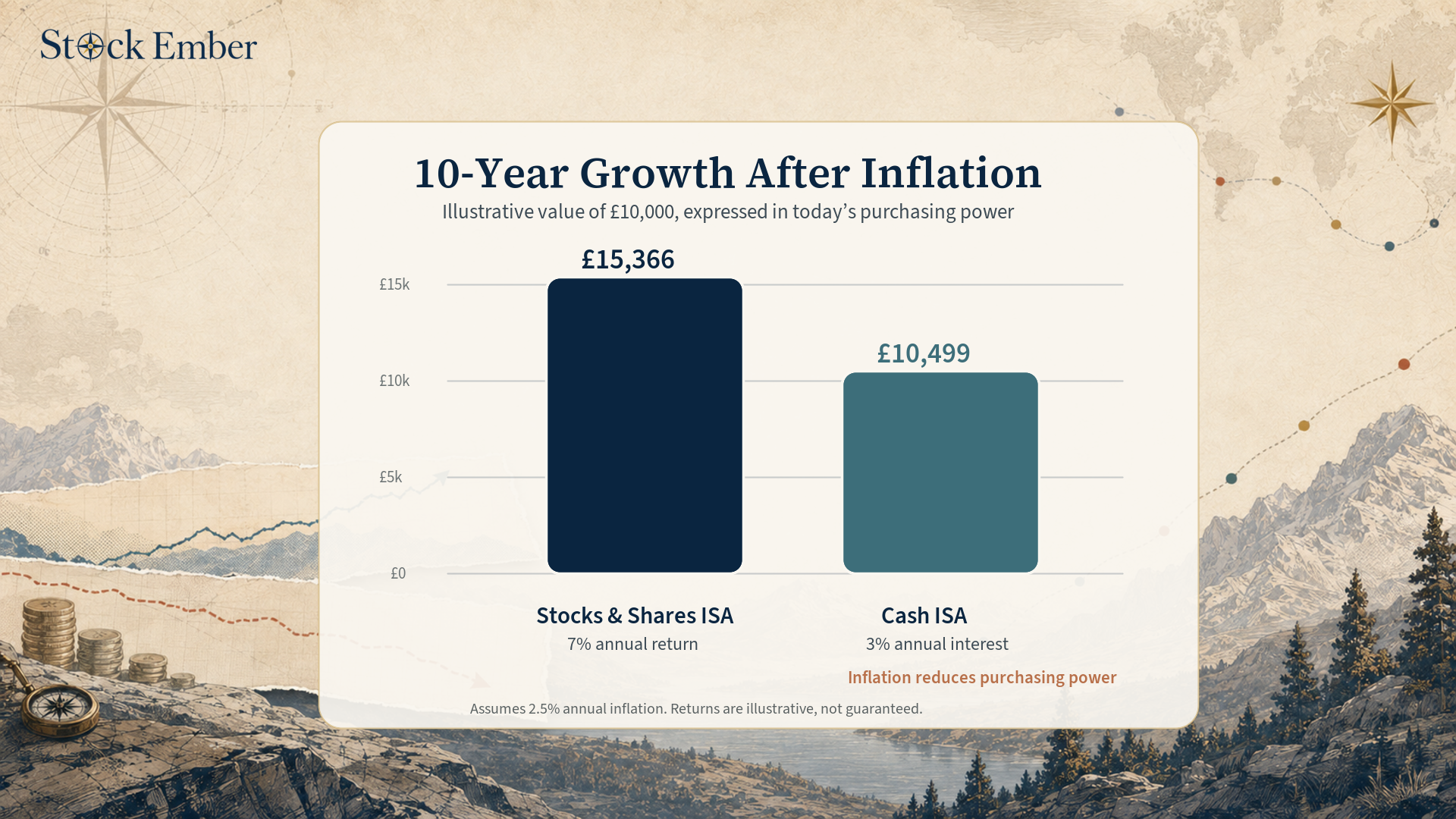
Evaluating stocks and shares isa performance requires weighing the guaranteed capital preservation of cash against the historically higher return potential of global equities.
Comparison chart showing equity growth potential versus cash inflation risk over 10 years.
A Cash ISA functions like a tax-free savings account, paying a defined interest rate with zero risk to your nominal principal balance. In contrast, This tax wrapper holds market-traded instruments, meaning your portfolio value fluctuates daily alongside financial markets.
Can you lose money in a Stocks and Shares ISA? Yes. Because you hold real assets like equities and ETFs, economic downturns will cause short-term portfolio declines. However, over 5- to 10-year holding periods, broad stock market indexes have historically outpaced cash savings rates and inflation, rewarding patient investors with an equity risk premium.
Unlike rigid pension arrangements, an ISA allows you to withdraw capital whenever necessary without tax penalties. However, investors familiar with international flexible retirement rules, such as ira withdrawal rules, should note that withdrawing cash from a non-flexible ISA permanently consumes that portion of your annual subscription allowance unless your provider specifically supports Flexible ISA rules.
Common Pitfalls to Avoid With Investment ISAs
Avoiding simple administrative and cost errors ensures your ISA wrapper remains an efficient, low-cost wealth builder.
Performing manual cash withdrawals instead of official ISA transfers: If you decide to change platform providers, never manually withdraw cash to your bank account to re-deposit it elsewhere. Manual withdrawals remove those funds from the tax shield, consuming new allowance when re-deposited. Always initiate an official cash or in-specie ISA transfer through your new provider.
Overpaying on platform custody and management fees: A platform charging a 0.45% custody fee combined with a 0.75% actively managed fund creates an ongoing 1.20% annual fee overhead. Over a 10-year horizon, a 1.20% fee drag quietly consumes over 11% of your total wealth compared to holding low-cost index ETFs.
Succumbing to end-of-tax-year panic buying: Rushing to fund an account hours before the April 5th tax-year deadline often leads investors to buy volatile, high-risk assets without a clear strategy. Setting up automated monthly contributions throughout the year helps dollar-cost average into positions and reduces emotional decision-making.
Conclusion
A Stocks and Shares ISA is one of the most tax-efficient account structures available to UK long-term investors, thanks to its full exemption from capital gains and dividend tax. By placing index funds, ETFs, or individual shares inside this tax wrapper, you insulate your compounding wealth from capital gains and dividend taxes over a 10-year horizon and beyond. Keeping platform costs minimal, maintaining a multi-year time horizon, and using official transfer procedures when switching accounts will help preserve your net returns. When you are ready to evaluate platforms and fee structures, our broker reviews provide an independent breakdown of platform charges.
FAQ
5 questions
How does a Stocks and Shares ISA save tax?
Inside a Stocks and Shares ISA, all realized capital gains from selling investments and all dividend yield income are completely exempt from UK Capital Gains Tax and Dividend Tax. This tax exemption allows your long-term returns to compound without annual tax drag eating into your net capital over a multi-year horizon.
What happens to your ISA allowance if you do not use it by April 5th?
The annual UK ISA subscription limit (currently £20,000) operates on a strict "use it or lose it" basis per tax year. Unused contribution allowances cannot be carried forward or rolled over into the subsequent tax year, resetting entirely every year on April 6th.
How do you transfer a Stocks and Shares ISA without losing its tax status?
To transfer an existing ISA between providers without losing its tax-sheltered status, you must submit an official ISA transfer request through your new platform. Never manually withdraw cash to a personal bank account to re-deposit it, as this destroys the tax shield and counts against your current tax-year contribution limit.
Who is eligible to open a Stocks and Shares ISA in the UK?
To open and contribute to a Stocks and Shares ISA, you must be at least 18 years old and a tax resident in the United Kingdom. Crown employees serving overseas (or their spouse/civil partner) are also eligible to open an account.
Can you hold cash inside a Stocks and Shares ISA?
Yes, most Stocks and Shares ISA platforms allow you to hold uninvested cash inside the account. However, cash held in an investment ISA may earn lower interest compared to dedicated Cash ISAs, making it primarily useful for holding funds between buying and selling investments.
Disclaimer
This guide was written with AI assistance and reviewed by the StockEmber editorial team for accuracy. StockEmber provides independent education, not personal financial advice. Some links may support our work at no additional cost to you.
The StockEmber Team is our in-house desk of independent research writers. We test brokerage platforms, read the fine print on fees and custody, and cover ETFs and long-horizon investing for people who plan to hold for decades — not days.