A Solo 401(k) and a SEP IRA are both tax-advantaged retirement accounts for self-employed individuals, but they differ in structure and contribution limits. A Solo 401(k) allows contributions as both employee and employer, enabling higher tax-sheltered savings at lower income levels. A SEP IRA is an employer-only account with simpler ongoing administration and lower reporting requirements.
A Solo 401(k) and a SEP IRA are tax-advantaged retirement wrappers designed for self-employed individuals and small business owners to shield income from current or future income taxes.
When you earn income from self-employment, deciding where to stash your retirement savings can feel overwhelming. Choosing between a Solo 401(k) and a SEP IRA directly impacts how much capital you can shelter from taxes each year and how your wealth compounds over a 10-year horizon. This guide breaks down how both accounts work, compares contribution formulas, and helps you pick the right wrapper for your enterprise.
Quick Takeaways
01Solo 401(k) plans allow higher contribution limits at low-to-moderate income levels because you contribute as both employee and employer.
02SEP IRAs offer significantly easier setup and lower ongoing administrative requirements, making them ideal for lower maintenance.
03Solo 401(k) accounts permit participant loans up to $50,000, whereas SEP IRAs strictly forbid borrowing against plan assets.
04Hiring a full-time W-2 employee usually disqualifies you from a Solo 401(k) and triggers employer contribution match rules under a SEP IRA.
Solo 401(k) vs SEP IRA: Core Concepts
A Solo 401(k) and a SEP IRA are retirement account wrappers established by the IRS to help self-employed sole proprietors and single-member business owners save for retirement. While both serve similar audiences, understanding how a Solo 401(k) differs from a SEP IRA comes down to account architecture and structural control.
A SEP IRA (Simplified Employee Pension) is strictly an employer-sponsored account where all contributions come directly from the business entity as profit sharing. By contrast, a Solo 401(k)—also known as an Individual 401(k)—treats you as both the employer and the employee of your business. This dual structure gives you two distinct channels to fund the account.
For international investors evaluating tax-advantaged structures, the US retirement account ecosystem functions similarly to how a Stocks and Shares ISA shelters capital gains and dividends in the UK, though US plans carry distinct annual contribution caps and tax-deduction rules.
How Contribution Mechanics Differ
Contribution mechanics mark the biggest structural difference when comparing a SEP IRA to a Solo 401(k) setup.
In a SEP IRA, your business can contribute up to 25% of net W-2 income (or roughly 20% of net Schedule C self-employment earnings) up to an annual maximum cap of $72,000 for 2026. If your net income is modest, your maximum tax-deductible contribution remains strictly constrained by that percentage limit.
In a Solo 401(k), you fund the account through two distinct buckets:
Employee Elective Deferral: As an employee, you can defer up to $24,500 of your earnings into the account for 2026.
Employer Profit-Sharing: As the employer, your business can add up to 25% of net W-2 salary (or ~20% of net Schedule C earnings).
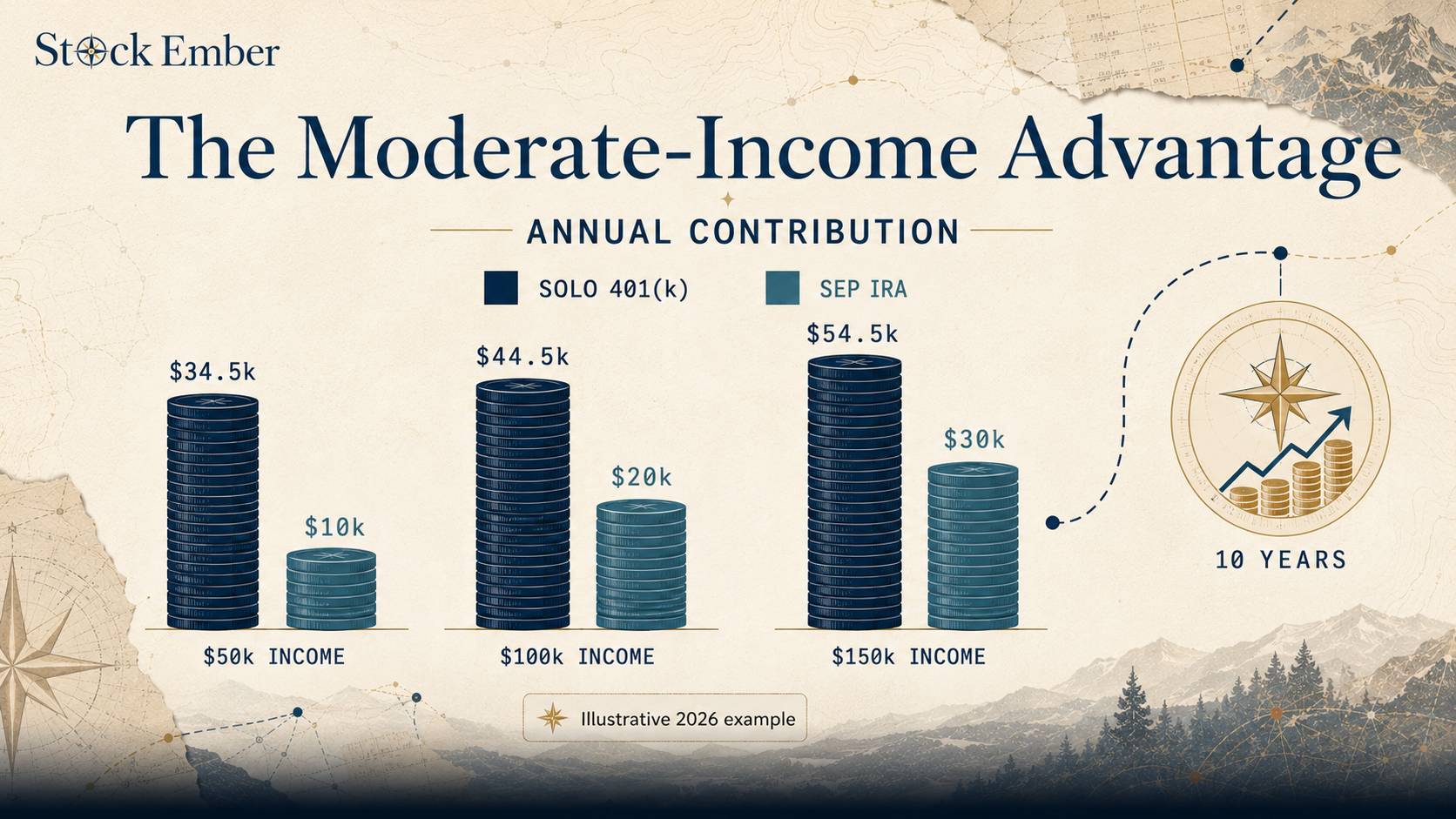
Because the employee deferral is a fixed dollar amount rather than a percentage, the Solo 401(k) allows self-employed individuals earning moderate incomes to shelter far more capital than a SEP IRA.
The Moderate-Income Advantage and 10-Year Compounding Impact
Chart comparing annual contribution limits between Solo 401(k) and SEP IRA plans by income level.
To see the practical impact on long-term wealth, consider a sole proprietor earning $75,000 in net Schedule C profits.
Under a SEP IRA, your maximum contribution is limited to roughly 20% of net income, capping your annual tax-advantaged savings at approximately $15,000.
Under a Solo 401(k), you can contribute the full $24,500 as an employee elective deferral, plus an employer profit-sharing contribution of roughly $13,900 (approximately 20% of net self-employment earnings after the deduction for one-half of self-employment tax), reaching a total sheltered amount of approximately $38,400. That represents an additional $23,400 in tax-sheltered capital invested in index funds or ETFs during a single tax year.
Over a 10-year investment horizon, sheltering an extra $15,000 to $20,000 each year lets market compounding work on a significantly larger pool of capital.
Assuming a hypothetical 7% annual investment return, an extra $15,000 invested annually builds into roughly $207,000 in additional sheltered assets over ten years—capital that would otherwise have faced immediate income taxation. This projection is hypothetical and for illustration only; actual investment returns are not guaranteed, and investing involves risk, including potential loss of principal.
Key Comparison: Solo 401(k) vs SEP IRA
Evaluating SEP IRA vs Solo 401k contribution limits and plan features side by side helps clarify which structure matches your operational needs.
Feature
Solo 401(k)
SEP IRA
Max Combined Limit (Under 50)
$72,000 (2026 limit)
$72,000 (2026 limit) or 25% of net salary
Employee Elective Deferral
Up to $24,500 (2026 limit)
Not permitted
Catch-Up Contribution (Age 50+)
Yes ($8,000 additional; $80,000 max total)
No
Roth Option Availability
Yes (Employee deferrals & employer matches)
Yes (Under SECURE 2.0 rules)
Participant Loans
Permitted (up to 50% of balance or $50,000)
Strictly Prohibited
Administrative Reporting
Form 5500-EZ required at $250k+ assets
Minimal ongoing reporting
For investors seeking tax-free growth in retirement, pairing a Solo 401(k) with a personal Roth IRA allows for maximum flexibility across both pre-tax and post-tax account buckets.
Administrative Rules and Common Pitfalls
Evaluating the operational trade-offs of both plans requires looking closely at ongoing compliance obligations and organizational changes.
Key administrative rules and common pitfalls include:
Form 5500-EZ Filing Threshold: When your total Solo 401(k) plan assets cross $250,000, you must file IRS Form 5500-EZ annually. Missing this filing can result in penalties.
Hiring Non-Spouse Employees: A Solo 401(k) is strictly restricted to business owners and their spouses. If you hire a full-time W-2 employee (working 1,000+ hours per year), your plan loses its individual status. Under a SEP IRA, if you contribute for yourself, you must make proportional percentage contributions for eligible employees.
Early Withdrawal Penalties: Taking distributions from either account before age 59½ generally incurs income tax plus a 10% IRS early distribution penalty, unless a specific statutory exception applies according to IRS guidelines for one-participant plans.
Conclusion
Choosing between these two self-employed account frameworks depends on your income, administrative patience, and long-term hiring plans. Weighing the Solo 401(k) vs SEP IRA pros and cons ahead of time can save you an expensive plan-conversion headache down the road.
If you earn a moderate income, want access to loan features, or wish to maximize contributions without high net earnings, the Solo 401(k) is typically the most powerful option. If you prefer minimal paperwork, do not need catch-up contributions, or plan to hire employees soon, a SEP IRA offers an easy, flexible alternative.
When you are ready to choose where to open your account wrapper, our broker reviews & rankings can help you compare brokerage providers based on plan fees, platform features, and investment selections. Investing always puts your capital at risk, and account rules can change over time, so treat this guide as an educational starting point for your own financial planning. Ultimately, the Solo 401(k) vs SEP IRA decision comes down to how quickly you want to scale contributions and whether you plan to hire staff.
FAQ
6 questions
Is a Solo 401(k) better than a SEP IRA for a sole proprietor?
A Solo 401(k) is often advantageous for sole proprietors earning low-to-moderate incomes because it allows a fixed employee elective deferral of up to $24,500 in addition to employer profit-sharing. This allows you to shelter a higher total dollar amount at lower net income levels compared to a SEP IRA, which strictly limits contributions to a percentage of net profit.
What happens to a Solo 401(k) if I hire a full-time W-2 employee?
A Solo 401(k) is restricted to business owners and their spouses with no full-time non-spouse employees. If you hire a full-time employee working 1,000 hours or more per year, your Solo 401(k) loses its single-participant status, requiring you to convert it into a standard employer 401(k) plan with full compliance under the Employee Retirement Income Security Act (ERISA) and non-discrimination testing.
Can I have both a Solo 401(k) and a SEP IRA in the same tax year?
Yes, you can technically maintain both accounts in the same tax year, but your total employee elective deferrals and total employer contributions across all plans remain subject to overall IRS aggregate contribution limits. Combining both plans does not double your maximum allowable annual contribution cap.
Can I borrow money from a SEP IRA like a Solo 401(k)?
No. IRS rules strictly prohibit participant loans from any IRA wrapper, including a SEP IRA. Attempting to borrow from a SEP IRA triggers a prohibited transaction, causing the entire account to lose its tax-exempt status. In contrast, a Solo 401(k) plan allows you to borrow up to 50% of your account balance, up to $50,000.
What is the Form 5500-EZ filing threshold for a Solo 401(k)?
You must file IRS Form 5500-EZ annually once the total combined asset value of all your Solo 401(k) plans exceeds $250,000 at the end of the plan year. If your balance remains under $250,000, no annual Form 5500-EZ filing is required, unless you terminate the plan.
What is a Solo 401(k) vs SEP IRA, and how do the two accounts differ?
A Solo 401(k) is a self-employed retirement plan that lets you contribute as both employee and employer, while a SEP IRA is funded entirely by employer profit-sharing contributions with no employee deferral option. The practical difference comes down to how much you can shelter at moderate income levels and how much paperwork you're willing to manage each year.
Disclaimer
This guide was written with AI assistance and reviewed by the StockEmber editorial team for accuracy. StockEmber provides independent education, not personal financial advice. Some links may support our work at no additional cost to you.
The StockEmber Team is our in-house desk of independent research writers. We test brokerage platforms, read the fine print on fees and custody, and cover ETFs and long-horizon investing for people who plan to hold for decades — not days.