Rolling over a 401(k) to a new employer consolidates your retirement savings into a single workplace account while maintaining tax-deferred status. It avoids mandatory tax withholding when executed via a direct trustee transfer and preserves federal ERISA creditor protections and plan loan provisions.
Rolling over a 401(k) to a new employer means transferring your retirement savings from a former company's workplace plan directly into your current employer's sponsored plan without triggering taxes or penalties.
When changing jobs, you may wonder, "should I rollover my 401(k) to a new employer?" Deciding what to do with your accumulated retirement savings significantly shapes your long-term wealth. Leaving funds scattered across old accounts often leads to forgotten balances and unnecessary administrative fee drag. This guide explores the advantages, tax considerations, and step-by-step process of consolidating your retirement funds into a new workplace 401(k).
Quick Takeaways
01Rolling over an old 401(k) into your new employer's plan simplifies retirement tracking by consolidating your investments into a single account.
02Direct trustee-to-trustee transfers protect your capital by avoiding mandatory 20% federal tax withholdings and early distribution penalties.
03Moving funds to a new 401(k) preserves workplace plan benefits, including federal ERISA protection and access to potential plan loans.
04Comparing fund fees between your old plan, new plan, and an IRA helps prevent long-term fee drag on your portfolio.
What Happens to Your 401(k) When You Leave a Job?
When you leave an employer, your 401(k) account remains intact, but you must choose how to manage those assets going forward.
You generally have four primary options for your old 401(k):
Leave the account in your former employer's plan (if the balance exceeds $5,000).
Roll over the balance into your new employer's 401(k).
Roll over the funds into an Individual Retirement Account (IRA).
Cash out the balance as a cash distribution.
Leaving funds inside tax-advantaged accounts allows your investments to keep compounding uninterrupted. Cashing out a 401(k) early is usually a costly mistake. For example, if you cash out a $50,000 401(k) balance at age 35, mandatory 20% tax withholding plus a 10% early distribution penalty immediately strips away $15,000.
Over ten years, that missing $50,000 could have compounded to nearly $100,000 assuming a hypothetical 7% average annual return. Keeping your money invested avoids this immediate loss and maintains long-term compounding.
Reasons to Roll Over to Your New Employer’s 401(k)
Rolling over to your new employer's 401(k) simplifies your finances by combining separate retirement balances under one administrative roof.
Consolidating your accounts offers several clear practical advantages:
Simplified Account Tracking: Managing a single retirement account lowers the risk of losing track of old balances or missing plan updates.
Access to Low-Cost Funds: Large enterprise plans often grant access to institutional share classes with annual expense ratios below 0.05%, which cost significantly less than standard retail investment options.
401(k) Loan Access: Many workplace plans allow participants to borrow against their total 401(k) balance, whereas IRAs strictly forbid account loans by law.
Clean Pre-Tax Accounting: Keeping pre-tax funds in workplace plans avoids mixing pre-tax and post-tax dollars in retail retirement accounts.
Should I Rollover My 401(k) to a New Employer or an IRA?
Deciding whether to roll over your 401(k) to a new employer or an IRA depends on account fees, investment options, legal protection, and your personal tax strategy.
Feature
New Employer 401(k)
Traditional or Roth IRA
Investment Range
Plan-selected fund menu
Broad choice of stocks, ETFs, and funds
Creditor Protection
Strong federal protection (ERISA)
Varies by state law
Penalty-Free Access
Age 55 (Rule of 55 if separated)
Age 59½
Backdoor Roth Impact
Does not trigger Pro-Rata tax rule
Pre-tax balances trigger Pro-Rata tax rule
Evaluating these structural distinctions helps clarify which choice fits your plan:
ERISA Legal Protections: Federal law under the Employee Retirement Income Security Act (ERISA) shields workplace 401(k) balances from bankruptcy and judgment creditors. IRA protection depends largely on individual state statutes.
The Rule of 55: If you leave your job during or after the calendar year you turn 55, you can take penalty-free distributions from that specific employer's 401(k). IRAs generally require you to wait until age 59½ to avoid early withdrawal penalties.
Avoiding the Pro-Rata Tax Trap: High earners who perform Backdoor Roth strategies should be cautious. Holding pre-tax money in a Traditional IRA triggers the IRS Pro-Rata rule, making future Roth conversions taxable. Moving pre-tax funds into a workplace 401(k) or contributing directly to a Roth IRA keeps your pre-tax balances separate. Outside the US, investors look at similar structural choices when evaluating a SIPP vs ISA for tax-efficient investing.
Direct vs. Indirect Rollovers: Tax Traps to Avoid
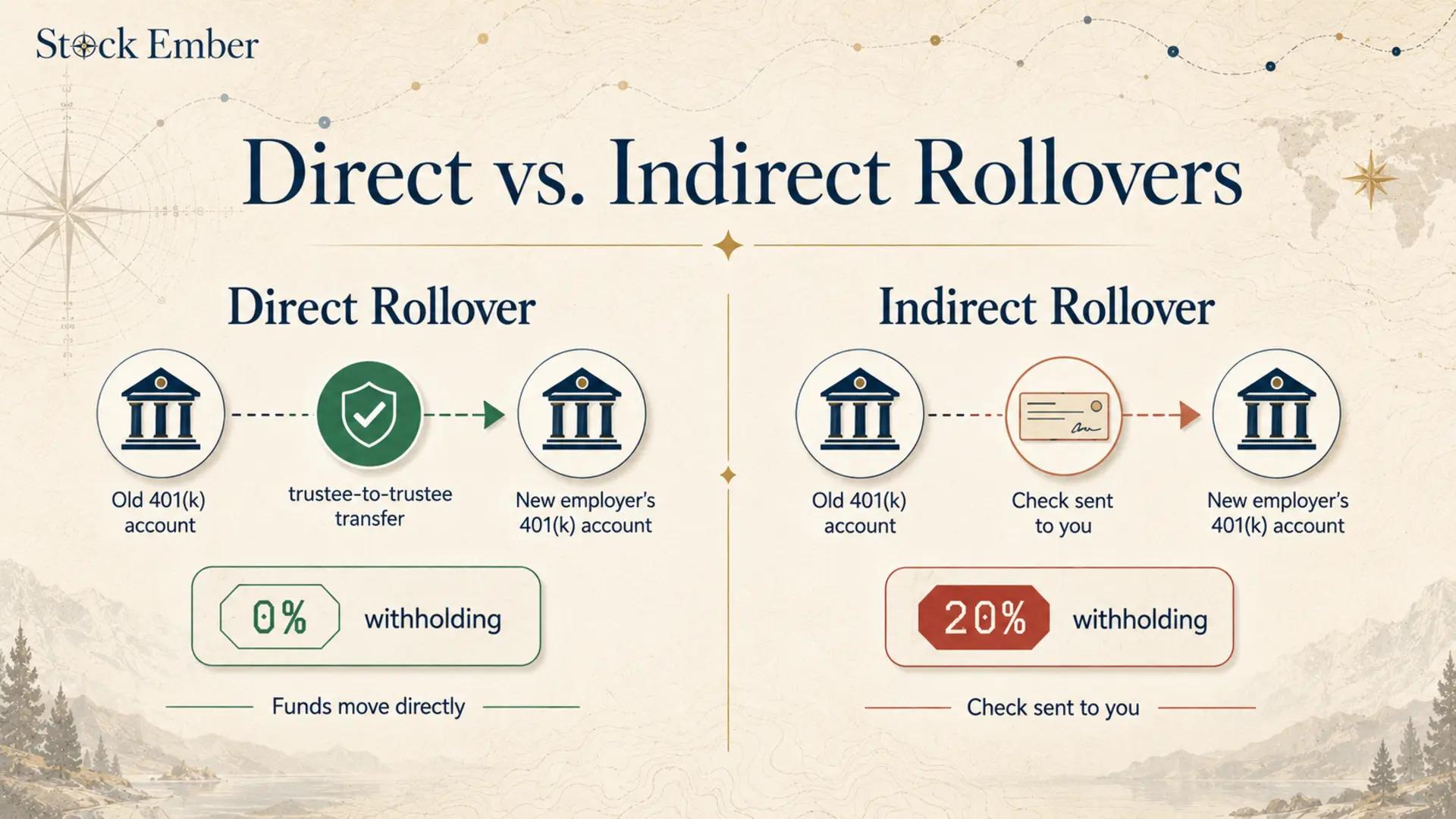
A direct trustee-to-trustee rollover moves funds directly between plan administrators, avoiding mandatory tax withholding and early withdrawal penalties.
Chart comparing direct trustee 401k transfer and indirect 60-day rollover.
In a direct rollover, your former plan provider sends the funds directly to your new 401(k) custodian (or issues a check payable to the new custodian for your benefit). No taxes are withheld, and the money retains its tax-deferred status without tax friction.
In an indirect rollover, your former provider issues a check made payable directly to you. This triggers strict IRS requirements:
The provider must withhold a mandatory 20% for federal income tax.
You have exactly 60 days from receipt to deposit the full 100% balance into your new retirement plan.
To deposit the full amount, you must replace the withheld 20% out of your own pocket.
If you miss the 60-day deadline or fail to cover the 20% gap, the missing amount is classified as an early distribution. The IRS taxes it as ordinary income and adds a 10% early withdrawal penalty if you are under age 59½.
How to Execute a Direct 401(k) Rollover
Executing a direct rollover requires four straightforward steps to transfer your funds safely without tax exposure.
Confirm New Plan Acceptance: Contact your human resources department or new plan administrator to confirm that your new 401(k) accepts incoming rollovers.
Request Delivery Instructions: Obtain exact check payment formatting and electronic transfer codes from your new plan administrator.
Initiate the Direct Transfer: Contact your former 401(k) custodian and request a direct trustee-to-trustee rollover. Ensure the payment is made out to your new account custodian, not to you personally.
Verify Deposit and Select Investments: Once the funds arrive in your new 401(k), log into your account portal to allocate the balance into your chosen investment funds.
Conclusion
Rolling over an old 401(k) into your new employer's plan is often the most practical choice if the new plan offers low-cost investment funds, strong federal ERISA creditor protection, and centralized account management. By selecting a direct trustee-to-trustee transfer, you protect your retirement savings from tax withholding risks and preserve options like the Rule of 55 or Backdoor Roth capabilities.
When you are ready to evaluate platforms and long-term account options, our Broker reviews & rankings provide clear comparisons to guide your overall setup.
Investing always carries risk, and account rules can vary between providers, so treat this guide as educational information rather than individualized legal or tax advice.
FAQ
5 questions
Is it better to roll over a 401(k) to a new employer or an IRA?
It depends on fund fees, investment preferences, and tax strategy. A new 401(k) provides federal ERISA creditor protection, potential plan loan access, and keeps pre-tax dollars out of Traditional IRAs to avoid Pro-Rata tax issues on Backdoor Roth IRAs. An IRA offers a wider selection of individual stocks and ETFs but may lack ERISA protection under certain state laws.
What is the main benefit of a direct 401(k) rollover?
A direct trustee-to-trustee transfer moves funds directly between financial custodians without taxes being withheld. This avoids the mandatory 20% federal tax withholding and potential 10% early withdrawal penalties associated with receiving an indirect manual check.
What happens if I miss the 60-day deadline for an indirect rollover?
If you do not redeposit the full distribution amount into an eligible retirement plan within 60 days, the IRS classifies the distribution as taxable ordinary income. If you are under age 59½, you will also incur a 10% early distribution penalty.
Can I roll over my old 401(k) into my new employer's plan at any time?
Most workplace plans allow incoming rollovers at any point once you are an active participant, but individual plan rules vary. Check with your new employer's human resources or benefits administrator to confirm their specific rollover policies.
Does rolling over an old 401(k) count toward my annual contribution limit?
No. Rollovers do not count toward your annual 401(k) or IRA contribution limits. You can roll over an unlimited dollar amount from a prior workplace plan while continuing to make full annual contributions to your current retirement accounts.
Disclaimer
This guide was written with AI assistance and reviewed by the StockEmber editorial team for accuracy. StockEmber provides independent education, not personal financial advice. Some links may support our work at no additional cost to you.
The StockEmber Team is our in-house desk of independent research writers. We test brokerage platforms, read the fine print on fees and custody, and cover ETFs and long-horizon investing for people who plan to hold for decades — not days.