A Traditional IRA offers potential upfront tax deductions with taxable ordinary income withdrawals in retirement, while a Roth IRA uses after-tax contributions to deliver tax-free investment growth and tax-free withdrawals. Choosing between them depends primarily on comparing your current marginal tax rate to your expected tax bracket in retirement.
Both a Roth IRA and a Traditional IRA offer tax-advantaged retirement compounding, but they differ in tax timing: a Traditional IRA provides an upfront tax deduction today, while a Roth IRA delivers tax-free income in retirement.
Choosing between pre-tax and after-tax accounts is one of the most critical decisions long-term investors make. Paying taxes today versus decades down the road changes how your net wealth compounds and how much flexibility you retain over your portfolio. This guide breaks down tax rules, withdrawal flexibility, and a practical framework to choose the right account wrapper.
Quick Takeaways
01The primary difference is tax timing: Traditional IRAs offer upfront tax deductions today, while Roth IRAs provide tax-free growth and tax-free withdrawals in retirement.
02Both accounts share the same annual IRS contribution cap ($7,500 under age 50, or $8,600 for age 50+ in 2026).
03Roth IRAs allow you to withdraw original principal contributions at any time without taxes or penalties, offering superior early liquidity.
04Traditional IRAs require mandatory distributions starting at age 73, whereas Roth IRAs have no Required Minimum Distributions (RMDs) for the original owner.
The Core Difference: Tax Now vs. Tax Later
The fundamental choice between a roth vs traditional ira comes down to when you pay income taxes on your investment money.
When you contribute to a Traditional IRA, you can often deduct that contribution from your current taxable income, lowering your tax bill in the current year. However, every dollar you withdraw in retirement is taxed as ordinary income. With a Roth IRA, you contribute after-tax income (receiving no current-year tax deduction), but all investment gains compound tax-free and all qualified withdrawals in retirement are completely exempt from federal income tax.
The 10-Year Compounding Tax Drag
Both account wrappers protect your portfolio from annual dividend and capital gains taxes, which creates a major compounding advantage over standard taxable brokerage accounts.
In a taxable account, paying taxes on dividends and rebalancing gains every year acts as a constant tax drag. Over 10 years, a $50,000 index portfolio returning 7% annually can lose thousands of dollars in compound growth due to annual tax friction. Inside either a Traditional IRA or a Roth IRA, that full return remains inside the account wrapper to compound uninterrupted.
Comparing taxable account and IRA wrappers
Comparing Key Features Side-by-Side
Comparing the operational rules of both IRAs reveals distinct differences in tax treatment, income limits, and distribution flexibility.
While both accounts help long-horizon investors build wealth, their structural differences impact how and when you access your money:
Feature
Roth IRA
Traditional IRA
Tax Treatment
After-tax dollars (no upfront deduction)
Pre-tax dollars (upfront tax deduction potential)
Withdrawal Taxes
100% Tax-free qualified distributions
Taxed as ordinary income in retirement
2026 Annual Limit
$7,500 ($8,600 if age 50+)
$7,500 ($8,600 if age 50+)
Income Restrictions
Direct contributions capped by MAGI
Tax deductibility capped if covered by workplace plan
Early Contribution Access
Principal contributions withdrawable anytime penalty-free
10% IRS penalty + income tax before age 59½
RMD Requirements
None during owner's lifetime
Mandatory distributions starting at age 73
Evaluating Account Specifics: Traditional IRA Baseline
A Traditional IRA provides immediate tax relief by lowering your current taxable income, making it a powerful tool during your highest-earning years.
If you are currently in a high income tax bracket, deducting your contribution today can yield substantial tax savings immediately. The tax-deferred environment allows your portfolio to compound without annual tax drag, though you must prepare for ordinary income tax liabilities when taking distributions in retirement.
To examine pre-tax mechanics, deductibility limits, and RMD schedules in detail, see our foundational guide on what is a traditional ira (INTERNAL: what-is-a-traditional-ira).
Evaluating Account Specifics: Roth IRA Tax-Free Growth
A Roth IRA trades immediate tax deductions for complete tax freedom on future growth and qualified retirement withdrawals.
Because you fund the account with after-tax dollars, every dollar of capital gains and dividends generated over decades belongs entirely to you. Furthermore, because original Roth IRA owners face no lifetime Required Minimum Distributions, your funds can compound uninterrupted for your entire life or be passed to heirs tax-free.
For a deep dive into eligibility caps and withdrawal rules, read our core guide on what is a roth ira.
Current vs. Retirement Tax Brackets: The Decision Framework
Choosing between a Roth and a Traditional IRA depends primarily on comparing your current marginal tax bracket to your anticipated tax rate in retirement.
Withdrawal flexibility of Roth IRA vs Traditional IRA
To select the most efficient tax wrapper, evaluate which of these common investor scenarios aligns with your personal financial timeline:
Scenario A: Lower Tax Bracket Today (Roth IRA Advantage). If you are early in your career or currently in a lower tax bracket, paying income tax today locks in low tax rates. All future growth compounds tax-free, protecting you from future tax increases.
Scenario B: Peak Earning Years (Traditional IRA Advantage). If you are in a high tax bracket today, taking an upfront tax deduction reduces high current taxes. In retirement, when your earned income drops, you may draw down those funds at a lower effective tax rate.
Scenario C: Tax Diversification (Holding Both Accounts). Many experienced investors build balances in both pre-tax and after-tax wrappers. Holding both allows you to pull taxable income from a Traditional IRA up to lower bracket thresholds while drawing tax-free cash from a Roth IRA to cover remaining retirement expenses.
Withdrawal Flexibility and Early Liquidity Rules
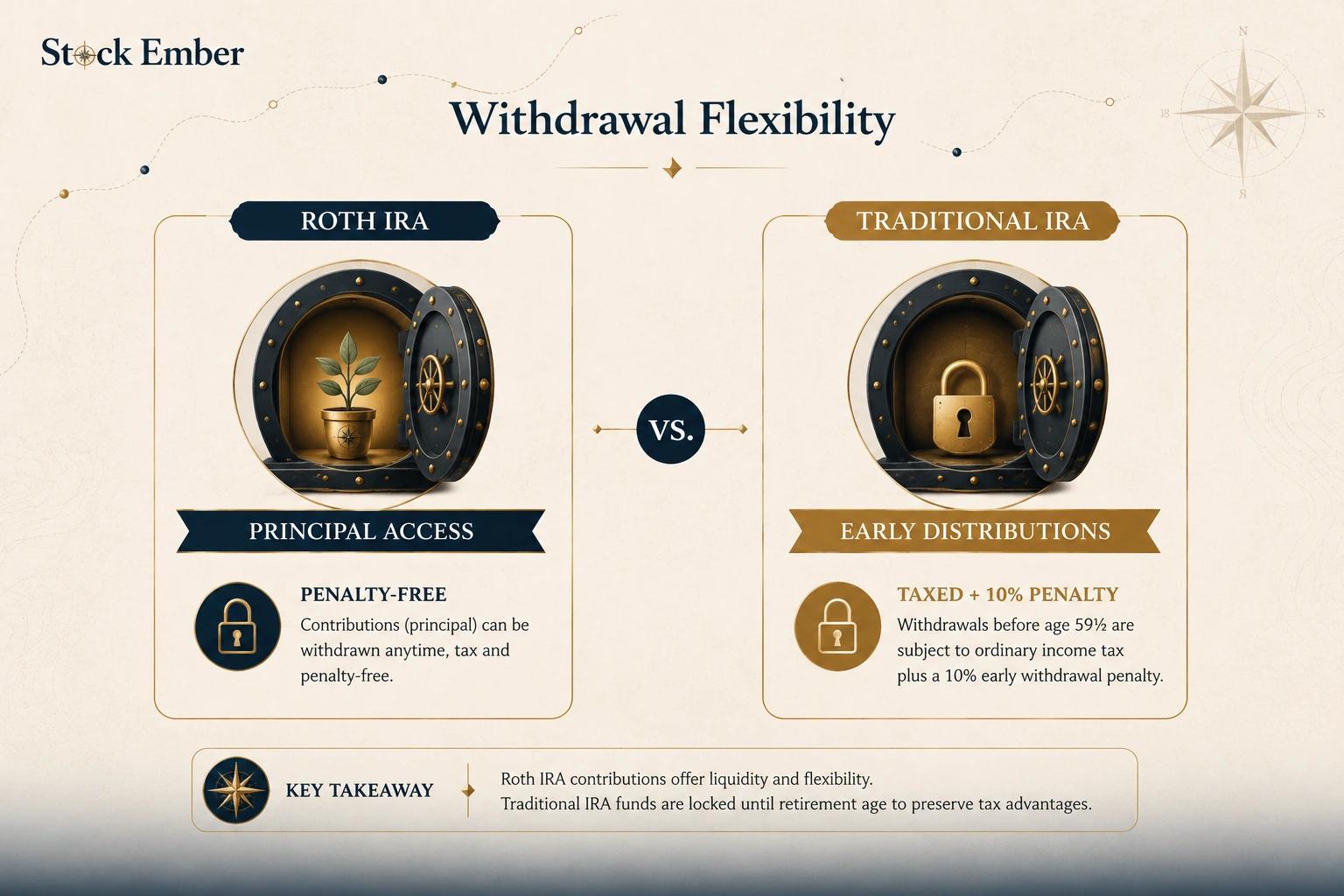
Roth IRAs offer significantly more withdrawal flexibility for early access to capital than Traditional IRAs.
Because you have already paid income tax on your Roth IRA contributions, the IRS allows you to withdraw your original principal contributions at any time, for any reason, completely tax- and penalty-free. Only the account's investment earnings are subject to age restrictions (59½) and the 5-year holding rule.
In contrast, taking early withdrawals from a Traditional IRA before age 59½ generally triggers a 10% IRS early withdrawal penalty in addition to standard ordinary income taxes on the entire distribution amount. While IRS exceptions exist for qualified expenses like first-time home purchases or higher education, Traditional IRAs are far less accessible as a secondary liquidity backstop.
Conclusion
Deciding between a Roth IRA and a Traditional IRA comes down to matching tax timing with your career earnings trajectory and liquidity needs. A Traditional IRA excels at reducing current tax liabilities during high-earning years, while a Roth IRA locks in tax-free compound growth and flexible principal access for the future. By evaluating your current tax bracket against your retirement goals—or building a diversified mix of both wrappers—you can minimize tax friction over a multi-decade horizon.
When you are ready to open an account container or compare platform features, our independent broker reviews evaluate custodian fees, available investments, and platform usability.
FAQ
4 questions
Is it better to choose a Roth IRA or Traditional IRA if you expect higher future income?
If you expect to be in a higher tax bracket in retirement than you are today, a Roth IRA is generally more advantageous. You pay income taxes upfront at your current lower rate and enjoy tax-free qualified withdrawals later in life.
Can you hold both a Roth IRA and a Traditional IRA at the same time?
Yes. You can hold and contribute to both accounts in the same tax year. However, the annual IRS IRA contribution limit applies to your combined deposits across all traditional and Roth IRAs, not to each account individually.
How do early withdrawal rules differ between Roth and Traditional IRAs?
You can withdraw your original cash contributions from a Roth IRA at any time penalty-free. Traditional IRA early withdrawals taken before age 59½ are subject to ordinary income tax plus a 10% IRS early withdrawal penalty unless an exception applies.
Are there income eligibility limits for contributing to a Traditional IRA?
Anyone with earned income can contribute to a Traditional IRA regardless of earnings level. However, if you or your spouse are covered by a workplace retirement plan, high earnings restrict or eliminate your ability to deduct those contributions on your tax return.
Disclaimer
This guide was written with AI assistance and reviewed by the StockEmber editorial team for accuracy. StockEmber provides independent education, not personal financial advice. Some links may support our work at no additional cost to you.
The StockEmber Team is our in-house desk of independent research writers. We test brokerage platforms, read the fine print on fees and custody, and cover ETFs and long-horizon investing for people who plan to hold for decades — not days.